Hawaii farmers hurting
in El Niño’s dry winter
The lack of rain brings
By Rod Ohira
poor crop quality and lower production
Star-BulletinA drier-than-usual winter in Hawaii has been a blessing for the visitor industry but not for some crop farmers. "I'm already getting low productivity and poor quality, so it's going to get worse if we don't get rain in a couple of weeks," said Kauai farmer Richard Coffman, who raises bananas in Lawai.
Waipahu watercress farmer Don Nakatani and Katsumi Higa, who grows green onions in east Honolulu, say unseasonal weather has affected their crops.
"We don't have a shortage of water, but I think the cold is affecting growth," Nakatani said. "We usually get a good crop at this time of year, but I wasn't able to harvest last week."
Chilly nights also have slowed the growth of Higa's green onions.
"This year has been exceptional because it has been continuously cold, not just for one or two nights," Higa said. "The cold weather stuns the plants, so they don't grow as fast, so we didn't have our regular after-New Year's harvest this year."
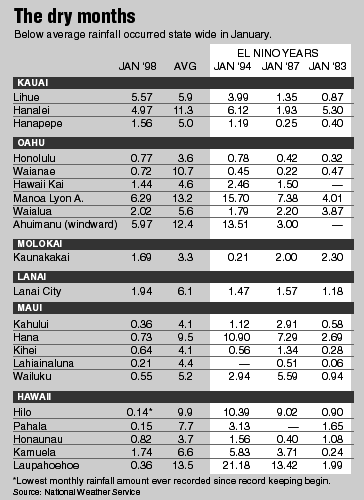
El Niño, the Pacific Ocean-warming phenomenon that affects worldwide weather patterns, is causing the locally dry weather and cool nights, says the National Weather Service.
"Tradewind-related precipitation is a major source of precipitation across most of the state in January," said Roger Pierce, the National Weather Service's senior hydrologist.
"Tradewinds were generally weak or absent throughout January 1998 . . . and this weather pattern resulted in very low rainfall totals."
Waianae, for example, which averages 10.7 inches of rain in January, had less than an inch (0.7) last month. Hilo, meanwhile, had a record-low 0.14 of an inch.
"There's no quick indication that tradewinds will be returning soon," said Pierce, who expects it to remain dry until April or May.
Tom Hill, a North Shore farmer, says farmers can make it through the dry spell. "Except for Hilo and Puna, where agriculture depends on rainfall, I think the short-term effects won't be bad and may even be advantageous because when it's dry, there's less disease," Hill said.
"If there's a second or third year, then you start worrying."
Currently, there's no water shortage on Oahu, despite the dry conditions.
"We'll weather it unless we have an extended dry period through the summer," said Chester Low of the Board of Water Supply's hydrology-geology section.
"The big problem may be next year if we draw water down this year and don't return to a normal year next year. That's why we always encourage people to conserve even when there isn't a crisis."
El Niño, however, has been a boon to farmers like Larry Jefts, who planned for it.
"It's the first weather event that has been predictable for us, so we're very, very pleased right now," said Jefts, who planted 25 percent more tomatoes this year, anticipating the negative effects El Niño would have on similar crops in Florida and Mexico.
"We had information to know that, so it's not a surprise.
"There's a high probability for dry weather for the next 90 to 120 days."
Jefts also planted his watermelon crop two weeks earlier.
"It's like knowing you're going to be in a car wreck tomorrow -- you can't prevent it but you can make plans to deal with it," Jefts said of El Niño.