
The '98 Legislature
Opportunities and Obstacles
Doomed from the Start?Facing legislators when they open their '98 session on Wednesday are a budget that's already obsolete and task force proposals that some believe are as good as dead, despite the mandate to fix the economy
By Rob Perez
Star-BulletinThe way Tom Arnone sees it, Gov. Ben Cayetano's task force plan to jump-start the economy needs a jump-start of its own - even a major overhaul. For starters, the retired engineer says, people living on fixed incomes will see their cost of living rise if the Economic Revitalization Task Force package is adopted.
"I don't see one bit of good coming out of it for retirees," Arnone says. "Everyone I talk to feels the same way."
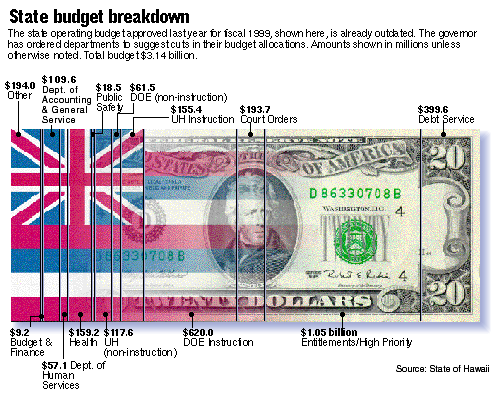
As the Legislature opens its annual session Wednesday, the sentiment of people like Arnone will help determine what lawmakers do to tackle the session's top issue: fixing the economy.Even before the session starts, though, the task force package seems to be in trouble.
Among its many recommendations, the plan calls for the largest personal income tax cut in state history - 40 percent over three years - but also a 34 percent jump in the general excise tax.
It's the latter proposal that is drawing howls of protest from retirees like Arnone, from small business owners, from low-income groups. They say the changes will hurt, not help them. Many complain that the plan will shift more of the tax burden from the wealthy to the poor.
Even Cayetano's own Democratic Party is urging legislators to scrutinize the package and make it "more friendly to working people."
But Cayetano and other proponents say the plan, taken in its entirety, will stimulate the economy, create jobs and result in tax savings for most taxpayers.
In the long run, they say, everyone will benefit from a healthier economy, and the structural changes advocated will make Hawaii more competitive in a global marketplace.
The task force is asking the Legislature to pass the package basically intact, arguing that major tinkering could make the plan ineffective.
But with all 51 House members and half the Senate up for re-election this year, few people give the excise-tax proposal - a vital element - much chance of passing.
"That's the easiest one for legislators to walk away from because it really hits home" among voters, said Red Morris, one of the state's most powerful lobbyists.
The state's worsening fiscal outlook and uncertainty over how badly the Asian economic crisis will hurt Hawaii also are clouding the picture.
With such a dreary outlook, some legislators wonder whether the state can afford to cut income taxes as much as the task force is proposing. The changes, even after accounting for the GET increase, are expected to cost the state roughly $75 million the first year, $325 million over three years.
Cayetano recently acknowledged that the magnitude of the tax changes may have to be adjusted to account for lower revenue projections released since the task force crafted the plan. (Another key revenue forecast is expected in March).
Indeed, some lawmakers who initially applauded the task force's work are now expressing reservations, lobbyists and others say.
"I've never seen so many legislators backpedal so swiftly," said Lowell Kalapa, head of the Tax Foundation of Hawaii. "They're looking for a way out."
To be sure, lawmakers are approaching the upcoming session with trepidation.
"Everybody is nervous," said Morris, the lobbyist. "It's not going to be happy days."
Many legislators realize the session will be judged largely on what they do - or don't do - for the economy, and their actions easily could effect re-election prospects.
If they don't approve the task force package, they must come up with an alternative that people believe will boost the economy, legislators say.
Either way, the task won't be easy. Given the stakes, the lobbying and horse-trading for votes are expected to get intense.
"There's going to be blood running down these halls," said Rep. Barbara Marumoto (R, Kahala-
Waialae).
"It's going to be a real challenge," said Senate President Norman Mizuguchi, who along with Cayetano and House Speaker Joe Souki formed the task force. "But doing nothing is really not an option."
There shouldn't be a shortage of options.
Rep. Calvin Say, who as House Finance chairman will play a key role in whatever is passed, is developing alternative tax scenarios in case the task force plan can't muster enough support.
A coalition of about a dozen House and Senate Democrats are working with nonprofit groups, small businesses and others to craft their own economic package, one they believe would be fairer to all Hawaii residents.
House Republicans, badly outnumbered by the Democrats, say they already have a better plan.
The key to what legislators ultimately pass rests largely with the public, lawmakers and others say.
"If a majority of the state of Hawaii says dump (the task force plan), they will dump it," said labor leader Gary Rodrigues, a member of the panel.
With that in mind, the task force is preparing a major advertising campaign during the session to drum up grassroots support.
Critics are dubbing the effort "Thumbs Up II," a reference to the failed public relations campaign, "Thumbs Up, Hawaii," that was tried several years ago to boost consumer confidence. That campaign was led by some members of the task force.
Despite all the criticism and the state's bleak fiscal outlook, Souki remains upbeat.
"I'm still optimistic that the package for the most part has a good chance of passage," he said. "It's a good plan."
Legislative hit list
Some Economic Revitalization Task Force proposals facing tough scrutiny in the Legislature:
34 percent jump in general excise tax
