

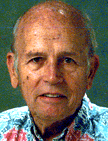
OUR 76 legislators go back into session next Wednesday to spend several months considering knotty problems. Very sensitive Hawaiian matters are on their agenda. So are the pretty controversial proposals made by Governor Cayetano's Economic Revitalization Task Force. Ex-Gov. Ariyoshi took unpopular stands
Tax revenues below earlier expectations will put even more stress on them.
I have a suggestion to all 76: Pull out former Gov. George Ariyoshi's 1997 autobiography, "With Obligation to All," and re-read at least pages 37-69. These are Chapters Three and Four, titled "A Democratic Revolution" and "The Use of Power."
They trace Ariyoshi's political career from his first campaign for office in 1954 to his election as governor 20 years later.
They show that you don't have to go along to get along. They show that you can stand against the crowd even in emotional times and still win elections. They show that the public can appreciate politicians who follow their best judgments even when these are unpopular in key circles.
Ariyoshi doesn't know for sure if that's why the late Gov. John A. Burns in 1970 singled out Ariyoshi to succeed him in 1974, but it obviously didn't hurt. Burns, like Ariyoshi, had a strong sense of duty to the public. Burns, too, was strong enough to continue to work with people who disagreed with him on an issue if he knew they could be together on others.
Ariyoshi's key qualification to Burns was his Japanese ethnicity. Burns felt Hawaii would be a healthier polity if it began to rotate the governorship ethnically. His advisers helped him home in on Ariyoshi even though Ariyoshi clearly was no yes man.
Ariyoshi had tangled with ILWU forces and Democratic Leader Charles Kauhane in his very first campaign in 1954. They wanted him to campaign solely as a team member fighting for one of the six House of Representatives seats from his district. No way, said Ariyoshi. He was new and the youngest candidate in the race. He needed to establish his own identity. He helped hand future U.S. Senator Hiram L. Fong, who had been House speaker, his only election defeat ever.
Later as a territorial senator Ariyoshi refused to join other Democrats in denying a state Circuit Court judgeship confirmation to future federal Judge Samuel P. King, simply because King's father had been a governor who had vetoed a lot of Democratic bills. Ariyoshi considered King fully qualified and joined Republicans to give King the vote he needed for confirmation.
Still later as Senate Ways and Means chairman Ariyoshi held the line on an education budget despite a committee walkout by members including Patsy Mink, future U.S. Congress member, and Nadao Yoshinaga, a key Democratic strategist of the time. He felt he couldn't justify more education spending considering the state's income at that time.
HIS hottest battle was his deciding vote in 1963 against what was called the Maryland Land Bill to give leaseholders the right to buy their properties in fee simple. He felt it wasn't a fair bill because it would benefit only future leaseholders, not present ones. This point was obscured in the emotional heat of the campaign but he got it through to voters in coffee hours and was re-elected in 1964.
In his book he writes: "I learned something indispensable that I hope young office-holders of today will consider. When voters realize you have carefully studied an issue and arrived at an honest judgment, they may vote for you again in spite of your specific position, provided you care enough to talk straight."