Vog may pose
health hazard
By Dennis Oda, Star-Bulletin
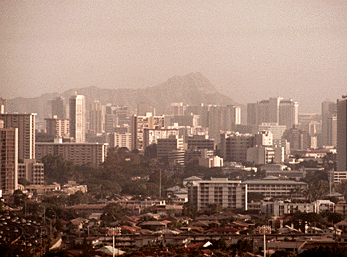
Yesterday's view of Diamond Head was clouded by a thick blanket of vog over the city.
The volcanic smog probably
By Susan Kreifels
will last the rest of the week
Star-BulletinThe Hawaiian word kona means "Leeward wind" or wind from the south. And to people with breathing problems, that translates into trouble. The trouble will likely last through the week, weather forecasters say.
While the usual tradewinds keep Hawaii's air some of the cleanest in the nation, winds from the south have blown vog across the islands since the weekend. Vog carries sulfur dioxide from Big Island's erupting Kilauea Volcano, which emits the equivalent pollution of 3,000 power plants.
Health officials have warned people with asthma, bronchitis, emphysema, and allergies to stay indoors where there is air-conditioning or filtered air, to avoid strenuous exercise, and to drink lots of water. The vog can also affect children and the elderly.
Problems from the sulfur compounds vary from difficulty in breathing and a tight chest to itchy, burning eyes, ears and throats, and headaches.
John Kearns, a lead forecaster at the National Weather Service, said high pressure areas south of the islands blow the vog from the southeast. Or the vog blows west of the Big Island, makes a turn and comes toward Oahu and Kauai from the southwest.
"The weather will continue to be fair so we won't see the vog washed out by rain," Kearns said. "If the high moves to the north, the tradewinds, or easterly winds, will return."
Tradewinds are most consistent during the summer, so vog is more common in the winter months, Kearns said.
Kearns said a storm track north of Hawaii and headed toward the mainland is causing the kona winds as well as the big surf on Oahu's north shore.
By Dennis Oda, Star-Bulletin
Members of the Maunalua Bay Canoe Club practiced in Maunalua Bay in Hawaii Kai yesterday as vog shrouded Diamond Head and created a spectacular evening sky. The vog probably will be around the rest of the week, forecasters say.
Allison Beale, director of environmental health at the American Lung Association of Hawaii, said asthma is increasing in Hawaii as well as generally in the United States, but no one knows why.People of native Hawaiian blood have a higher prevalence of it.
"If you have asthma or chronic lung diseases, there's a real potential to have health problems," Beale said.
"We get complacent because we don't get impacted by vog so often."
Bruce Anderson, deputy director of the Department of Health, said studies on how vog affects health have been inconclusive.
The state has spent $100,000 of federal money studying the properties of vog and has requested another $100,000 for phase two of the study: comparing the health of sixth-graders in south Kona, where vog is regularly present, to sixth-graders in Hamakua on the other side of the Big Island, where vog is not common.
The demographics are similar in the two areas otherwise, Anderson said.
"We'll look at the health status and see if it is different," Anderson said.
A review of hospital insurance records showed people who live in south Kona have more chronic respiratory problems than on the other side of the island.
Anderson said, however, that hospital records show no significant increase of admissions when vog covers the islands.