


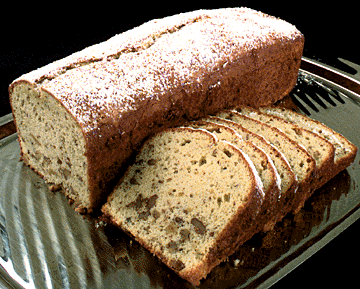
Blueprint for a better cake HERBIE Chang of Moanalua asked why his wife's cakes sometimes rise, then fall.An architect provides advice on turning out a high-rising delight
Architect Gilman Hu - whose passion is baking and who says he learns from his "many more failures than successes" - suggests storing baking powder in a frost-free freezer and offers a time-tested, reliable recipe for his favorite cake. His confection boasts a moist, even texture chunky with nuts. It is light and not too sweet - yet rich and delectable.
Hu advises readers to save the cake recipe as the basis for the Alexander Young Hotel Bakery lemon crunch cake. Readers, including Mrs. Robert Cook, Jimmy Pang, Thomas Santiago and "Taryn," have requested the latter recipe. Hu promises to share the formula soon - during a sunnier, less humid period when the sugar syrup can crystallize properly.
His architecturally thorough recipe follows.
Butter sponge cake
By Muriel Wong2 cups cake flour (sift before measuring)Set the oven at 340 degrees. Set the rack at the second level from the bottom. Use 10-inch round tube pan, 10-inch or 12-inch round cake pan with tall (2-inch minimum) sides, or 15-inch loaf pan (Wilton).
3/4 teaspoon baking powder (fresh)
1/2 teaspoon salt
1/4 pound (1 stick) butter at room temperature
1/4 pound (1 stick) margarine at refrigerator temperature
1 cup sugar, sifted
6 to 7 large eggs at room temperature, separated
1 teaspoon vanilla
2 cups chopped walnuts, optional
3/4 cup sugar, sifted (for the meringue)
1/2 teaspoon cream of tartar (or salt if copper bowl is used)
2 tablespoons confectioner's sugar, optionalSift together 4 or 5 times the flour, baking powder and salt.
Cream butter and margarine, by hand or with a mixer, slowly, adding the 1 cup sugar slowly, until there are little or no lumps. Do not overbeat. Hawaii heat and humidity can liquefy this very quickly. Look for a smooth grainy paste. Clean mixer blades, and scrape bottom and side.
With mixer at medium speed, add egg yolks one at a time. Scrape the beaters and bowl and mix again. Look for a smoother and lighter paste. Add vanilla. Beat at a fast speed for a minute. Look for a light foamy paste.
Add sifted dry ingredients in 4 parts. Run the mixer at short spurts, just enough to mix and absorb the flour. At the end of the fourth addition, scrape blades and bowl, then mix at medium speed for 30 seconds to 1 minute. Look for a smooth, even batter, but do not overmix. Set aside or scrape batter to a another large mixing bowl.
If desired, add the chopped walnuts.
If you are using the same mixing bowl for the mixer, wash it well in hot soapy water.
Make sure all grease is removed. If you are
using a copper bowl, wash it also. Wipe dry. Add the egg whites, salt (if copper bowl) or cream of tartar (all other bowls) and start beating slowly, increasing speed until the egg whites turn from a yellow tinge to white. Stop from time to time to test. Look for an even-textured foam, and a curl that forms a soft loop that is still elastic. (Do not overbeat the whites.) With the mixer running at high speed, add the remaining 3/4 cup sugar. Stop and scrape the blades and bowl. Mix again until the mix, called a meringue, is white, shiny and fine textured and the sugar is all mixed in and melted.
Add about a third of the meringue to the batter and fold lightly. Try to accomplish this with the minimum of hand strokes. Add the next third of the meringue, repeat. Clean the blades, scrape the bowl clean, and fold the last batch with the lightest touch and the fewest strokes. Look for a huge, light, sponge that is well blended with a minimum of handstrokes.
Pour into prepared clean, dry cake pan. Shake pan to even the top (I put a light spin to the round pan). Place in center of oven. Set timer for 35 to 40 minutes. By the time you clean up the mess, the cake should be ready. Insert a toothpick to test. If it comes out clean, it is ready. If not, allow another 5 minutes.
Look for an even-rising cake. If the center cracks, the heat is too high. If the cake is very low at the sides and very high in the center, your pan is not tall enough. Your cake should increase in volume by 75 to 85 percent from the batter. If your cake has pulled from the sides and looks shrunken, you have overbaked it. If the center is soggy, the cake is undercooked. If you don't have the volume, you should practice your folding technique.
Remove cake from oven when done. Turn it upside-down over a cake rack. Throw a dishtowel over to keep it out of a draft and allow it to cool (2 to 3 hours). The cake will hang from the pan. It should not fall out during cooling. To remove from a round (springform) pan, run a spatula around the side, then run across the bottom.
To remove from a loaf pan, run a spatula around all 4 sides. Using a wide blade spatula, insert it along the side and use the tip to scrape the bottom. Repeat this along the 4 sides. The cake at this stage will be very elastic and can stand the rough handling.
The cake is now ready to be eaten as is, or filled and/or frosted as desired.
Approximate nutritional analysis per serving, based on 30 slices with walnuts and dusted with confectioner's sugar: 190 calories, 12 grams total fat, 3.5 grams saturated fat, 50 milligrams cholesterol, 130 milligrams sodium.*
