By Ken Ige, Star-Bulletin
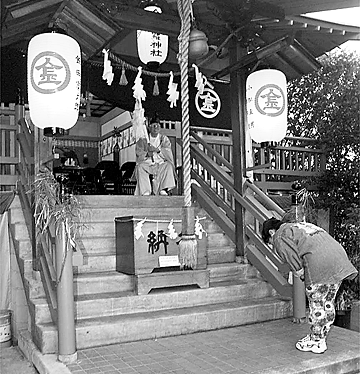
Irene Takizawa bows to the god of good luck,
prosperity and fishing this morning at the Kotohira
Jinsha Dazaifu Tenmangu shrine in Kalihi.
Kamnushi (priest) James Kunichika
gives his blessing.
Japanese ‘throw out’
the old year
New Year's traditions include
By Craig Gima
good-luck charms and ‘sharing
food with the gods’
Star-BulletinAfter a midnight snack of soba noodles for long life, Bill Nakamoto washed his hands, bowed twice, clapped twice, and bowed once; a guji, or Shinto priest, then waved a wooden wand with long, white paper tassels over his head to purify him for the New Year.
"It helps clean your body or soul. It gives you good luck. It's supposed to put your mind straight," Nakamoto said.
"I remember my mother ... used to come when I was a boy," he said.
"I used to go there, wash our hands, bow, ring the bell, buy omomori (good luck charms)."
As he got older, Nakamoto moved away and stopped visiting the shrine on New Year's.
But a few years ago, the Kalihi resident decided his children needed to learn the traditions and values he observed as a boy.
"I told my kids, 'This is something you gotta learn,'" Nakamoto said. "I didn't want them to lose those values."
Now he and his children volunteer to help on New Year's. And Nakamoto said he sees many fathers like himself who are returning to old traditions with their children.
"I really feel with all the crime, drugs coming up, people want to return to the old values, to the good old days when you were a kid," he said.
Between midnight and 6 p.m. today, up to 4,000 people were expected to visit the Kotohira Jinsha Dazaifu Tenmangu Shrine on Kama Lane near the H-1 Freeway in Kalihi.
Thousands more were visiting other Shinto shrines and Buddhist temples across the state, on what is the most important holiday of the year for Japanese and many Japanese Americans.
"On New Year's you can take all the bad stuff in the old year and you get to throw it out," explained George Tanabe, a professor of Japanese religion at the University of Hawaii.
Shinto shrines and Buddhist temples were brought to Hawaii by immigrants just after the turn of the century.
At the 94-year-old Daijingu Temple of Hawaii on Puiwa Road in Nuuanu, Rev. Akihiro Okada said the members are mostly older Japanese but he's seeing more younger faces of all nationalities among the 10,000 people who visit for New Year's.
Since the shrine was established, the traditions have evolved, Okada said.
"It's a little bit different than the Japanese style. It's Hawaiian style," he said.
On New Year's Day, visitors are served paper cups of sake. They can also buy rice that has been blessed. The rice is supposed to be served with the first meal of the new year.
"It's sharing food with the gods," said Tanabe. "Rice is staple of life. Sake is a derivative of rice and is a symbol of potency."
Visitors can also buy omomori, or good luck charms, which protect the home, car and person.
New charms need to be purchased every year. The old omomori are returned to be burned at the shrine.
"Even amulets lose their power," explained Tanabe. "Like the Eveready battery, you need to renew your amulet."
In another tradition, visitors can purchase pieces of paper with fortunes and tie them to a tree.
Bad fortunes will blow away. The good ones will be sent to the gods.
Temples open till 6
Shinto shrines on Oahu and several dozen Buddhist temples open until about 6 p.m. on New Year's Day and during the day for several days after Jan. 1:
The Daijingu Temple of Hawaii, 61 Puiwa Road, near the Queen Emma Summer Palace.