

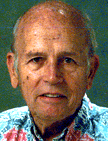
RICHARD H. Kosaki is retiring as president of Hawaii Tokai International College, returning to an advisory role, and phasing out a distinguished educational career that has spanned 47 years. Educator Richard Kosaki
is retiringWe talked about it at a Kaimana Hotel lunch table where we could see down the curve of Waikiki Beach to all the giant hotels now clustered on the water and along Kalakaua Avenue.
It was symbolically appropriate. Kosaki was born near the beach, grew up there, swam and fished there and watched its tremendous changes over his 73 years. Only the Moana and Halekulani hotels were there when he was born. The Royal Hawaiian didn't open until 1927. All the high rises rose since statehood in 1959.
Kosaki, for his part, has been a big mover for educational change in Hawaii. He is the architect of the University of Hawaii's community college system that now embraces well over half of all UH enrollment. He was with the UH faculty group that generated the concept of the East-West Center.
After he retired as chancellor at UH-Manoa he carried his belief in Hawaii as an international education center to helping Japan's enormous Tokai University Educational System establish an outpost here in a superbly built high rise at 2241 Kapiolani Blvd.
In his beginning years as an educator, he taught political science, worked with the Legislative Reference Bureau, and helped educate many students who went on to be leaders in government. He even helped to wise up newspaper writers like me.
We talked about two things: international education in Hawaii, and other educational changes to expect in the years ahead.
The Tokai University Pacific Center here, the umbrella under which the college exists, is not the gangbuster success early visualized. It still needs heavy subsidy from Japan. International students have never filled all of its 200 dorm spaces but they have totaled over 100, and international visitors and conferences and visitors have filled a lot of the rest.
While most of the international enrollment is from Japan, annual outstanding student award winners have come also from Taiwan, Cambodia, Vietnam and Brazil. The only U.S. winner came from Molokai.
Courses deal mostly with English and an introduction to America. They provide a "friendly gateway" to America for international students planning study elsewhere. Besides its help to these full-year students, the center offers short-term introductions to Hawaii and Hawaiiana to students regularly enrolled on Tokai's numerous Japanese campuses.
Kosaki sees this "friendly gateway" as an important continuing role for Hawaii.
And what about education generally?
More use of Internet and TV for off-campus education.
He has a favorite maxim: "Tell me and I forget. Teach me and I remember. Involve me and I learn." He succeeded under the old system of listening to lecturers, memorizing and feeding things back in exams. But he thinks involvement is better and should be lifelong.
Real education starts at conception, he says. Early life experiences are the most formative. Kindergarten teachers thus are more important in shaping a life than graduate school professors. The latter are much better paid but the balance is worth re-examining.