By Keith Robinson, Special to the Star-Bulletin
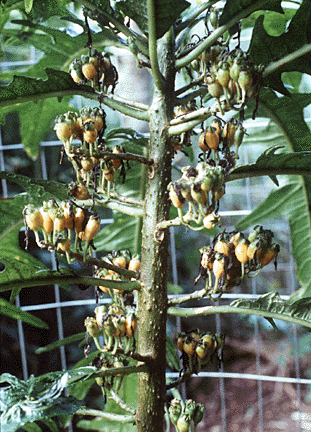
The Cyanea pinnatifida reached maturity and produced
fruit under the watchful eye of Keith Robinson, who cared
for the plants at his private wildlife reserve in Makaweli,
Kauai. Three plants flowered in August and produced
2,000-3,000 seeds, and scientists last week preserved
those seeds in test tube cultures.
Experts race
to save last plant
of its kind
After 32 years, the last
By Trish Moore
Cyanea pinnatifida has produced
seed-bearing fruit
Star-BulletinLIHUE -- The race to save a one-of-a-kind plant is on in the islands. Located in Honouliuli Preserve on Oahu, the world's only Cyanea pinnatifida had never, in 32 years of monitoring and care, reached maturity and produced fruit.
In 1992, Gregory Koob, a micropropagation specialist, formerly with Lyon Arboretum on Oahu, cloned the plant.
The arboretum produced several hundred copies of the plant and distributed them to botanical gardens around the state, and to Keith Robinson's private wildlife reserve in Makaweli, Kauai.
Of all the copies given away, only Robinson's managed to flower and produce fruit. Three of his approximately 20 plants flowered in August and produced some 2,000-3,000 seeds.
Scientists last week preserved those seeds in test tube cultures, and are hoping the seeds will save the plant's future.
Cyanea Pinnatifida is endemic to Oahu, part of the Lobelius family with a trumpet-shaped flower, creamy white with a purple stripe.
State officials aided the process by issuing permits to handle the plant under new state rules that are still pending final approval from the attorney general's office.
"I've been very public in telling people we're going to do what's right," said Michael Buck, Division of Forestry and Wildlife administrator.
The old rules, which prohibit individuals from possessing endangered plant species, are "really arcane," Buck said.
"We've had to push from the botanical era to the horicultural era. We don't want to look at dead plants between pieces of paper -- we want to grow them."
Ignoring state and federal laws, Robinson since 1978 has successfully cared for and propagated endangered plants on his family lands.
Robinson said his "outlaw" status has enabled him to be more effective in saving and protecting endangered species than agencies subject to cumbersome regulations.
Robinson teamed up with Koob and Kauai Community College botanist Brian Yamamoto to preserve the genetic material of the plant's offspring in test tubes.
But Yamamoto and Koob needed state permits before they could handle the seeds. What Koob called an "emergency room situation" was further complicated by a glitch in the mail delivery of the permits.
Although Yamamoto had received a verbal approval from the state, he said he wanted the permits in hand before handling the seeds.
Meanwhile, rats ate more than two-thirds of the precious fruit.
Robinson said he had hoped the work could be done during the week of Dec. 8-12 before the fruit got too ripe and started falling.
The permits arrived on Dec. 12 and were hand-carried to Yamamoto. On Dec. 15, when Robinson went to check on the plants located deep in the mountains of Makaweli, he discovered the rat problem.
"This disaster vividly illustrates how official government agencies, even at their very best, can never act as fast as 'outlaw' rescue efforts that are outside the official system," Robinson wrote in a letter to Buck.
"One more night and everything would have been gone. This extremely close call shows why I never like to get bogged down by operating within the official system -- the results can be deadly for dying species."
Despite the rats, the team managed to save 83 pieces of fruit and preserve between 600-1,000 seeds.
Koob said the seeds are "extremely valuable, especially if they contain any genetic variability."
Some genetic differences may have been lost to the rats, Koob said. "It's sad, but not devastating."
Variations in the plant's offspring make the species sturdier and more likely to reproduce on their own and react to changes in the environment, Koob said.
Koob said the fruits are a testament to Robinson's skill and dedication.
For more than a year, Robinson hand-carried water and fertilizer over treacherous mountain terrain to care for the plants.
Buck said the new endangered species rules, which have passed public hearings, are among the most innovative in the country.
By getting more endangered plants out to the public, the better their chances of survival, he said.
Robinson said he freely gives away extra seeds of endangered plants.