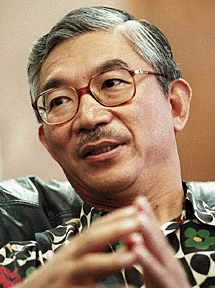
Kishichiro Amae:
Predicts five more years of
economic woes for isles
Japan consul Amae
helped curb crime
against Japanese
The departing diplomat spoke
By Susan Kreifels
out about the visitor incidents
Star-BulletinKishichiro Amae doesn't fit the stereotype of a diplomat who shies away from controversy in a foreign land. But taking on crime in Hawaii wasn't exactly a low-profile challenge.
The consul-general of Japan called on local officials last year to initiate what he called "combat against crime" targeting Japanese tourists. Amae leaves his post next month aware that speaking out helped bring what he called a dramatic drop in that crime.
Amae, who calls himself a "very much ordinary citizen and government official," also said it's up to the Legislature to pass laws making Hawaii a better investment and changing its business-unfriendly image. "The economy of Hawaii can be improved just like the combat against crime," he said.
He predicted two to five tough economic years for Hawaii because of the Asia currency crisis and Japan's continued slump. Competition for Japanese tourists is fierce on the U.S. mainland.
Amae started his war on crime against Japanese tourists in 1996. Drive-by purse snatchings that year were bad enough, but a gunpoint robbery on a golf course by three masked criminals was too much for Amae. He wrote a strongly worded letter to the mayor and chief of police warning that "vigorous action must be taken immediately." He told the media that 1997 was a year to declare "combat on crime." And he suggested that the state build more prisons.
"As a diplomat and Japanese representative, we don't want to meddle in internal affairs," Amae said.
"But when it comes to Japanese citizens involved in that kind of nasty incident, and with things getting nastier and nastier, something had to be done."
Amae felt tourists were too naive about crime in "paradise" and he produced a video with the help of Honolulu police to warn them when they arrived at their hotels. Amae also said local officials responded to his warnings.
Friday, a smiling Amae talked about a 60 percent drop in crimes against Japanese tourists earlier this year: from January through August 1996 numbers reached 243, compared with 92 incidents in the same period a year later.
But even though the numbers have improved, the threat continues. The consulate's chef was robbed at knifepoint in Waikiki earlier this year.
Amae leaves Hawaii on Jan. 16 for his new Tokyo post: director-general designate for Middle-Eastern and African Affairs Bureau at the Ministry of Foreign Affairs.
He arrived in Hawaii in March 1995 to a job he considered a "trophy" after a career filled with tough assignments.
Amae witnessed the fall of the Shah of Iran and the Soviet Union.
He believes Hawaii is an important diplomatic post, not just a beautiful one. The U.S. Pacific military command is based here, one out of three tourists last year was Japanese, and about a quarter of Hawaii residents claim ancestral roots in Japan.
Amae wishes he had done more to strengthen economic ties by enticing Japanese investors here. But he said that's tough in a state still considered anti-business. And other states offer greater investment incentives.
Amae also said there's a sour taste left over from the bubble days when Japanese real estate investors bought Hawaii property at much inflated prices and then lost big after Japan's economy crashed.