Marathon turns 25,
still a Shorter race
The man who won gold
By Pat Bigold
gave Honolulu a running start
toward respectability
Star-BulletinHe has aged with the Honolulu Marathon, from a front-running contender to a middle-of-the-pack participant. He has seen the race from inside and out through its three decades, struggling as everyone else has against the punishing winds of Kalanianaole Highway and the tormenting subtropical humidity that exacts a toll over 26.2 miles.
If you were running in the three-hour range, you might have happened upon him somewhere between Waikiki and Lunalilo Home Road.
A 17-time participant, he's never won it and never gained more from it than the average runner has: the satisfaction of completing the world's most scenic endurance test.
But take a closer look at this 50-year-old Colorado lawyer with the salt-and-pepper mane and washboard stomach and you'll see it's Frank Shorter.
By Ken Sakamoto, Star-Bulletin
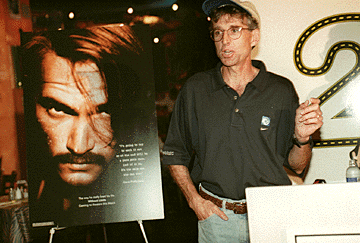
Frank Shorter, shown here with a poster promoting
a movie about running legend Steve Prefontaine, is back
for his 17th race, though he's doing commentary
this year instead of running.
Shorter was the first marathoner to become a household name in America when he won the gold medal before a mesmerized worldwide TV audience during the 1972 Olympic Games in Munich. No American had done that in more than 60 years. No American has done it since.Shorter, more than anyone, ignited the nationwide "running boom" that gave birth to the Honolulu Marathon and assured its perpetuity.
From a barely noticeable first-time field of 162 in 1973 to a rolling sea of 30,000-plus in its modern form, the Honolulu Marathon turns 25 years old when the howitzer fires at 5 a.m. Sunday on Ala Moana Boulevard.
"The start is always surreal," said Shorter, who will do TV commentary on the race, a chore he has performed at the network level for the Olympics. "There is no other feeling like it at the start of a marathon -- all these thousands of people descending upon a darkened ghost town, rustling around in their foil blankets. It's other-wordly."
Old-timers such as Shorter ruminate on a quiet little local footrace that now draws people from 39 countries, 45 states, the District of Columbia and two territories and has evolved into a mega-event that shuts down part of the city one Sunday every December.
Staging the race is like mounting Desert Storm: 172,200 pounds of ice, 80,000 sponges, 2,125 flasher barricades, 19 massive dumpsters, 10,110 feet of red nylon fencing, 225 off-duty police and 35 solo bikers, 2,325 no-parking signs, 3,750 traffic cones ... the list seems endless and the planning goes on year-round.
When he was persuaded by Dr. Jack Scaff and fellow marathoner Kenny Moore to enter the 1974 Honolulu Marathon, Shorter was fresh off winning the selectively elite Fukuoka Marathon in Japan.
With one week's rest, he stepped into a field of 315 -- nearly twice the size of the event's inaugural field.
Shorter didn't invent the Honolulu Marathon in the literal sense, a distinction due Scaff, the Mid-Pacific Road Runners Club and the City and County of Honolulu.
But his Munich miracle gave marathoning a popularity and acceptance it had never enjoyed, and he noticed that in his first Honolulu Marathon.
"You could feel this wave starting to build," Shorter said, "and I enjoyed pulling all my friends along in it."
By Ken Sakamoto, Star-Bulletin
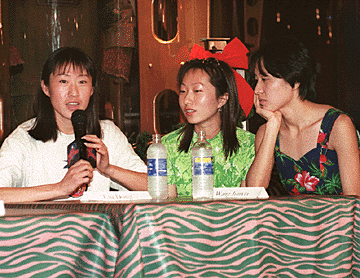
Dong Liu, left and Junxia Wang, right, meet the press
at a Honolulu Marathon/Waikiki Mile press conference
yesterday, through an interpreter, center.
There was no $25,000 first prize back then, although the names at the front of the pack were world-renowned. Olympian Jeff Galloway led Shorter and Moore, and 1973 winner Duncan Macdonald, to the finish.Macdonald, an alumnus of Kailua High and Stanford University, is the only locally born man to win the Honolulu Marathon (1973, 1976, 1980). Now a practicing anesthesiologist, he also is the only locally born man to run a sub-4-minute mile.
The luminaries of running would show up in the old days, but the pace was comfortable because it was not a pressure race.
"It was a busman's holiday for us," said Shorter, who ran 2 hours, 11 minutes in Fukuoka in 1974 but cruised through Honolulu in two-and-a-half hours seven days later.
"It was a national-caliber race with good American runners, but now it's become an international event," Shorter said.
Starting in 1985, when Drs. Jim Barahal and Jon Cross took over the reins of the marathon, the race up front took on a more serious attitude.
Barahal and Cross, seeking to elevate the competitive image of Honolulu, recruited hungry up-and-coming runners from around the globe, particularly Kenyans.
Africans have won 10 of the last 12 Honolulu Marathons.
The move to bring in runners from Kenya, a country whose athletes now dominate international distance running, boosted the Honolulu Marathon's reputation and worldwide visibility. Runners who cut their teeth in winning Honolulu went on to win at a higher level.
Three-time Honolulu winner Ibrahim Hussein and two-time runner-up Cosmas Ndeti of Kenya each scored three Boston Marathon victories. Josiah Thungwane of South Africa followed his victory in 1995 with a gold medal in the 1996 Olympics in Atlanta.
Korean Bong Ju Lee, who won here in 1993, took the silver medal in the same Olympic race.
Barahal has said that no one will ever run an American record on the tough Honolulu course, but he knows a 2-hour, 12-minute performance here can be translated into a 2-hour, 7-minute performance in Europe or on the U.S. mainland. "I know that Hussein could have even run a 2:06:00 elsewhere under the right conditions," he said.
Shorter has lost sight of the front-runners, but he has enjoyed melting into the rank and file. He said it gave him a chance to taste the true flavor of the Honolulu Marathon.
"At the mass participation level, it's more of a fun run," he said. "And for me, that's the very interesting part. No one knows what anybody else does for a living. Social equality sets in, and so does cultural equality."
Culturally, the face of the marathon has changed dramatically since 1973, with Japanese participation increasing to extraordinary levels. At its peak, Japanese participation accounted for 70 percent of the field in 1991. Last year, the 18,285 Japanese entries represented 59.25 percent of the 30,864 entries.
Sponsorship by Japan Airlines, heavy promotion of marathon travel packages and the unrestricted nature of the Honolulu race have made it a highly attractive event. In Japan, all races have time standards and entries are limited, whereas Honolulu requires no time standards and the field has thus never been capped.
The marathon field has been over the 10,000 level every year since 1986 and above 20,000 since 1992. Entries have topped 30,000 four times, with the peak year being 1995 when 34,434 signed up.
That year, 27,022 finished, making Honolulu the largest marathon in the world.
Numbers declined somewhat last year to 30,864 entries (24,414 finishers), but the latest figures for 1997 had 31,787 registered.
Shorter thinks back to how the Kapiolani Park finish area looked in 1974 and how it looks nowadays.
"The best analogy would be that it once looked like a Division III college football crowd, and it now looks like the Olympic Games," he said.
"You've got to remember that every runner brings two or three people to the park, so the place is teeming."
Shorter chuckled.
"The guys up front in the race still have the same little bitty cabin that we had to operate in. It's the size of the rocket below them that has changed."
The 25th Honolulu Marathon
What: 26.2-mile foot race