Newsmaker
Monday, December 8, 1997
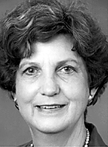
Name: Jane Renfro Smith
Hawaii is the Aloha State, and the Hawaii Community Foundation intends to find out how much that holds true. Quantifying aloha
The philanthropic foundation is collecting data on who gives how much in charitable donations. Those statistics can then be compared to national figures.
But 30 years in philanthropy makes Jane Smith, president and chief executive officer of the foundation, a good judge of giving behavior.
"Hawaii is considered generous," said Smith, who retires next June.
Smith is the recipient of the President's Award, given by the Hawaii Chapter of the National Society of Fundraising Executives.
She grew up as an "Army brat," often moving with her family. But Hawaii seemed the best place to stay put, which she has done for about 50 years.
Smith has seen the ebb and flow of generosity in the state and -- after recently attending a business conference on "the doom and gloom" of the state's economy -- realized the importance of her foundation.
"I've been asking myself, 'What does philanthropy do, and what would happen if it disappeared?'" she said. "Most philanthropy is relatively invisible to anyone except those who submit proposals."
Across the nation last year, Americans contributed around $150.7 billion to nonprofit organizations. Almost 80 percent of that came from individuals. Seven percent was through bequests and the rest came from business.
Low-income people are among the most generous.
"We spend a lot of time trying to figure out why," Smith said. "They appear to be more religious, and almost half goes to religious organizations."
Higher-income donators give more to private education, their alma mater and museums. Among recipients, human services and the environment rank low, Smith said.
"Trends tend to be generational. When you were born has greater effect on giving patterns than anything else," she said.
Americans 60 and older are the most generous. They value savings, are likely to be religious and grew up in a family tradition of giving, Smith said.
"It's part of one's civic duty. Then it goes downhill. Baby-boomers are not savers, they want fairly immediate gratification."
Younger generations tend to give more to telethon events and concert benefits "that go beyond borders. I'm not knocking it, but where does that put United Way and community-based economic revitalization? Long-term changes in people's lives is what institutional philanthropy is concerned about rather than short-term."
Smith said people want to give more this time of the year as a way of showing their thanks for their own blessings.
"Instead of buying toys that will break, invest in human resources of the community by setting up charitable funds. Stuff the Salvation Army bucket with dollars instead of change."
With retirement approaching, Smith says she'll be "reinventing herself." But the new Smith may not change much.
"I would like to see who I am with respect to an international relief agency, or volunteer at a national park," she said.
Susan Kreifels, Star-Bulletin