PELE'S PIT
The new crater on loihi presents more surprises about the undersea volcano
By Alexander Malahoff, Hawaii Undersea Research Lab
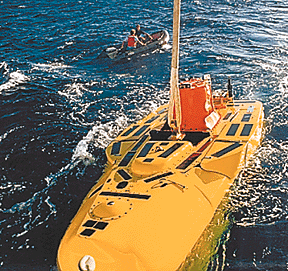
Pisces V, Hawaii Undersea Research Laboratory’s submersible, returns from an exploration of Pele’s Pit.
By Helen Altonn
Star-BulletinOutside the little submersible, it was 410 degrees Fahrenheit in the "forbidden pit's" hydrothermal vents. University of Hawaii scientists skirted needlepoint pinnacles and towering peaks to explore Pele's Pit, a new crater on Loihi.
They dove to the bottom of the half-mile-wide pit in the Hawaii Undersea Research Laboratory's three-person submersible Pisces V.
"It was like diving in Chicago through downtown high-rises," said HURL director and oceanographer Alexander Malahoff.
The recent expedition was a big success, he said, producing more surprises and mysteries about the undersea volcano off the Big Island. Among them:
Glass shards or sands similar to black sand on Kilauea, believed to be from explosive eruptions.
Pele's Pit, about 4,600 feet deep, was created last year when a peak called Pele's Vents collapsed during earthquakes.
Scientists jokingly dubbed it the "forbidden pit," because they couldn't go into it last year. Malahoff felt conditions were too dangerous after an initial dive with Terry Kerby, Pisces pilot and operations director.
With better conditions in September, the two pioneered a long, gradual glide path through the pit to a site with high-temperature hydrothermal vents. It's marked by pinnacles on two sides, Kerby said. IN THE PIT
"We call it the gateway."
He said he recognized the site as one where he and Malahoff landed last year, and he'd been waiting since to try another approach.
"It became a regular milk run going down," Kerby said. Out of nine dives into the pit, he landed right at the site seven times, he said. Alternating as co-pilots were Chuck Holloway and Tym Catterson.
Malahoff said hot water poured out of the vents and the whole area was covered by red shrimp - "voracious feeders." Several mop-like creatures also were collected.
He said close to 300 million tons of rocks probably went down the hole when Pele's Vents collapsed. Where the magma went, and why it was created, remain puzzling questions, he said, noting, "There is probably a hot dike system going through the area like Kilauea."
The magma probably went into the plumbing system, he said.
Although the source of lava that erupted last year eluded scientists, they discovered glass shards from two possible eruptions, said geologist Michael Garcia.
UH geology and geophysics professor Ken Rubin, using a technique that he pioneered, dated one sample from about February 1996 and another from about May 1996, Garcia said.
"We hadn't anticipated it would be explosive, but it was."
He said the Loihi shards look the same as glass shards that form around bubbles as lava enters the ocean, called limu Pele.
"The same sort of thing is happening in one kilometer of water down on Loihi, so water and molten rock were mixing to form these bubbles," Garcia said.
Geologist Rodey Batiza said the shards or sand "are a real mystery. They are going to tell a real interesting story related possibly to explosive volcanism." 'A REAL MYSTERY'
Batiza said the shiny, jet black particles look like "little pieces of a broken beer bottle." They vary in shape and sizes, from fine sand to about half an inch.
He's found such sand on other Pacific volcanoes at deeper pressures and believes "in some mysterious way, there's a kind of magma-water interaction that we normally don't see in the deep sea."
He thinks it's "making steam out of sea water, which results in some sort of explosive-like behavior in the eruption."
Normally in submarine eruptions, Batiza said, magma comes out quietly, like toothpaste, and forms pillowly slopes.
"Just the fact that you have sand instead of flows shows the eruption was real different . . . A lot of people said it is too deep to have any explosions. Yet, there they were. How else do you make sand?"
Batiza thinks Loihi's summit, about 3,300 feet below the ocean surface, is in a transition area that is fairly deep but may be shallow enough to have steam explosions.
Oceanographer Frank Sansone said the seamount, which in hundreds of thousands of years will pop above water to become a Hawaiian island, has a lot of hydrothermal activity, but it's calmer than last year.
White bacterial mats that blanketed Loihi last year were gone last month - replaced by reddish bacterial matter, Sansone said.
"It looked like a big snowstorm had left three inches of brown snow," he said.
Sansone said currents were very strong in the pit. He had only one chance to pick up a water sampler left last year, he said.
"We did get it," he said. "It was touch and go."
Geochemist Gary McMurtry said he and former UH graduate student Peter Sedwick published several papers years ago predicting a high temperature system on Loihi based on the water chemistry. PREDICTIONS CAME TRUE
Colleagues were skeptical because there was no evidence of sulfide chimneys indicating high temperatures, he said.
But a temperature of 200 degrees Celsius (410 degrees Fahrenheit) was recorded in Pele's Pit last month, he said.
"And, guess what? We found sulfides and sulfates forming along with high-temperature waters," McMurtry said. "Thanks to the pit collapse, the volcano has sort of exposed itself to us."
McMurtry said he took a gamble and tested a chemical monitoring station that he's developing for Loihi in the hottest Pele's Pit vent he could find. The batteries gave out, but it worked and was recovered safely, he said.
The station eventually will be hooked to the Hawaii Undersea Geo-observatory recently placed on Loihi by geophysicist Fred Duennebier. HUGO automatically transmits data by fiber-optic cable to a recording station on the Big Island.
Duennebier said the National Science Foundation has approved funding for an unscheduled return trip to Loihi in January. Plans are to spend six days at sea and, weather permitting, make four Pisces dives to replace two instruments that stopped working, add others and make sure the cable is safe, he said.
Garcia said all information from the dives, as well as HUGO, are going on the World Wide Web.
"People all over the world have been following the progress of this in real time," he said. "School kids all over the world have contacted us and used the information for projects in class.
"This is one of the most exciting and novel parts of the research program. It's not just in our labs, but it has touched students all over the world."
Space engineers can learn from Loihi experts
By Helen Altonn
Star-BulletinThe Jet Propulsion Laboratory could use some of the University of Hawaii's expertise in ocean explorations for space missions. was the message of laboratory officials at a recent workshop to examine University of Hawaii and NASA interests in commercial ocean technologies.
Jet Propulsion Laboratory engineers are experts at developing instruments for space investigations, but they don't know how to work in the oceans, said UH geochemist-volcanologist Gary McMurtry.
He said Loihi would be an ideal site to test instruments for volcanic systems and life in extreme environments.
The Jet Propulsion Laboratory is starting to explore ice-covered Antarctica's Lake Vostok as a prelude to sending a spacecraft to explore Europa, a satellite of Jupiter, which may have a planet-wide ocean covered in ice.
The Vostok venture is an attempt to learn to do things on Earth that can be applied to Europa, said Joan C. Horvath, with JPL's commercial technology program.
If there is an ocean deep under the ice of Europa, it is probably volcanically heated, similar to Lake Vostok, she said.
The idea is to somehow get through the ice and send a little submersible down to explore things, Horvath said.
"We want to learn from you - people dealing with the ocean. We have to trade off knowledge," she said. "We have to get very light and very small in space."
Arthur L. Lane, with the JPL Insitu Center of Excellence, described the challenges of designing and building instruments for hostile environments with high radiation, extreme temperatures, high pressures and strange gases.
If it's a 10-year mission over 3 billion miles from Earth, there is no way to make repairs, he said.
"We've got to make it right the first time," Lane said.
Just meeting sterilization requirements for instruments is a tough job and a "really intense area of research," he said.
"We're trying to stimulate an interest in development and application of instruments in an environment you're more familiar with than we are," he said, addressing those at the workshop.
"Talk to us. We need a lot of creativity."
The UH Office of Technology Transfer and Economic Development, which receives NASA funding, is trying to match partners for research and development, said Ann N. Park, special projects coordinator.
Research laboratories on the mainland want to work with businesses, she said.
"The timing is good."