
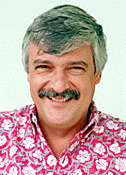
MARK November 1997 as the month when at least one local organization got serious about politics. Larry Johnson, chief executive officer and chairman of Bank of Hawaii, announced last week that he was going to direct his bank's political contributions only to those who support Gov. Ben Cayetano's economic recovery plans. Bank boss gets
serious about politics
That group wants to restructure local tax laws, including cutting income tax rates, raising excise taxes and cutting back on the pyramiding of excise taxes.
The group has gotten positive and mixed reviews, with most business folk giving the idea a thumbs up. Because it was conceived by the leaders of the Legislature and the governor, it is expected to have wide support at the Capitol next year.
But Johnson, who served on the task force, wants to give the plan as much support as possible. So the bank will contribute only to politicians who support the plan.
Bank of Hawaii is not shy about donating to politicians, so if Johnson starts to change the rules on who gets what politicians will notice.
Between July of this year and January of 1996, Bank of Hawaii slipped $141,261 into politicians' hands, according to figures filed with the state Campaign Spending Commission.
Almost all of the money went to incumbents in the state House and Senate, usually in donations of $250. Money also went to U.S. Sen. Daniel K. Inouye, U.S. Rep. Neil Abercrombie, candidates in elections in Guam, the state Republican Party, candidates for the Office of Hawaiian Affairs and even some members of the Honolulu City Council.
The bank got the money from its vice presidents and senior officers, who contribute in chunks of $150 at a time.
Sometimes the bank backs both candidates for an office, such as when it gave to both Abercrombie and his GOP opponent, Orson Swindle. Although incumbents are the favorite target of the bank's largess, it has given money to outsiders, such as Libertarian Tracy Ryan.
But all that is over.
Johnson says this isn't the bank that says yes, and this isn't the bank that rolls over.
Oddly enough, several reform groups, including Common Cause, the League of Women Voters and the Sierra Club saw this as a sign of evil and corruption.
None of these groups uttered a peep last year when Gary Rodrigues, as the then-state AFL-CIO president, told workers to take their money out of Bank of Hawaii because Johnson had called for reforms to state workers' compensation insurance.
Rodrigues even made his demands during a Labor Day picnic at Thomas Square, sponsored in part by Bank of Hawaii. Rodrigues, who served on the economic task force with Johnson, has been silent on his announcement last week.
BOB Watada, state Campaign Spending Commission executive director, who is as straight an arrow as you will find, says he doesn't see anything wrong with Johnson's call. Neither does Cayetano.
What the government reform and environmental organizations seem to be forgetting is that we live in a country operated by the politically active. That is the way it is supposed to be.
Successful politicians, unions and businesses know that you succeed by setting goals, telling everyone in your organization about your goals and then convincing them to join in the struggle. That's not bribery or corruption. That's playing tough politics, out in public, the way it should be.
Read the full text of the
Economic Task Force recommendations.