Reconstruction
of Saddle Road
may start in ’98
‘A disaster waiting to happen’
By Rod Thompson
is how one planner
describes it
Star-BulletinHILO -- With traffic traveling down the center of a crumbling roadway well over the speed limit while military vehicles slowly cross it dragging howitzers, the Big Island's Saddle Road is one of the most dangerous in the state. "It's a disaster waiting to happen," contract planner Bill Moore said.
A study shows an accident rate 81 percent higher than the state average.
If all goes well, the first of up to $167 million in reconstruction of the road could begin as soon as the fall of 1998, said federal highways engineer Bert McCauley.
But he also warned, "That's in the best of all possible worlds."
There is no money for construction at present.
McCauley and Moore outlined Saddle Road proposals in a draft environmental study yesterday.
"Basically, what you have is a one-lane road with wide shoulders," Moore said, referring to the existing road built by the Army in 1942. "It encourages people to drive down the middle."
A study by officials at the Army's Pohakuloa Training Area showed civilian traffic moves through a 45-mph zone on the base at an average of 60 mph.
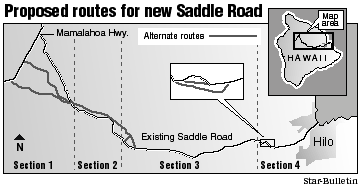
The Army wants to move the 13-mile portion in the base to its northern boundary at a cost of up to $40.5 million. About $8 million more would have to be spent on creating at least 5,000 acres of new habitat for the endangered palila bird.
None of the birds actually live in or near the 100 acres of mamane forest, which the realignment would affect, but it is designated critical habitat for the bird under the protection of U.S. Fish and Wildlife Service, which hopes the bird will expand its range some day.
Another possible problem is one corner of the new alignment, which goes over Department of Hawaiian Home Lands property. Moore said the department has been cooperative, but an alternative route was identified in case problems arise.
The realignment at Pohakuloa would be paid for with Department of Defense funds being sought by Sen. Daniel Inouye.
That would be the first of four segments to be improved on the 48-mile road.
The remaining three segments would be 80 percent federally funded, with the state paying the rest.
That would mean up to $25 million from the financially strapped state government.
Two new alternatives are proposed on the western end of the road leading to Kailua-Kona: one more direct, the other less so, but connecting with the road to Waikoloa.
On the eastern side heading toward Hilo, 19 miles of road would not be substantially realigned, but would be rebuilt.
A special fourth segment involves two alternatives for eliminating a major curve at Kaumana City subdivision above Hilo.
The end result, if all improvements are built, would be an increase from 900 vehicles per day on the road in 1994 to an estimated 14,000 per day in 2014, McCauley said.
The distance from Hilo to Kailua-Kona would drop from 100 miles to 80, and driving time would decrease by a half-hour, Moore said.
Concern was voiced at the meeting about the proposed two-lane road becoming clogged with heavy commercial trucks.
But a survey showed that some truckers believe increasing traffic on the Saddle Road might make the more roundabout Hamakua Road more attractive to them.
Two public hearings on the environmental study for Public hearings scheduled
Saddle Road improvements are planned:
Dec. 11: 7-10 p.m. at the Royal Waikoloan resort.