By Ken Sakamoto, Star-Bulletin
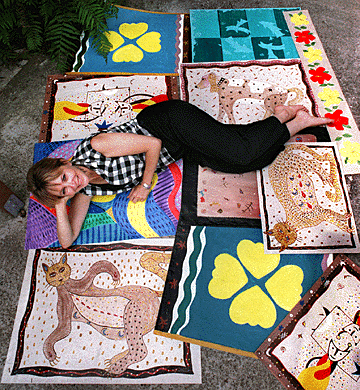
"I was home a lot, watching the baby fling food on the floor.
Why not make a piece to protect the floor that also looks nice?"
says Gena Grant about her painted floor mats.
Below, Grant's painted chairs.
Pretty crafty
More people have designs
By Burl Burlingame
on this artistic enterprise
Star-BulletinThere's plenty of hoo-rah that's bandied about concerning diversified agriculture, but you don't hear about diversified crafting. Yet home-made objects are available as never before, and craft fairs are proliferating in ways that rabbits can only dream about.
There's at least one large craft fair a month these days, and as we count down toward Christmas, you won't be able to swing a shopping bag without hitting a craft fair. Sunday it's the Temari "Trash and Treasure" Craft Fair.
Gena Grant will have some of her work at the fair. She takes mundane household objects like old furniture and floor mats and turns them into brightly colored pieces that tap into folk art traditions and mythologies.
"I had a degree in art, and I had a baby," is Grant's explanation of her original inspiration. "So I was home a lot, watching the baby fling food on the floor. Why not make a piece to protect the floor, that also looks nice?"
So she began painting designs on duck canvas with waterproof and colorful acrylic paints and then treating it with a water sealer. This led to taking old furniture, sanding it down and repainting it. "We collect folk art and I've always been interested in primitive art, being creative with everyday objects. And I'm inspired by Matisse and Klee."
David Takamiya does specialty leather work, primarily one-of-a-kind business items like briefcases and portfolios, but he's known as the guy who creates realistic mice finger puppets.
"My wife saw a notice of a craft fair at Mission Houses in 1979, and we had a nice Christmas sale and kept on going," said Takamiya. "Of course, I severely underpriced myself.
"I never had much of an interest in crafts, per se, but I had a passing interest in leather work, which is taken seriously at the University of Colorado, where I graduated." His degree and career track was in behavioral genetics, but the attraction of leather work pulled him in full-time about seven years ago.
Most crafters do it as a sideline, however. George and Willa Tanabe both teach Japanese culture and language at the University of Hawaii. On the side, they create neckties and vests out of antique kimono and aizome fabrics.
"My mother was a really good seamstress, and we got into it so she wouldn't get bored," said George Tanabe. "We knew it wouldn't get big, because who wears ties in Hawaii?
"We started with the ties, and called it Family Ties. Later, we started making vests out of the scraps. We discovered local people like the variety. All we do are craft fairs because we like meeting people."
Barbara Chung Ho teaches various Asian arts at Temari, and more than a decade ago decided to put her skills where her mouth is. She began making her own crafts because "I wanted to participate, to get in touch with my Asian side." Her specialties are Chinese knotting -- an art descended from Chinese button-closure design -- and paper-cut designs.
"The cut paper is silhouettes. I cut away the negative and create positive images," said Ho. "Mine is more of a folk art. And I really enjoy showing my own creativity that focuses on my Asian background."
Money brought in by craft sales is helpful in a depressed economy, but creating original works also satisfies other needs.
"It's a way to make money and still be able to do art," Grant said. "I can also control my own hours and my own business, and work at home. And I can make pieces for people who are aesthetically inclined, who want something a little unusual and one-of-a-kind.
"Any kind of small business is suffering these days, even arts and crafts. But I've noticed that even though craftspeople are having a hard time in the bad economy, more people are trying their luck at it. The craft fair business has just exploded. The problem is that they're underpricing themselves and they're not producing quality items.
"The serious crafters work at it full time -- it's not a hobby -- and they get business licenses and pay their taxes," said Grant.
"There are two ways to price things, both unrealistic," said Takamiya. "One is to set a minimum amount per hour, another is to look around for similar items and price accordingly. I've been doing a lot of custom work, making nice, high-end things for people, but you can't survive on that. Hawaii is not exactly a leather center."
So Takamiya hit on finger puppets made of rabbit fur that look like a real mouse. "It also helps attract people to the booth. Even though I'm basically a shy person, I've had to learn to be a bit of a showman."
Takamiya will be showing off at a Nov. 9 fair at the Diamond Head campus of Kapiolani Community College and the Nov. 14 HGEA fair.
Although it's kind of a contradiction in terms, all the crafters we talked to wished for more professional standards in their amateur industry.
"We're about 10 years behind the mainland in our reluctance to accept new ideas," said Takamiya. "But the economy is forcing all kinds of changes. On the mainland, craft fairs are regular and regulated; it's part of the local economic cycle there. And it would be great to have a really large indoor fair, like at the convention center."
Craft fairs are becoming crowded with people who "are making knick-knacks without doing it well," said Grant. So she's branching out, placing her work in crafty boutiques like the Contemporary Art Museum gift shop, Art Plantation and Compleat Kitchen.
"It really does help. It's hard to make a living in Hawaii anyway, and money is even harder to come by these days," said Grant.
"Of course, I hoped that it would help bring in enough for an income, but it's enough that others enjoy my totally Asian art," said Ho. "I think a lot of people truly enjoy hand-made items, because then they can share the experience."
"It's just extremely satisfying," said Tanabe. "We don't look at the money too closely, because that would be depressing. It's not financially rewarding, but it's rewarding in other ways. We teach all day, dealing with abstract ideas. In crafts, it's immediate and physical. A different part of the brain. And if we see someone wearing one of our pieces, we just get ecstatic!
"It also helped bring the family together. We'd have sewing sessions, the whole family, with great potluck dinners. We got together more often just to do this, and that's more valuable than money."
When George Tanabe's mother passed away a few years ago, the family craft business teetered. "We thought of quitting. But we established a scholarship in her name, and Grandpa and I started making desk accessories out of koa, so we go on. A portion out of all our proceeds goes to the scholarship. It's more gratifying than ever."
Grant is trying to sculpt these days, serious art. "But it's hard with a five-year-old. And it's so cool that she sees me doing these craft pieces and she wants to do it, too. She says, 'Mommy, when can I do YOUR work?' This is the kind of work she's around, so she thinks it's normal. So we don't make a big deal about it.
"I think about the kind of world it would be if everyone did this sort of thing. No house would look alike. I don't even have two plates that match! It makes us appreciate everyone's difference instead of holding it against them. It becomes a more interesting world, don't you think?"
Fair facts
What: Temari "Trash and Treasure" Craft Fair