SENTRIES OF THE SEA
By Craig T. Kojima, Star-Bulletin
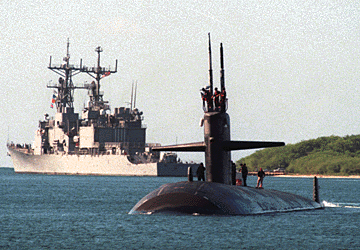
The USS Honolulu sails past another warship
leaving Pearl Harbor.
Cold War to hot water
With the Soviet threat gone,
By Gregg K. Kakesako
U.S. subs train to prowl shallow seas
to counter a Third World peril
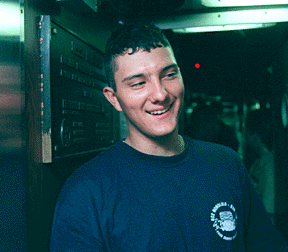
Star-BulletinWhen Army and Navy recruiters visited Matthew Thomas' Tucson high school a year ago, it didn't take him long to decide which military service to join. Thomas, the youngest member of the nuclear attack submarine USS Honolulu, said "the Navy had the best job to offer in the field of mechanics and that's what I always wanted to get in."
Since then Thomas, who enlisted when he was 17, said he hasn't seen anything in the Navy or the "Silent Service" that hasn't lived up to what was promised, like giving him training in the field of mechanics.
"I get homesick being away from home, but that's about it," said Thomas, who joined the crew of the Pearl Harbor-based sub in August.
By Craig T. Kojima, Star-Bulletin
Matthew Thomas is the boat's youngest crewmember.
Thomas' enthusiasm was reflected in the morale of the 140-man nuclear submarine as it ran through a series of drills recently 16 miles off the south shore of Oahu.As the deep-blue water threat of the Soviet navy -- which at the height of the Cold War peaked at 440 subs -- diminished with the fall of the Berlin Wall, the operational tempo of the U.S. fleet of attack and ballistic missile subs did not.
"We probably need our submarine fleet much more today than ever before," says Cmdr. Cecil D. Haney, skipper of the 360-foot Honolulu.
Capt. John Frederick Dohse, commander of the Pacific Fleet Third Submarine Squadron, said that during the Cold War there was only one threat -- the Soviet Union -- and the mission of a nuclear attack submarine was to sink Soviet submarines.
By Craig T. Kojima, Star-Bulletin
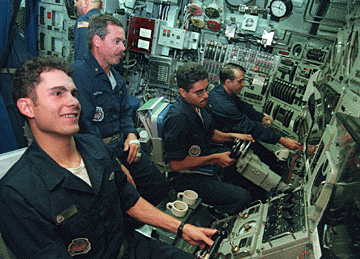
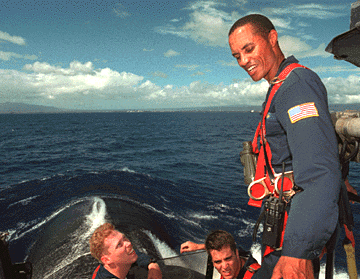
From left, Bruce Medlyn, Bobby Patton, Florentine Rojas,
and Brian Shaw during diving exercises.
"Today the submarine is the weapon of choice of many Third World countries," said Dohse, who commands eight of the 24 attack subs homeported at Pearl Harbor. "Forty-three countries now have diesel submarines, which is a great equalizer."With such smaller, diesel-powered subs, Third World countries could blockade key maritime shipping lanes, or attack tankers and cargo ships.
Although still in the anti-submarine warfare business, today's U.S. attack subs are also an integral part of the military's strike capabilities, since they deliver missiles to targets on land and can influence the outcome on the battlefield.
But the nation's submarine fleet is shrinking even as it is called upon to do more.
By Craig T. Kojima, Star-Bulletin
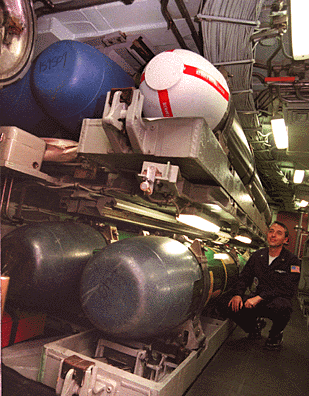
Chief Petty Officer Brian Shaw checks out
the torpedo room.
There are 30 nuclear-powered attack submarines in the Pacific: six at San Diego and 24 at Pearl Harbor. An additional 37 are stationed in the Atlantic. By the turn of the century there will be only 55 attack submarines in the Pacific and Atlantic commands, slipping to 50 by the year 2003.Rear Adm. Winford "Jerry" Ellis, Pacific Fleet submarine commander, said that will just force him "to do the best we can with what the country gives us. And we'll make sure we are doing the right sort of missions."
This can be done even with the smaller fleet, Ellis said, by better prioritizing what the subs are required to do.
By Craig T. Kojima, Star-Bulletin
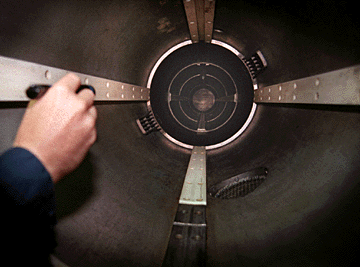
A view out the torpedo tube toward the hatch
which keeps seawater out.
"I think we will continue to support the same missions that we have previously, but perhaps with not the periodicity as we have in the past," he said.Today's submarine commander has to learn to fight in shallow waters closer to shore. There a ship's ability to dive is restricted, and sonar behaves differently.
This again requires better prioritizing a sub's training time to perfect the ability to operate "in these very constrained areas of water," Ellis said.
By Craig T. Kojima, Star-Bulletin
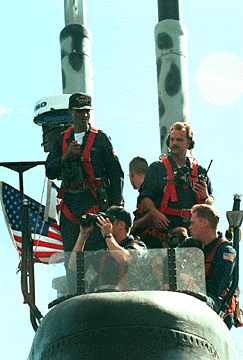
Atop the the sail, the crew navigates
the Pearl Harbor entry.
In addition, attack subs like the Pearl Harbor-based USS Olympia and the USS Bremerton now are routinely assigned to a carrier battle group, not only to protect the aircraft carrier but also to lend the additional firepower of their Tomahawk cruise missiles, as was done in the gulf war against Iraq.Even now the Olympia and Bremerton are on their way to the Persian Gulf as part of President Clinton's desire to beef up security in the Middle East.
By Craig T. Kojima, Star-Bulletin
Cmdr. Haney of the Honolulu gives commands for
entering Pearl Harbor, which is 2,000 yards away.
With unlimited endurance because of its nuclear propulsion plant, Ellis said submarines can offer the battle group commander "some unique contributions" since they can roam 200 to 300 miles ahead, searching out a particular choke point before the battle group moves through it.As for women on subs, Ellis said that question deals more with privacy than with women's capabilities. For example, a crew of 80 has to share three toilets.
"It's difficult on a submarine," said Ellis. "The spaces are very crowded. We should, and will, continue to assess integrating women into submarine crews in the future. Studies conducted so far indicate that now is not the time."
USS Honolulu Facts
The USS Honolulu is the third vessel to be named after the island city. The first was a cargo ship that earned a World War I Victory Medal and served from 1918 to 1919. The second USS Honolulu was a light cruiser and was in service from 1938 to 1946. During World War II, it sank one cruiser and four destroyers, shot down four planes and participated in eight South Pacific bombardments.The newest USS Honolulu is the 97th fast-attack nuclear submarine to be commissioned, and the 31st in the Los Angeles class. It was commissioned on July 6, 1985.
Speed: In excess of 25 knots (28.75 mph)