Barbers Point Harbor
expanding, but. . .
Dredging is just a start
By Peter Wagner
on what must be done to
catch up with shipping
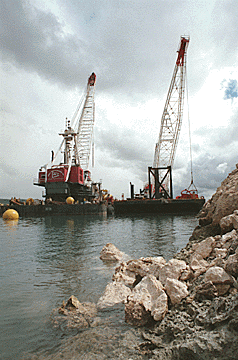
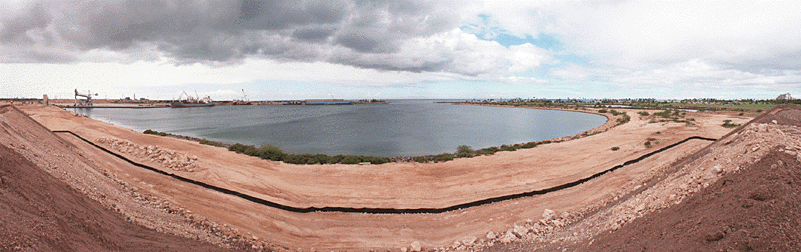
Star-BulletinA low range of limestone hills is rising on the Ewa Plain, framing a 15-acre excavation at Barbers Point Harbor. With the help of a huge crane barged from New Jersey, nearly 2 million cubic yards of material will be carved away to expand the harbor by early 1999. The $14 million project, by the state Department of Transportation, harbors division, will create an inlet 1,100 feet long by 600 feet wide and 38 feet deep.
Across the harbor, a small triangular corner will also be squared off, making room for tugboats.
But ship operators at Barbers Point are not impressed. Scaled back from an original 25 acres, the expansion comes without piers, docks or other port facilities.
"It's going to be a hole in the water where you can stick a fishing pole until the piers are installed," said Bill Thayer, president of Waldron Steamship Co., Ltd. and chairman of the Barbers Point Harbor Advisory Council. "We needed these facilities yesterday. We're burdened with ships waiting out in the channel."
The council, formed last year to improve communications with harbor planners, includes AES Hawaii, BHP Hawaii, Briggs Pacific Industries, Chevron Products, Texaco, Hawaiian Cement, Hawaii Metal Recycling, Marisco Ltd. and Waldron, a shipping agency representing most carriers using the harbor.
Thayer says the expansion project is a start. But it does little to ease problems in a harbor that is too small, too shallow and woefully short of piers.
By Dean Sensui, Star-Bulletin
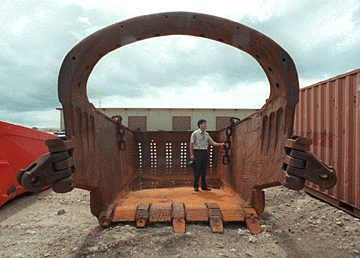
Project manager Marshall Ando of the Transportation
Department's Harbors Division is dwarfed by a bucket
used to dredge the new section of the harbor. The bucket
scoops up 14 cubic yards of material.
"We're maxed out and we have been for some time," Thayer said.State harbors officials agree the harbor needs work. They note that cargo ships are forced to wait offshore at a cost of up to $50,000 a day. But with demands at other boat harbors and commercial ports across the state, improvements must come one step at a time.
"We know his desires," said Harry Murakami, who works closely with Thayer. "But we have to work within what we can afford."
The division this year floated $56.3 million in revenue bonds, $35.5 million earmarked for projects including the harbor cutout.
Barbers Point Harbor is not seeing the type of traffic planners had in mind when they dug a 95-acre hole in the Ewa plain. There are no cranes, container yards or rocking fleets of fishing boats. Just "bulk" carriers tied up at two piers and maybe a barge across the harbor. A 30-acre container yard stands empty, as does a 36,000-square-foot shed.
But neither has the "second city" of Kapolei, the planned urban center the harbor was to serve, fully emerged. Until Kapolei becomes a major economic force, container cargo carriers say they'll stay at Sand Island.
Yet the infant port, opened in 1991, has quietly become the second-busiest in the state.
Operating with just two 800-foot piers and a smaller barge facility, Barbers Point last year handled more than 3 million tons of coal, scrap iron, fuel, cement and other bulk cargo. That was second only to Honolulu Harbor, with 8.5 million tons. Kahului Harbor was third with 2.3 million tons.
The activity, a 500 percent increase in volume over 1991, underscores state efforts to direct bulk cargo away from Honolulu Harbor to Barbers Point.
But Honolulu Harbor has 22,500 feet of pier space. Barbers Point operates with about 1,800. It's nowhere near enough to meet current demand, much less handle future growth, users say.
A Greek cargo ship recently waited offshore for three and a half days while scrap metal was being loaded at one of the piers. Such waiting can add $15,000 a day to costs, shipping companies say.
By Dean Sensui, Star-Bulletin
Cranes on barges are set up to dredge
the new section of the harbor.
The harbor also lacks adequate lighting for night operation, forcing ships to wait for daylight before entering or leaving -- another costly wait.And Barbers Point Harbor, originally designed for container ships, is too shallow at 38 feet for the coal and heavy bulk carriers now calling on the port. The ships are coming in "light" to avoid scraping bottom.
"I come in at a draft of 36 feet and I pay dead freight on the balance," said Doyle Hibler, of AES Hawaii. "That's 10,000 or 20,000 tons of cargo that's not on board. If I could come in at 40 feet I might be using one less ship per year."
He estimates the light loading adds about $170,000 a year to the company's shipping costs.
By Dean Sensui, Star-Bulletin
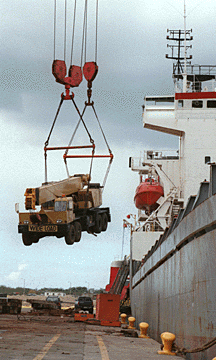
A crane is hoisted aboard a Greek freighter as
shipping continues amid the dredging.
The U.S. Army Corps of Engineers is studying a state proposal to dredge the harbor from its current depth of 38 feet to 45 feet.While the new cutout will initially go without piers -- 20-year plans call for 1,900 feet of piers -- the area will be occupied by a floating drydock now occupying prime space targeted for piers, Murakami said.
Immediate plans call for a 300-foot, $5.5 million pier to be built by 1999 to accommodate Aloha Cargo Transport, a Seattle-based barge carrier now operating at Fort Armstrong. Also on tap is a $1 million perimeter lighting system, to be installed next year. And plans are in the works for a fuel pier and other harbor modifications.
It's a tall order for the division, which operates only on fees and tariffs from shippers. Revenues last year totaled $27.6 million, about $1.6 million generated at Barbers Point.
"We're trying to approach it in a businesslike manner," said Murakami. "We have other requirements in other ports for port facilities. It's all a matter of budgeting."