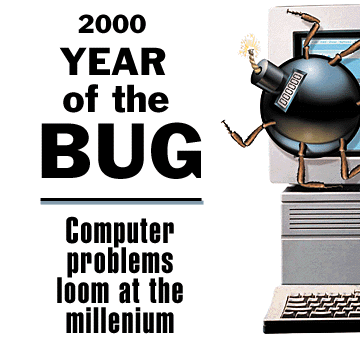
Illustration by Kevin Hand, Chicago Tribune
Hawaii is staring at a time bomb.
By Peter Wagner
Fixing it is an enormous, costly job, and
time is short. Here's what the state is doing.
Star-BulletinIt's a small thing, really. Just a little bug in the system. But don't get caught with your computer down when the "millennium bug" hits in the wee hours of Saturday, Jan. 1, 2000. Nobody knows what will happen, but experts agree vast networks of electronic information will be in jeopardy if the bug isn't killed in the next 27 months.
We're talking about bank accounts, investments, paychecks, mortgages, prescriptions, elevators, traffic lights -- anything tied to a computer or microchip.
"It's kind of a scary problem," said Dennis Yuisugi, a branch manager at the state Information and Communication Services Division.
The division oversees 8,300 computer programs tracking tax records, payrolls, invoices and a host of other sensitive applications -- about half of them threatened by the bug.
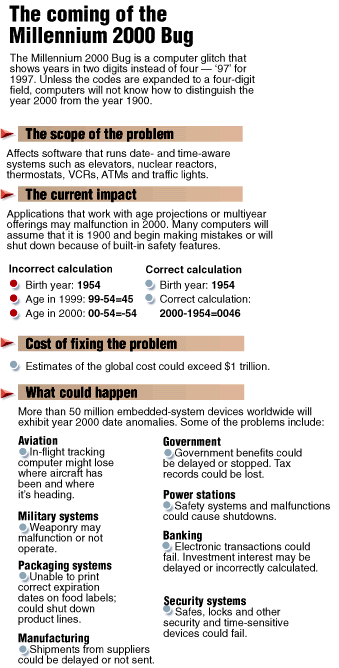
But that's just a peek at this monumentally expensive problem. Estimates go as high as $1.5 trillion worldwide to fix millions of aging software applications, replace systems, pay legal judgments over equipment or lost business, and other expenses.
All this over a tiny glitch left decades ago by programmers trying to save space in a computer's memory.
The "bug" is a widely used notation in programming codes that puts yearly dates into a two-digit field -- "97" for 1997. The format won't allow computers to correctly process dates after Dec. 31, 1999. And unless the codes are fixed or systems replaced by the year 2000, computers could crash or go haywire.
According to the Information Technology Association of America, some $150 billion to $300 billion will be spent in the United States -- $15 billion in tax dollars -- to head off the problem. The Office of Management and Budget recently estimated costs to federal agencies -- including the military -- at about $3.8 billion.
In Hawaii, state and county agencies are facing costs of more than $40 million -- $35 million for
a new system in the tax department, $4 million among state agencies and $2 million among the four counties. Figures are preliminary and don't include undetermined expenses at the University of Hawaii and state Department of Education.
"It's an enormous job," said a worried Richard Asato, who heads systems at the DOE. "I need help. I need resources."
Asato, who is trying to come up with a budget request, said new software and other tools are discussed at seminars across the country. But his staff has been unable to attend because of the state's tight budget.
"We get the news secondhand through the Internet and periodicals," he said. "You get a condensed version of the information and sometimes not enough of it."
Buy or fix?
While some are buying new systems, others are opting to fix what they have. It isn't easy.Changing two-digit date fields in old programming codes is a tedious line-by-line task that few programmers have the skills to do. That's because the predominant codes, written in a 30-year-old language called COBOL -- Common Business-Oriented Language -- are becoming a lost art. Students coming out of computer schools today are rarely familiar with such dated programming languages.
At the city's Department of Data Systems, director James Remedios is overseeing a two-year, $1.4 million project that includes de-bugging 4 million lines of codes. The wilting, 24,000-hour task will tie up his staff for months.
"It's just so damn much," said Remedios. "It's so large."
He may have to bring some programmers out of retirement, if he can find them. But can the city afford them? Some mainland companies reportely are paying up to $200 an hour for scarce COBOL programmers. At current rates of about $1.50 per line, it would cost the city about $6 million to contract out those 4 million lines of COBOL.
The situation is giving many who operate older "legacy" systems a reason to scrap them for something new.
The case for 'new'
At the state Department of Taxation -- with the largest database in the state -- plans are to replace an old mainframe system with something not only bug-free but also able to increase collections. The estimated cost: $30 million to $40 million."My thought was, if we had to spend $5 million to $10 million fixing the year 2000 problem and still not have a good system, why not have the best?" said Tax Director Ray Kamikawa.
Other large data processors are following suit. Pacific Century Financial Corp., parent of Bank of Hawaii, has allocated $30 million for an organizationwide upgrade. First Hawaiian Bank is putting $10 million into a new system. Hawaii Medical Service Association will spend about $6 million.
Analysts say the United States, Canada, Australia and Britain are leading efforts to fix the problem, with Western Europe and Asia trailing. But while many banks, hospitals and other large institutions are spending millions of dollars here and across the country, efforts are scattered.
The time is drawing near
Recent surveys show just one in five companies in the United States has a clear plan to deal with 2000. And less than half of state governments -- Hawaii not among them -- have put plans into action. With the year 2000 just 27 months away, experts say, time is drawing near."Most companies only have a year and a half to come to grips with this," said Howard Rubin, chairman of computer sciences at Hunter College in New York City and an expert on the problem. "It does not look good."
Rubin last month surveyed 128 top U.S. corporations, finding just 24 percent of them had a detailed plan to fix computers. The figure is up from 15 percent last year.
Rubin notes the deadline is nearer than it looks because many systems will need up to a year for testing.
First Hawaiian Bank began looking at its problem in 1995. Two years later, the bank is still a year from testing its $10 million investment.
"We looked at three areas," said Gary Caulfield, executive vice president of the bank's information group. "Internal computer systems, physical systems like elevators, vaults, and clocks, and the integration between our computers and systems outside."
Those "outside" systems -- scores of businesses and clients the bank interacts with via computer -- are a major concern.
At Bank of Hawaii, whose computers have been undergoing a major upgrade, a support group was recently formed to keep in touch with other companies.
"All of us are in some way dependent on other businesses for critical products or services," said Bill Valuet, Year 2000 Project Director at Bank of Hawaii. "Even when we do our job right to become year 2000 compliant in time, we still assume a degree of risk if our business clients and vendors fail to address their problems."
The federal government, meanwhile, continues to lag with its problem, recently estimated at $3.8 billion. The Clinton administration last week banned the agriculture, transportation and education departments and the Agency for International Development from buying new computers until they've dealt with the bug.
One reason for the foot-dragging, some say, could be the high cost of fixing something that doesn't pay visible dividends.
"It's a bitter pill to swallow," said the city's Remedios. "I'm spending $1.4 million and all I'm getting is a system that will allow me to continue work tomorrow."
According to the National Association of Information Resource Executives, Hawaii is among 27 states that have yet to implement year 2000 plans. California, with projected costs between $80 million and $100 million, is among 23 states moving toward final stages. Massachusetts, New Hampshire, Oklahoma and Vermont trail all states, the association said.
The local picture
At the state Information and Communication Services Division, which oversees 80 percent of computers in the executive branch, administrator Tom Yamashiro is coordinating statewide plans. But with five systems operating independently among state agencies, it's a loose arrangement: the legislative and judicial branches are handling their own computer problems, as are the University of Hawaii and the Department of Education.Yamashiro is confident the most critical systems will be fixed in time. But the division has been sapped in recent years by budget cuts -- more than 150 positions have been lost in the past five years -- and could be hard-pressed to meet the deadline.
The picture worries Remedios, whose computers, like the other counties', are tied to the state's system.
"We're just crossing our fingers they've got their act under control," he said. "If they don't, there's nothing we can do."
Locally, some consulting and computer services firms have seen a recent flurry of activity.
Phil Bossert, president of Strategic Information Solutions, has seen a 20 percent jump in business in the past year.
"It seems like there's a lot of fear out there," he said.
Gartner Group, a Stamford, Conn.-based consulting firm, predicts that big companies making year 2000 adjustments will swallow up smaller ones that are lagging.
"The small companies are going to get much weaker and the large companies are going to get much larger," said Lou Marcoccio, a Gartner Group analyst.
Art Tokin, managing partner at accounting and consulting firm Coopers & Lybrand Hawaii, advises clients to get a leg up on the competition by taking care of the problem early.
"There are projections that only half of companies are going to adequately address this problem by the year 2000," he said. "If that is even close to being true, it's interesting from a competitive standpoint."
Meanwhile, the city's data chief, Remedios, quietly frets.
"Deep in my heart I think we have it under control," he said. "But somewhere in the back of my mind I'm afraid somebody may have forgotten a nickel application that's going to bring the whole thing down."
Fixing one computer system won't solve the problem. Analysts say unless all interconnected businesses and systems are up to date, transactions in the year 2000 are bound to fail. All systems must be
fixed to end problemGary Caulfield, executive vice president of First Hawaiian Bank's information management group, illustrates the looming problem:
"Say you're a customer in a retail store. Your credit card has to be year-2000 compliant. The merchant's computer must also be compliant. It then goes through phone lines, so the phone system has to be OK. It reaches First Hawaiian Bank computers, and they have to be working. And if the card is from outside our customer base, it has to be verified on the mainland, so the mainland phone lines have to be compliant."
Peter Wagner, Star-Bulletin
Support group tackles
By Peter Wagner
bug problem together
Star-BulletinIt's a tight little group of about 20 that meets in Honolulu on the first Tuesday of each month. Call it a support group, where top business leaders and government officials hold hands to help each other through a tough situation. The Honolulu Year 2000 Users Group, set up early this year by Bank of Hawaii, is a forum for those trying to deal with the "millennium bug" computer problem.
"All of our approaches and the roadblocks are pretty much the same," said Nancy Downes, communications administrator for the group.
A recent topic discussed was the certification of software vendors to make sure their new products will work in the year 2000.
Downes said businesses that don't come to terms with the problem soon could pay a price.
"I think the ones who are really going to suffer are those who underestimate the impact and deny the reality of the situation."
"There's no way of knowing what's going to happen, but the surest way to make sure you're OK is to plan well and make sure you have the resources you need."
The group is open to new members. Call 537-8381 to learn more.
Meanwhile, Bank of Hawaii has also set up a community hotline where citizens can raise questions or concerns. Call 538-4978.
Make sure your system
By Peter Wagner
passes Year-2000 test
Star-BulletinThe big problem is with big computers operated by big companies and organizations. That's also where the big money is: Fortune 500 companies are likely to spend $50 million to $100 million apiece on new equipment, consulting and other services in the next several years. But what about those little desktop computers in people's homes or small businesses?
A recent test of 500 personal computers made this year found almost half of them -- 235 -- failed the year-2000 test. The test, done by a consulting company called Greenwich Mean Time, also found 93 percent of "BIOS" chips made before 1997 were unable to adjust. BIOS -- Basic In Out System -- is a program that allows a computer's operating system to talk to its internal clock.
Experts advise consumers to check with computer and software vendors to make sure your equipment is ready for the year 2000. They also warn that many new products are not 2000 "compliant." Most susceptible to problems are date-sensitive software, such as accounting spreadsheets.
"Many people that shut off their personal computers on Dec. 31, 1999, could be surprised when they turn them on the next day to find their computer's clock set at Jan. 4, 1980 -- another strange error that experts predict will occur because of the way internal clocks in computers handle the rollover to a new year," said Peter de Jager, a leading authority on the year-2000 problem.
But the worry factor seems low among PC owners, particularly small isle businesses where meeting payrolls is a more immediate concern. And rapid change in the computer industry means today's computers will likely be obsolete in two years anyway, some say.