
State’s crime rate
continues to decline
A double-digit drop is expected
By Rod Ohira
for the first half of this year
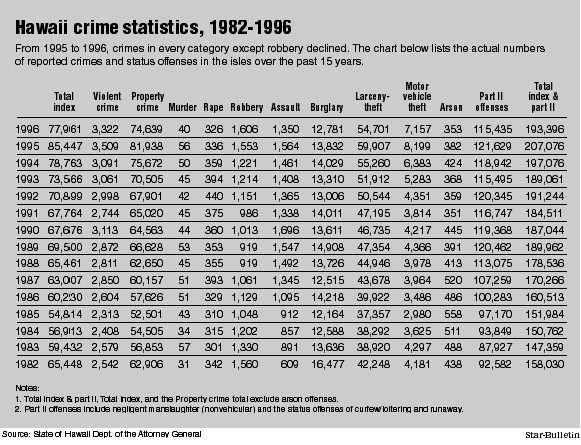
Star-BulletinThe State of Hawaii's crime rate continues to drop in 1997, after falling 9 percent last year. "Based on preliminary data for the first half of 1997, I feel comfortable in predicting that the current trend will continue," said Paul Perrone, chief of the Research and Statistics Branch of the state Attorney General's Crime Prevention and Justice Assistance Division.
"I'm almost certain there'll be a double-digit decrease for the first half of the year," he added.
The "Crime in Hawaii 1996" report compiled by Perrone's office and released yesterday shows an across-the-board decrease for all reported serious offenses except robbery.
"While the 1996 figures show a promising improvement for Hawaii, they still indicate a need for serious concern and continued effort to reduce crime further," Attorney General Margery Bronster said.
The number of serious crimes reported to police decreased in all counties except Kauai.
Reverses a trend
The statewide decrease in reported crime reverses a trend in which the rate had increased during each of the previous four years."Crime has been decreasing nationally the last five years in a row while it was going up four years in a row in Hawaii," Perrone said. "Hawaii is usually behind the trend.
"Crime figures are cyclical and there's no one thing or 20 things you can point out to explain it," he added.
Perrone, however, notes that robbery, aggravated assault and larceny-theft have the greatest impact on Hawaii's numbers.
"Violent crimes are driven by robbery and aggravated assault and property crimes by larceny-theft," he said. "And property crimes drive the total index because there are more of them."
Larceny-theft (54,701 cases) accounted for 45.6 percent of all property crimes and property taken was valued at $35.3 million. One-third of the cases involved theft from motor vehicles.
Of the total, 41,915 cases of larceny-theft were reported in Honolulu involving property valued at $28.8 million.
Larceny-theft includes offenses such as pocket picking (390 cases), purse snatching (382), shoplifting (7,511), motor vehicle parts (5,808) and theft from buildings (7,495).
Big Isle’s 1996
By Rod Thompson
crime rate lowest
Star-BulletinHILO -- Hawaii County had the lowest crime rate in the state last year, police said. Statistics compiled by the state attorney general's office also show criminal activity on the Big Island is at its lowest point since 1987, they said.
"The public has gotten the unfortunate impression that crime is running rampant," a statement from Chief Wayne Carvalho's office said. "I think the statistics show we have been on the right track in putting more officers on our streets and highways, expanding our community policing efforts and involving the community more in the fight against crime."
The violent crime rate decreased 20 percent from 1995 to 1996, the chief's statement said. The overall rate of "index" crimes (violent and serious property offenses) dropped 3.1 percent, it said.
One black mark on the record was a 10 percent increase in crimes, mostly property offenses, in the Hilo area.
In terms of index crimes per 1,000 population, Hawaii County ranked lowest of the four counties with 49.5 offenses, followed by Kauai with 52.8, and Maui and Honolulu tied for third place with 68.9.
The attorney general's report also said Hawaii as a whole ranks 42nd in the nation in violent crimes, but third in the nation in property crimes.
Youth arrests up;
By Rod Ohira
figures deceiving
Star-BulletinA 26 percent increase in violent juvenile crime arrests last year presents a distorted picture of the problem in Hawaii without proper interpretation, says a state statistician. "The perception is absolutely worse than the reality," said Paul Perrone, chief statistician for the state Attorney General's Crime Prevention and Justice Assistance Division, which compiles the annual "Crime in Hawaii" report.
"This is not to say that it's not a problem and we shouldn't be concerned, but it's not like we have kids running wild in the streets," he added. "What we have is a handful of kids who are more violent than their counterparts and the media's focus is so much on the exception that the exception becomes the typical."
According to the 1996 "Crime in Hawaii" report released yesterday, there were 464 arrests for violent juvenile crimes in 1996, compared with 368 in 1995.
Robbery accounts for 299 of the 464 arrests, which is a 15-year high.
"Statistics are tools and the numbers don't always speak for themselves," Perrone said. "Interpreting statistics can be like peeling an onion, there are different layers.
"Almost the entire 1996 increase is accounted for by arrests for robberies," he added. "It's not an across-the-board increase but if people only see that violent crime arrests have increased without digging a little deeper, the perception is that all violent crime is up."
Arrest figures represent the number of counts a suspect is booked for. When one suspect is booked for several robbery offenses, each count is considered an arrest.
"The number of arrests does not necessarily mean the number of kids arrested," Perrone said.
Robbery statistics also do not reflect a degree of seriousness, Perrone noted.
"I'd be very interested to see the nature of the robberies, whether they are muggings on the streets or the age-old bullying of lunch money from other students in school," Perrone added. "Ten years ago, extorting lunch money used to be a disciplinary problem handled by the schools but now when the exact same thing happens, police are called and the kid is arrested."
State juvenile crime statistics are divided into two categories: Part I lists the eight most serious crimes - murder, forcible rape, robbery, aggravated assault, burglary, larceny-theft, motor vehicle theft and arson - while Part II deals with all other offenses.
Of the 17,516 juvenile arrests last year, 13,026 were for Part II offenses, of which over 5,000 were runaways. Larceny-theft accounted for 3,064 of 4,490 total arrests for violent and property crimes.
National juvenile arrests have increased 30 percent between 1986 and 1995, but Hawaii has experienced a 9 percent rise during the same period, Perrone said.
"However, when a 91 percent increase in arrests for noncriminal status offenses such as running away and curfew violation is excluded, Hawaii actually experienced an 11 percent decrease in juvenile arrests from 1987 to 1996," Perrone said.
"Not only are status offenses typically thought of as very minor offenses, it is also critical to note that the increase in status offense arrests in Hawaii has largely been the product of increasingly enhanced police effort to make these arrests." The increased arrest effort is geared toward reaching status offenders early and getting them into intervention programs, Perrone said.
The number of juvenile arrests for serious violent offenses is so low each year in Hawaii that an increase or decrease of only a few dozen compared to any other year can translate into a percentage change that appears far more dramatic than it actually is, says Perrone.
"For instance, a drop of only 50 juvenile arrests for violent crimes in 1986 resulted in a one-year decrease of 21 percent." He said such arrests in Hawaii have been stable or declining for the last 10 years.
The following is a breakdown by counties: Where crimes happen
Honolulu With 73.6 percent of the state's population, Oahu had 77 percent of the state's index crimes, 82.7 percent of violent crimes and 76.8 percent of property crimes.
Honolulu's numbers, however, dropped 11 percent with decreases in six of eight categories - murder, assault, burglary, larceny-theft, motor vehicle theft and arson. There were 222 rapes reported, five more than in 1995, and 1,421 robberies, up 50.
