

It comes in a can, has a variety of aromas that range from pancake batter to industrial effluent, expands to several times its size, sticks to anything and everything, resists water, squeezes out air and hasn't yet been disassociated from Gerard Jervis. It's polyurethane foam, a chemical brew that, when mixed and exposed to air and water vapor, catalyzes and creates carbon dioxide. This causes the mix to bubble and expand like shaving cream.
There are a variety of brands with names like Great Stuff and Fast Foam and DAPtex. They all come in cans that look like your standard Krylon spray can with an odd hose attachment on top. They cost somewhere between $5 and $8 and create one to two gallons of foam.
The foam is dispensed upside down so that the gas propellants can push the material out the nozzle, also like shaving cream.
Cool.
Why should we care?
The stuff is terrific at only one thing -- filling voids. Fill the cracks around doors or windows, and it will expand and make it airtight and watertight. Fill the space around wall outlets and you won't be air-conditioning the inside of the wall. Fill the space around dryer vents or recessed lighting and heat won't be transmitted as easily to the rest of the house. Fill the gap around the pipe under the sink where it goes into the wall, and bugs and other varmints can't get in, or out. Fill holes in trees so they won't get water rot. Fill gaps in masonry so rock walls won't fall down. Fill the voids in your car body to make your car quieter. Fill the top edge of a sawhorse to make it cushioned. Fill the mouths of those Christmas-tree phone salesmen so they won't bother you during "Frasier."
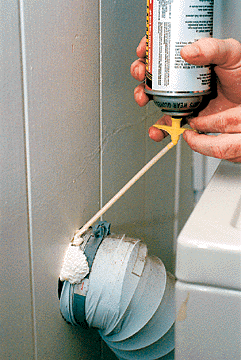
OK, maybe not the last one, no matter how tempting. But you get the idea.The information here on how to use the stuff was gleaned from various direction packets and labels, and from web sites devoted to these products.
Safety first: ALL these foams recommend that you wear goggles or glasses and gloves. Except for Teflon, silicone, polyethylene or Ronald Reagan, the foam sticks to anything. We're serious. It clings like an old sweetheart.
While it's still setting up, it can be removed with acetone or a similar strong solvent, but after it catalyzes, forget it. It's bonded to your skin.
But don't worry about it. It'll wear off in a few days. Probably.
And keep the pets away!
The propellants are somewhat flammable as well. No open flame while using foam.
Almost all cans are used upside down to help the foam flow out a long polyethylene nozzle. Shake the can, then turn it over and depress the rocker handles on either side of the nozzle base. The tube will sputter, then foam will flow out like cake icing. Practice on a newspaper, preferably the morning paper.
Release the triggers before you're done foaming. Foam continues to flow for a couple of seconds. The foam will expand for an hour or so and then skin over. The catalyst is water vapor in the air, so it'll harden from the outside in. It takes about eight hours to harden to the texture of a dry kitchen sponge. To make it harden faster, spritz water around the site to be filled before using the foam.
Foams are rated by their expansion properties. "Minimal" expands about 100 percent, others can expand up to 300 percent. Keep that in mind when squirting into a void: don't fill it all the way up. The tumescent foam will rise to the occasion, and then some.
The gas created by the foam is self-generated, so it'll continue to bubble and grow even if the air supply is cut off. The foam is fairly benign if it has an escape route, but if it's trapped, it'll generate tremendous pressure, thousands of pounds worth. So don't squirt it into a wall and then nail a board over it. It'll make your wall blow out if there's no pressure release.
The foam sticks to everything but ice, so don't try to shape it, except with ice cubes. You can make a crude ice knife or spatula by molding one out of aluminum foil and freezing water in it.
DAP's new "DAPtex" foam, just now reaching the market, has a latex base, which means it can be washed off with soap and water before it sets.
After the foam expands and hardens, it can be trimmed off flush with a utility knife, sanded, filled and painted.
Sticking a wet pipe cleaner in the nozzle will make the foam harden around it, sealing the foam still in the can for later use. Yank the pipe cleaner out when you want to do more foaming. A screw or a nail also works.
How much do you need? Chances are, one can will last you a while, because it's the equivalent of 15 tubes of caulk. And unlike caulk, it has insulating properties. Foam, sweet foam.

