By Ken Sakamoto, Star-Bulletin
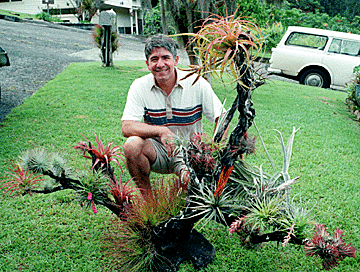
Peter De Mello mounted several tillandsias
in an arrangement on a tree.
COLUMBUS may or may not have discovered America, but he did discover bromeliads. The plants are native to South and Central America and as far north as southeastern Virginia. They were introduced to the Western world by Christopher Columbus following his second voyage to the New World in 1493, when he brought back pineapple plants he found in the West Indies. Tillandsia thrives
in tough terrainPineapples, which are bromeliads, became the rage in Spain and by the early 1500s were cultivated throughout the warmer parts of the world.
There are about 2,000 species in the bromeliad family (compared to 15,000 in the orchid family), and half of those are tillandsias. And it's tillandsias that moved from a hobby to a second career for Peter De Mello, a full-time airplane mechanic and a part-time grower with nurseries in upper Nuuanu and at Kona.
"My wife and I started this about 11 years ago," De Mello said. "We were growing orchids, and it seemed like a good idea to grow tillandsia in the summer months to shade the orchids." Now they have more tillandsias than orchids, and tillandsias ask a lot less of the grower than orchids do.
By Ken Sakamoto, Star-Bulletin
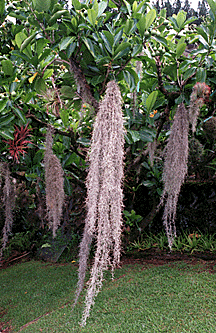
Most tillandsias are air plants, feeding
through their leaves rather than roots.
Tillandsias and other bromeliads have adapted themselves to live in the most hostile and stressful environments, on barren rocks or as air plants in the canopy of trees exposed to extreme conditions of climate. So if the plant can cling to a rock or a branch in intense sun or driving rain, it will be grateful and happy on your lanai.
Nearly all tillandsias are air plants, which means that they take in moisture and nutrients through their leaves, rather than their roots as most plants do. They have a very small root system, and its purpose is to support the plant rather than to feed it.
Tillandsias that grow in dry areas have gray, green or reddish foliage covered with a silvery finish that growers sometimes call "star dust."
Tillandsias from cooler areas that live in the shade of the rain forest have softer leaves of a deeper green. When choosing plants for your garden, try to match the leaf structure to your own climate. The silver-gray tillandsias grow best in full or at least partial sun with good air circulation. The softer leaf varieties will burn if exposed to full sun and require filtered light at all times. They all flower, briefly and modestly, and are grown for their foliage rather than their blossoms, De Mello said.
De Mello lives close to a forest, on property bordered by enormous Norfolk Island pines hosting mammoth monstera vines. "I grew up in this house," he said. "These woods were a wonderful place for kids to play."
They are also a great habitat for tillandsias. De Mello grows some of his on trees already established around his house, but others are stuck onto bark, cork or coffee tree stumps from Kona.
This provides the maximum of air circulation that is essential to the growth of the plants. According to a publication of the Bromeliad Society of Australia, the gray leafed tillandsias are the ones most easily mounted. They advise applying a silicone adhesive to cork or a similarly soft material. It should be a light application so that any root growth is not buried in the glue.
Make sure you know exactly how you want the plant mounted before applying the glue, and you may need to cut a groove into the cork for a secure anchor. It is better to apply the glue to the side of the plant rather than the base, leaving room for roots to fasten to the planting material.
When fixing larger tillandsias to less flexible material like driftwood or light branches, the suggestion is to use plastic covered wire to secure them. Be sure the wire is covered, because contact with such metals as zinc or copper can kill the plant.
Most tillandsias will produce keiki as they mature. The offsets should be removed when they reach about one-third the size of the parent plant, and the callus at the break should be allowed to dry and harden for a few days before replanting. It should then be mounted separately, and it will take about six months for it to grow roots.
De Mello propagates most of his plants from seed. They are started on cork or tree fern bark, and look like fuzz in the beginning. It can take six months to four years before the seeds have grown into plants about 2 inches high, when they can then be transplanted into small individual pots.
As a general rule, these plants can tolerate hot, dry conditions far better than they can those that are cold and wet. Don't overwater tillandsias or their roots will rot. If you do water, choose a time when the sun is not directly on the plant, and water only if the plant is indoors or the weather has been very dry. "When tillandsias need water, the leaves curl and get soft and spongy. Otherwise they are crisp like cactus, filled up with water," he said.
Tillandsias can also be grown in pots, in a mix of sphagnum moss and hapu'u but never a regular potting mix. Good drainage is essential for the root system. The Australian growers recommend clay pots because they dry out faster than plastic pots, and the planting material should be allowed to dry out between waterings.
De Mello fertilizes his plants four times a year, using a water-soluble cactus or orchid fertilizer at one-quarter of the strength recommended on the package. Other growers don't fertilize at all since tillandsias in their natural environment exist on very little nutrients. They absorb carbon dioxide, ammonia and dissolved organic material from the atmosphere, and that's it. If you do fertilize, go lightly.
For beginners, De Mello recommends Tillandsia cyanea, and Tillandsia ionantha as easy to grow. Cynea grows in a tight rosette with many fine, grass-like leaves that grow to 14 inches in length. The blossom has a flat fan-shaped head from which dark blue flowers emerge. Ionantha grows in clumps in small rosettes with 2-inch leaves covered in a silver gray.
De Mello is a wholesaler, but his plants can be found in most of the major garden shops on the island. He will be at the Foster Garden plant sale tomorrow from 9 a.m. to 4 p.m. at the garden, 50 N. Vineyard St. at Nuuanu Avenue. He will answer questions, but says to remember that tillandsias are easy to grow. They're grateful.
Gardening Calendar in Do It Electric!
Send queries along with name and phone number to:
Evergreen by Lois Taylor, Honolulu Star-Bulletin, P.O. Box 3080, Honolulu 96802.
Or send e-mail to features@starbulletin.com.
Please be sure to include a phone number.
Evergreen by Lois Taylor is a regular Friday feature of the
Honolulu Star-Bulletin. © 1996 All rights reserved.