By Ken Sakamoto, Star-Bulletin
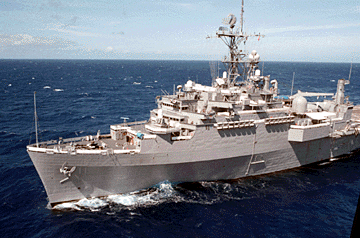
The USS Coronado, Third Fleet command ship.
At the center
of ‘Ring of Fire’
The USS Coronado is the
By Gregg K. Kakesako
brain center of some of the Navy's most
sophisticated operations
Star-BulletinWarfare techniques being tested by the Navy's 3rd Fleet seem to be straight out of a Tom Clancy techno-novel. Last month, for example, Navy SEALS sent a digitized photo of a target bridge via satellite and over the Internet to an F-18 Hornet jet fighter, enabling the pilot to see a picture of the target, fly to it and take it out.
The test was conducted during the Navy's Fleet Battle Experiment Bravo, the second in a series of four computer-generated exercises designed to test warfare fighting concepts and capabilities for the 21st century.
Experiment Bravo involved California-based Marines training on Oahu last week and will include the nuclear aircraft carrier USS Nimitz.
Tests will be conducted during the next several months aboard the newly renovated USS Coronado -- the command and control ship of the San Diego-based Third Fleet.
The Coronado is equipped with the latest computer, satellite communications and sensor systems.
"I am absolutely convinced that we have .... built a very reliable and maintainable command and control ship," said Vice Adm. Herb Browne, 3rd Fleet commander. "But the only way we can really tell is to stress it in order to show the deployability of command ships."
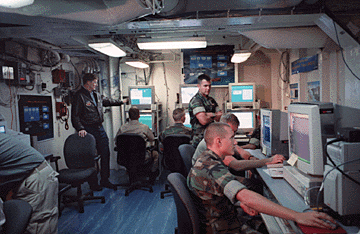
The Coronado, with its new combat control systems looking more like modern office suites than a Navy battle center, will be in Hawaiian waters through Friday as part of its 10-week Western Pacific deployment.
The Navy is trying to better integrate tactical air strike missions with its growing arsenal of missiles, and to better utilize the intelligence its weapons get from satellites and other sophisticated equipment such as the Global Positioning System, or GPS.
The experiment has two parts. The first phase kicked off last week when Camp Pendleton Marines stormed ashore at Bellows Air Force Station to begin training at Makua Valley, Kahuku and Schofield Barracks.
By Ken Sakamoto, Star-Bulletin
This is part of the satellite communications
equipment aboard the Coronado.
Part of the "Ring of Fire" experiment involved the USS Coronado responding to calls for simulated fire support from Marines of the 13th Marine Expeditionary Unit training on Oahu. The "Ring of Fire" concept, devised by Lt. Cmdr. Ross Mitchell, uses computers to help speed the process of deciding whether to launch a missile from a Navy ship or to drop bombs from an aircraft."In the old days it was one ship talking to one guy on the beach who requested fire support," Mitchell said.
That's no longer true, since weapons officers have at their disposal missiles, aircraft and bombs and heavy guns.
Using a Windows-based operating platform, Mitchell devised a system that tells military planners which ships or aircraft are in the best position to respond to a request for help. The system also keeps track of missile inventory on individual ships and aircraft.
That's where "Quantum Leap" came into focus last month.
During the demonstration, Navy SEALS on the ground in China Lake in Southern California photographed a digital image of a bridge and transmitted it via satellite to the Quantum Leap Laboratory at the Coronado Naval Amphibious Base. There the image was placed on a classified Web page on a secret Internet, said Lt. Cmdr. Dave Summer, coordinator of Experiment Bravo.
Personnel aboard the USS Coronado downloaded the image from the Web page and transmitted it to the cockpit of the F-18 Hornet.
Several images were transmitted from the Coronado to give the pilot different views of the target, including the position of the SEALS on the ground.
Various enhanced image sizes were produced, ranging from a 10-mile-by-10-mile box of the target area to a half-mile-by-half-mile strike scene.
"Following the F-18 strike, the SEALS shot another image of the damaged bridge to assist in the BDA (bomb damage assessment)," Summer said.
In the past, SEALS would have stayed in the battle area to help "paint" the target with a laser beam that would guide the missile or bomb.
The second part of Experiment Bravo, called "Silent Fury," is aimed at meeting the challenge posed by the latest generation of satellite-guided munitions.
"We will be answering the question of how do we get accurate aim points quickly," said Lt. Steve Clarke, 3rd Fleet planning officer. "And in sufficient volume to use these weapons because they will hit exactly where we tell them to. So we need to be very accurate."
Mitchell said Experiment Bravo also will test a new Tomahawk, which gained fame during the gulf war for its long-range attacks.
"There's a new tactical missile that goes out and just loiters around the battle zone until it is told where to go," he said.
Another new Tomahawk system allows ships to generate routes rather than having to rely on land-based missile support centers.