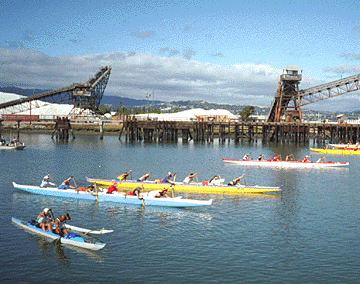
By Greg Ambrose, Star-Bulletin
Teams from the Northern California Outrigger Canoe Association
paddled earlier this month in the Kilohana Outrigger Race.
Paddling
by the Bay
Outrigger canoe racing
By Greg Ambrose
is enjoying tremendous growth
in San Francisco and N. California
Star-BulletinBEV Dyc had to drag her husband to Hawaii on vacation a few decades ago. Now Dave Dyc returns to the islands several times a year to paddle for a local outrigger canoe hui on the Big Island, as well as compete in the Molokai race. "He has become a wannabe Hawaiian," Bev says with an indulgent smile.
Judging from the way the Polynesian sport of outrigger canoe paddling has expanded in popularity, there are thousands of wannabe Hawaiians in California.
And there are just as many transplanted islanders who have embraced paddling to maintain their ties to Hawaii.
Thelma and Shaka Madali both graduated from Farrington High School, then moved to the Bay Area seeking better opportunities. They never paddled outrigger when they lived in Hawaii, but picked it up on the mainland in the '70s when their kids were young and there were only four clubs in Northern California.
Thelma's daughter is 30 now and still paddles, following the good example of her parents, who paddle with Dyc in the Pupu O' Hawaii canoe club in Santa Cruz.
"The exercise has kept us active and fit for life," Thelma says. "And paddling helps pass on our heritage to people who have never done this or seen this.
"To join a club or paddle an outrigger amazes them, people that don't know a thing about Hawaiiana."
There are now 15 clubs in the Northern California Outrigger Canoe Association, covering an area from Marin south to Morro Bay and east to Sacramento. They include names such as Ono Kapakai, Ke Anuenue and Kamali'i O Ke Kai, guaranteed to make islanders homesick.
Between April and October the clubs hold 12 long-distance competitions and seven sprint-paddling events, and many teams head to Southern California to compete.
They are especially proud to have worked with the Pacific Islanders Cultural Association in 1995 to invite the traditional Hawaiian sailing canoe Hokule'a to Chrissy Field in San Francisco Bay to coincide with the paddling competition. The event attracted thousands of Hawaii expatriates and thousands of others who got their first eye-opening dose of Polynesian partying.
There is a tremendous ebb and flow of paddlers between California and Hawaii, until it becomes confusing to tell who paddles for which team. Anona Napoleon of Palolo Valley has done some serious stroking on both sides of the Pacific Ocean.
She has paddled for Pupu O' Hawaii's wahine team while vacationing on the mainland, and helped them win at Lake Tahoe and again at Catalina Island last year. This year she is really going to the mainland for fun, to cheer for husband Nappy Napoleon and his Anuenue team as they and four other Hawaii canoe clubs compete in Lake Tahoe over the Labor Day weekend, and again at Catalina Island a few days later.
Back in Hawaii, Anona's canoe club loaned the Pupu O' Hawaii team its canoe for the Molokai Ho'e. The team took second place. "The first time I started paddling in 1956, my steersman was Keala Stibbard. Now she has founded Pupu O' Hawaii. I have come full circle," Anona says. "She was my steersman, and now she has been my coach."
Shaka Madali also paddles the Molokai race every year, and he and Thelma come back home and try to compete with their friends as often as they can.
One of the main goals of the Northern California canoe association is to "teach, train, instruct and expose children, men and women in the ancient arts, crafts and stories of Hawaiian canoeing." The city of Santa Cruz will enjoy the full Hawaiian experience Friday through Sunday during the Aloha Outrigger Races and Polynesian Festival.
Besides the canoe racing the festivities include a parade of canoes from Santa Cruz Lighthouse to the wharf, a bonfire, hula dancing and canoe blessings.
Traditional and contemporary Hawaiian music by such performers as Cyril Pahinui, Randy Lorenzo and Ohe'o, as well as hula dancing and shave ice will keep people entertained between races.
Dave Dyc, 59, is convinced that paddling not only improved his life, it actually saved it. He had just returned to Santa Cruz from the Queen Liliuokalani race in Hawaii and was training for the Molokai race when he was afflicted by flesh-eating bacteria.
He was in critical condition for 30 hours while the bacteria raced through his bloodstream, and his chances of survival were slim. But he pulled through with only the loss of a finger, and amazed doctors decided that his strong constitution from surfing and paddling kept Dyc alive.
"I've got one eye, a titanium hip and nine fingers, and I'm still going strong," says Dyc, whose adopted name is Makapa'a, which translates to blind eye.
"He really loves paddling for the sport," says Beverly Dyc, "but I enjoy it for the culture that surrounds it."