
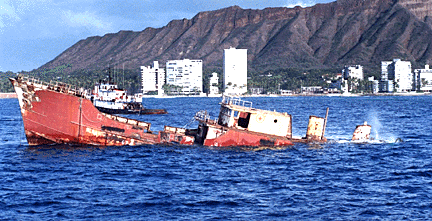
If you sink it,
they will come
Dive operators say sending
By Jerry Tune
derelict ships to the bottom will help
tourism's bottom line
Star-BulletinHawaii's ocean-recreation businesses want to turn derelict ships into artificial reefs to create tourist dive attractions throughout the state. The idea would save the state money used to dispose of the ships and generate more tourism dollars, said Jim Housh, director of the Ocean Recreation Council of Hawaii, composed of 150 members.
"We would design these to be diver safe and environmentally sound," Housh told a luncheon meeting yesterday of the Eight Bells maritime educational group at the Hawaii Maritime Center.
Most existing artificial reefs were designed for fishing. Housh wants a separate reef system for divers to create a "fish habitat" that would be open to tourist and local divers who just want to look at the fish.
"These would be diving reefs with no spear guns allowed. There would be a 'no take' policy, a kapu system," he said.
But environmentalists and surfers oppose adding these wrecks to waters. They cite past problems when strong surf broke up two airplane fuselages used as an artificial reef a mile off Waikiki by Atlantis Submarines Hawaii LP.
John Kelly, president of the Save Our Surf group, calls the practice of creating artificial reef a way to "privatize the ocean."
Yet Housh contends that artificial reefs can provide relief for natural reefs. "I've been in the diving business for 20 years and many of the natural (reef) sites are being overrun (by recreation or commercial charter ships)," he said in an interview.
Housh also talked about setting up a revolving fund, using part of scuba diving ticket price, to use for cleaning up old ships.
Ed Boot, vice president and general manager for Voyager Submarines, expects to spend $150,000 or more to cleanup each of two ships that he wants to put down three-fourths of a mile off Ala Moana Beach. The proposal before the state is now out for public comment.
"Our business is growing," Boot said. "I don't know (exactly) what an investment like that will bring me in added business but it's something we want to do."
Boot said the waters off Waikiki are bare -- without fish to see -- because the natural reef has been decimated.
His plan is to have four moorings at the Ala Moana site, in 90- to 100-feet deep water. Two of these would be open to the public. Other dive operators also could tie up at the location, he said. Voyager would use the site for submarine tours and scuba diving.
Boot said the project's environmental impact statement should be complete by the end of September and, if the company receives permission, the two ships can be sunk by early next year.
Housh cited a study by Richard E. Brock, at the University of Hawaii Sea Grant Extension Service, that found that vessels sunk off Waikiki generated about $728,000 in annual gross revenue for scuba tour operators.
Housh said any artificial reef should be placed in a non-surfing area, at a depth of no more than 90 feet. "We want to be in a stable area (away from strong surf) so the ships don't move around," he said.
But Save Our Surf has been fighting reef proposals by the ocean recreation companies.
Kelly said that huge storms from the south come to Hawaii between September and March every year and can damage artificial reefs using old ships or cars.
In 1992 Hurricane Iniki caused surf that broke up two aluminum fuselages from Mid-Pacific Airlines sunk by Atlantis Submarines. This left aluminum airplane pieces scattered over the waters near Waikiki, Kelly said.
Terry O'Halloran, director of project development at Atlantis, said scuba divers cleaned up most of the pieces and the rest went out to deep water.
"The University of Hawaii is monitoring the reef and we're spending $25,000 a year to fund that research," he said. "There still are a lot of biological questions about artificial reefs."
Craig MacDonald, ocean resources development manager at the state Department of Business Economic Development and Tourism, has been talking to Housh about artificial reefs.
"Scuba diving is one of the fastest growing attractions in the world but Hawaii doesn't have many good sites for divers, like they do in the Caribbean," MacDonald said.
As it now stands, Housh said, derelict ships can sit in Honolulu harbor for up to three years while they run up harbor fees and deteriorate. Then the ships go out to a bid process, but if they are not purchased the state must clean them up for disposal.
"Then the state takes them out 12 miles and pulls the plug (sinks them)," said Housh, who is also director of Maui Commercial Shiping and Ocean Affiliated Transportation, a group of about 26 commercial operators.
Housh cited a recent state expenditure of more than $50,000 to clean up one larger vessel before disposal.
Tom Fujikawa, harbors division chief for the state Department of Transportation, said the department spent about $120,000 to clean up and dispose of six derelict ships in 1995-96. Another $30,000 was lost in impoundment fees while the state dealt with the problem ships.
Some of these ships were wooden and they would not be suitable for artificial reefs, he added.
The ships must be cleaned up to meet federal standards before being dumped in waters beyond three miles off the Hawaii coastline. State Health Department standards are more stringent for the shallower state waters within three miles of shore and so cleanup costs are higher.
The state has been using donated vessels for artificial reefs since 1970 when the Navy provided a barge for the Waianae area.
