By Ken Sakamoto, Star-Bulletin
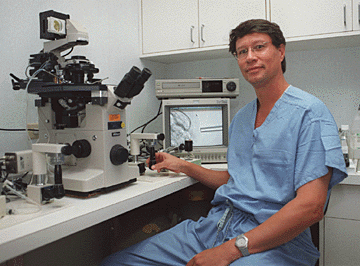
Dr. Thomas Huang at his micro-manipulator microscope.
He uses the equipment to fertilize human eggs with
sperm for in vitro fertilization.
Egg donation can
help produce pregnancy
A program gives hope to to
By Pat Omandan
infertile women with weak or absent
ovarian functions
Star-BulletinFor 35 years, thousands of infertile couples in Hawaii have drawn on sperm donors to help start a family. Now, they can turn to egg donations to achieve the same result. The Pacific In Vitro Fertilization Institute at Kapiolani Hospital has launched the first egg donation program in the islands, giving infertile women with diminishing or absent ovarian functions a chance at pregnancy.
Dr. Philip McNamee, the institute's co-director, said a number of women over age 35 cannot provide their own eggs for reproduction due to their age or ovarian problems such as cancer surgery, chemotherapy or congenital abnormalities.
McNamee said by carefully matching donors with recipients, the institute can implant eggs that have a better chance of making it through pregnancy. The institute has had eight successful pregnancies from this arrangement, and the demand is growing from women over age 40, he said.
"It's very, very difficult to get pregnant at their age with their own eggs," McNamee said.
The institute was founded in 1984 to treat the most difficult cases of infertility in Hawaii.
The use of donated eggs is incorporated into the technique established for in vitro fertilization. Birth control pills are used to synchronize menstrual cycles of the egg donor and the infertile woman, with the egg recipient given medication to suppress her menstrual cycle and prepare her uterus for an embryo.
Pacific In Vitro Fertilization Institute
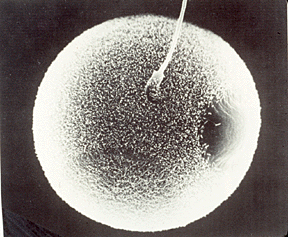
An egg is fertilized using the in vitro fertilization
technique. Egg donations are enabling infertile
women to achieve pregnancy.
The donor is given hormone medications to produce multiple eggs, which are then harvested and fertilized in a laboratory with sperm from the recipient's partner.The embryo or embryos are then placed into the woman's uterus. McNamee said the pregnancy rate for donor eggs is the highest for in vitro fertilization at 50 percent to 60 percent.
The first reported pregnancy in the United States with donor eggs was in 1984.
In 1994, 163 clinics nationwide offered the procedure, resulting in 1,240 births.
Thomas Huang, the institute's laboratory director, said donor eggs work so well because donors are no older than 32. Huang said women's eggs seem to age and deteriorate between the third and fourth decade of life, lessening the chance of pregnancy.
"We're really hoping that egg donation will give them a much better chance to start a family," he said.
In addition, new research may soon allow older women to inject the contents of a donor egg into their own eggs, thereby maintaining a genetic link with the embryo and possible child, Huang said.
The institute screens donors for genetic, infectious and sexually transmitted diseases. It also administers a psychological test. Doctors try to match the recipients' ethnicity, hair and eye color, and interests as closely as possible.
"So we can match up the donor with the recipient very well so that the recipient looks like the donor in a way," McNamee said.
The institute uses local and mainland programs to recruit egg donors, who receive about $2,000 for their eggs.
The in vitro procedure costs about $16,000. McNamee estimates 25 Hawaii couples this year may be helped by this procedure.
McNamee and Huang say there are benefits for couples who use donor eggs to start a family rather than adoption.
" . . . She gets to carry her own baby, she gets to deliver her own baby and she knows exactly what happened during the nine months that she was nurturing this baby in her womb," McNamee said.
" . . . The negative portion of the donor egg -- even though it's the highest success rate in in vitro fertilization -- is it's still only around 50 to 60 percent per try, so there's no guarantee they're going to end up having a baby."
Seminar offered for the infertile
Couples experiencing infertility can attend a free seminar Thursday on how to improve their chances of having a baby.Dr. Philip McNamee and Thomas Huang, directors of the Pacific In Vitro Fertilization Institute, and Marlene Kaminsky, executive director of Woman to Woman Fertility, a donor egg and surrogate program in California, will speak at 6:30 p.m. at Kapiolani Hospital.
The seminar will include updates on hormone stimulation, in vitro fertilization, donor egg programs and other new technologies available for couples, women over age 35 and women with ovarian abnormalities. Call 946-2226.