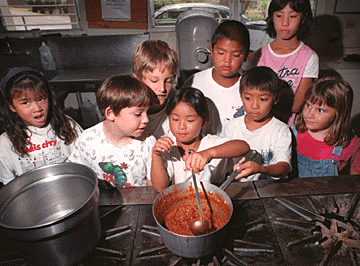
By Ken Ige, Star-Bulletin
Star of the Sea summer students learn how to make chili
in a cooking class. They are, front row, from left: Debbie Mala,
Eric Darmstaedter, Emi Igarashi, Justin Wong and Melissa Olin.
Back row, from left, are: Justin Sinclair, Aaron Ono and Akaya Sakai.
YEAR-ROUND SCHOOLING
‘Learning (occurs)
throughout the year’
Since 1995, the number
By Debra Barayuga
of Hawaii public schools on the
year-round schedules has tripled
Star-BulletinKRISTEN Murata has about two more weeks to practice for color guard, volunteer at a Summer Fun program, plan a leadership retreat with student leaders and finish "Scarlet Letter" before classes resume at Waialua High. The summer vacation has been reduced to a blur for her and more than 27,000 students at 45 public schools statewide that have switched to year-round schooling.
"I'm excited about it," said Murata, a senior who hopes to manage her workload more effectively throughout the school year and avoid burnout. "I'm sure it will benefit me and other people."
Since 1995, the number of Hawaii public schools on year-round schedules has tripled -- a change supported by parents and school officials who say year-round schools help improve learning.
This year, Waialua High and 18 other schools join the list, shortening summer vacations by four to six weeks.
Private schools included
Nine private schools are also on year-round schedules. Students at Hawaii Baptist Academy -- the latest private school to switch to year-round schooling -- will return to class Aug. 4.At year-round schools, instructional days -- 177 for public schools -- are more evenly spaced throughout the year and students have shorter, but more frequent breaks, or "intersessions."
Implementing a year-round schedule doesn't cost any more than the traditional school year, although additional teachers need to be hired for the intersessions.
Most year-round public schools take two weeks off in October, an additional week at Christmas and an additional week for spring break, plus the usual state holidays.
Kristen and her dad, Les Murata, School/Community-Based Management coordinator at Waialua High, believe in breaks after each quarter.
The old system where students are given three months off during the summer is archaic, said Alan Zukerkorn, parent of a second-grader at Star of the Sea, the first private school here to adopt a year-round schedule in 1991.
"It goes back to the days when you had to harvest the crops -- there's no longer any purpose for that," he said.
As a working single parent, "I can't imagine what I would do with her during the three months vacation," Zukerkorn said.
Positive change noted
Educationally, year-round schooling makes more sense, said Lawrence Joyo, principal at Waihee School on Maui -- the first public school to adopt a year-round schedule nine years ago."Learning (occurs) throughout the year," he said.
At Waihee, year-round schooling has contributed to a positive change in student attitudes toward school, Joyo said.
By Ken Ige, Star-Bulletin
Star of the Sea summer interssession student Kalani
Puana concentrates on his work in reading class.
"They now understand why they come to school -- to learn -- and they're a lot more happy," he said.Nationwide for the 1996-97 school year, 1.8 million students were in school year-round at 2,460 schools in 41 states, said Kelly Johnson, spokeswoman for the National Association for Year-Round Education. Fewer than 400 U.S. schools were on year-round schedules in 1985.
Research shows that after two weeks, a person gradually begins to forget subject matter -- particularly in math and spelling -- and an even greater decline in memory occurs after eight weeks, said Charles Higgins, education specialist in the Department of Education's School/Community-Based Management office.
Shorter breaks mean students retain more, allowing teachers to cover more material throughout the year and spend less time reviewing, he said.
He said other benefits of year-round schools include:
Fewer discipline problems.
In addition, families find it cheaper, less hectic and easier to schedule family trips during off-peak vacation times.
Intersessions provide opportunities for students who need remedial work so they don't have to wait until summer school when they could be further behind.
More activities covered
Students also can participate in enrichment activities that teachers normally wouldn't cover during the school year. Teachers are required to cover so many subject areas that nonessential areas such as art, music, physical education or health are cut back or neglected, said Darla DeVille, director of the Hawaii Pacific Association for Year Round Education.This summer, Star of the Sea offered classes in cooking, outdoor education, computers, as well as remedial classes in reading and math.
Organizations can volunteer talents or services, such as a bank that offered a math course that covered interest rates, the stock market, and how to balance checkbooks, DeVille said.
Students also take advantage of intersessions for exchange programs or educational school trips that normally would cut into instructional days, said Richard Bento, president of Hawaii Baptist Academy, which adopted year-round schooling over the past two years.
Biggest obstacle
The biggest obstacle to change is acceptance, DeVille said. But if students, parents and teachers are informed and involved, acceptance comes easier.Waihee Elementary shows no sign of returning to the regular school schedule, even though funding for intersessions was cut back three years ago.
Student achievement has gone up and down since Waihee adopted a year-round schedule, but students who began with the year-round schedule in kindergarten "have made an improvement on a consistent basis," Joyo said.
"We've been pleased, but not satisfied," Joyo said. "We're constantly working to improve."
Teacher retention was one reason Kamaile Elementary made the switch, said Principal Alvin Aihara. Teachers were getting burned out because of having to deal with disciplinary problems in addition to teaching.
"Shorter breaks spread out should help children academically and socially," said Aihara, who hopes to eventually see a drop in behavioral problems and a rise in SAT scores.
Gains may not be evident for three to five years, but "we're optimistic we will help the children," he said.