By Kathryn Bender, Star-Bulletin
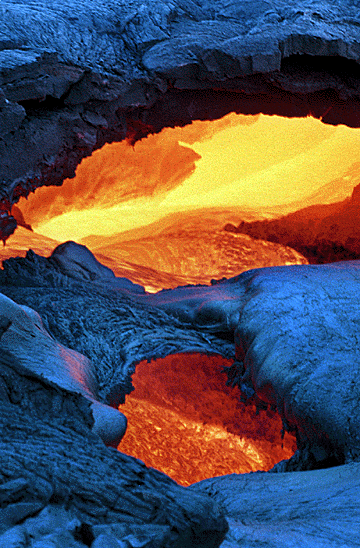
A glimpse inside a lava tube.
Nature’s cauldron
'Absolutely amazing' Kilauea
By Rod Thompson
awes volcano-watchers
Star-BulletinHILO -- For volcano watchers on the Big Island, the pizzazz is back. After almost no activity in February, then hopscotching breakouts of lava in the remote Puu Oo area, the Kilauea eruption finally regained some of its old flair this past weekend when a six-mile flow reached the sea.
"It's absolutely amazing. I've never seen anything like it," said Lynn Adams of St. Petersburg, Fla., following a helicopter tour yesterday of Puu Oo cinder cone, a lava pond and the river of lava flowing into the sea.
Bypassing a couple of houses in the mostly abandoned Royal Gardens subdivision, overrun by several earlier flows, the lava now enters the ocean a quarter-mile from 700-year-old Wahaula Heiau.
That puts the ocean entry four miles from the nearest Hawaii Volcanoes National Park viewing site, luring visitors like Adams to get a closer view via tour helicopter. She was impressed by the way 14 years of flows have laid an eight-mile blanket of lava across Chain of Craters Road from the national park to Kalapana.
By Kathryn Bender, Star-Bulletin
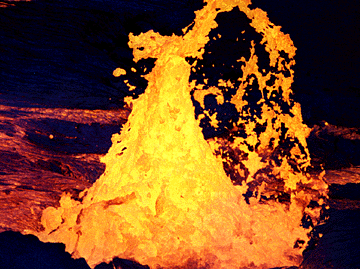
Lava spews 6 to 10 feet into the air.
Virginia Naughten of Oakland, Calif., hunted for words to describe it. "The flow comes down and incinerates. It turns to ashes. It turns to black sand," she said. Her husband, Joe, was struck by the source of the lava inside Puu Oo: "There's a cauldron in there that's boiling."Even people who don't get the close-up helicopter view are impressed, said park ranger Mardie Lane. "You will be rewarded, even if it's a steam plume (you see). It's the thrill of a lifetime to be at a place where earth is being created."
The day after the park reopened Chain of Craters Road last Friday following repairs, about a thousand visitors drove to look at the distant flow, she said. When rangers left at nightfall, about 60 cars remained as people watched the night glow.
"The skylights (glowing open spots in the lava tube) on the hillside, the plume lit up, the whole aura of splashing surf, the night sky, the red glow off in the distance, it was a celebration of the road reopening," Lane said.
By Kathryn Bender, Star-Bulletin
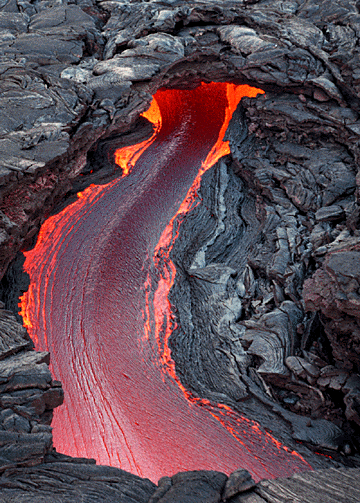
This is one of many skylights along the chain of craters in the east
rift zone, where lava surfaces from the main Kilauea crater. Skylights
are glowing open spots in the lava tube. The eruption is pumping out
600,000 to 700,000 cubic meters of the swirling, liquid rock each day
A word of warning to those not satisfied with distant views: The park prohibits hiking to the flows and people would be foolish to try. It's a round-trip hike of eight miles of hot sun, fractured ground, no water, a plume of steam laced with hydrochloric acid, and tiny fragments of volcanic glass blowing in your face.Arnold Okamura at the Hawaiian Volcano Observatory said the eruption, though distant, is stronger than before it shut off on Jan. 30. Back then, 300,000 to 400,000 cubic meters of liquid rock were gushing out every day. Now it's up to 600,000 to 700,000 cubic meters per day.
As to why the lava stayed away from the sea so long, Okamura said lava flowed out of Puu Oo again beginning March 28, but the eruption jumped back and forth among three vents, and no one vent lasted long enough to produce a tube to carry lava to the sea.
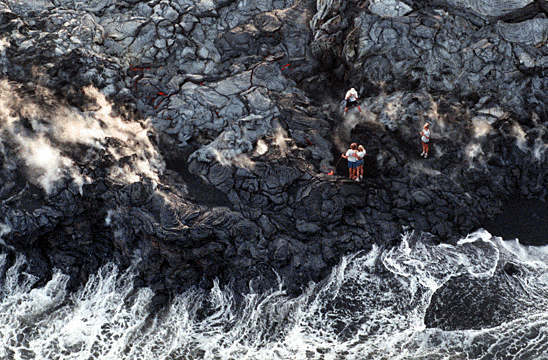
By Kathryn Bender, Star-Bulletin
Hiking to the lava flows is prohibited for safety reasons, but
some people insist on doing it anyway. They're shown here
where the lava flow enters the ocean.