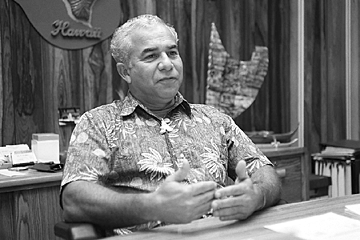
By Ken Sakamoto, Star-Bulletin
Gary Rodrigues, state director of the United Public Workers,
was to be sworn in today as a Judicial Selection Commission
member. The powerful, politically active Rodrigues has been
a lightning rod for controversy.
UPW’s Rodrigues
takes controversial post
He and three others
By Mary Adamski
join the commission that selects
nominees for state judgeships
Star-BulletinFour people will be installed as members of the Judicial Selection Commission today, but there is no question that public attention will focus on Gary Rodrigues, state director of the United Public Workers. Critics have challenged the appointment as the last straw in power wielded by the leader of the 13,000-member blue-collar union. Rodrigues has gained high visibility in the past year in political struggles over "privatizing" government services and setting a constitutional convention.
The nine-member commission selects nominees from which the governor appoints judges, and has authority to reappoint judges.
"Someone has a wild imagination ... that I would determine judges, one vote out of nine, it's outrageous," said Rodrigues in a recent interview.
He said he did not seek the appointment, which was actually made in early 1996 but held up because of changes made in the way appointments are made.
"It came as a complete surprise" when state Senate President Norman Mizuguchi proposed his nomination. "He said he thought labor should be represented. There was nobody there since Tommy Trask (former ILWU director whose commission term ended in 1993).
"Why shouldn't we (a public employee union representative) be on the commission? Working people make up a large proportion of the community. We're voters, we pay taxes," Rodrigues said.
He said those who criticize organized labor's role in the political scene are saying "we can only cook the dinner but we cannot sit down to eat. That is a real 'master' type attitude." Rodrigues, 55, has been elected UPW state director since 1981. He was elected president of the Hawaii State AFL-CIO in 1985.
This is not his first political appointment. Gov. John Waihee named him to the Research Corporation of the University of Hawaii for two terms. Gov. George Ariyoshi appointed him to the Compensation Review Commission for public officials and employees. The UH Board of Regents picked him for a 1992 advisory committee in the search for a university president. He chairs the Hawaii Health Council created to plan health care initiatives following the government and business Vision 2000 planning conference. He has served on numerous boards and committees concerning conditions and benefits for the workforce.
Also being sworn in are Max Sword, Outrigger Enterprises Inc. director of industry affairs; Wayne Matsuo, former head of the state Office of Youth Services, and Honolulu lawyer James Kawashima.
The focus on Rodrigues comes, in part, because of a challenge by a group of Republican lawmakers who say the appointment violates the state Constitution mandate that "no member shall take an active part in political management or in political campaigns." They called on Rodrigues to resign from activities as lobbyist and political action committee leader for the union.
The state Ethics Commission said their challenge was outside its jurisdiction. The state attorney general did not respond with a legal opinion, and Mizuguchi ignored their demand to withdraw his nomination.
It isn't an issue for the Judicial Selection Commission at this point either, said attorney David Fairbanks, acting chairman. "If there is a question of whether he is participating in a political campaign or managing a political campaign, then that is something we might look at.
"But until he is seated on the commission and there is some evidence he is violating a rule, we would not." Fairbanks said Judicial Selection Commission members frequently step aside from participating when they have a personal or professional connection with a candidate for nomination or reappointment.
Desmond Byrne, state chairman of Common Cause/Hawaii, said: "Selecting judges is just one more lever of power here. We don't like to see it concentrated in too few people. Anybody as litigious as the UPW ... we don't want to see people with a lot of matters before the courts selecting judges."
Byrne said: "There's enough cynicism already that power is too concentrated in Hawaii. If someone heads one institution, we don't want to see him influencing another institution."
The perception that Rodrigues already has clout in the judicial branch of government as well as the executive and legislative branches was heightened because of a couple of recent Hawaii Supreme Court decisions.
First, there was the UPW challenge to a Hawaii County contract for a privately run landfill, the kind of jobs usually held by county refuse workers. After the high court upheld the union position, the battleground moved to the Legislature, which wrestled with but didn't succeed in defining limits of privatization. Then it was back into the courts again as three neighbor island mayors canceled numerous contracts.
Also there is the federal judge's decision last week mandating a new election on the question of whether a Constitutional Convention shall be called. The furor was kicked off by Rodrigues, as head of the State Federation of Labor, AFL-CIO, and other Con Con opponents.
The Supreme Court upheld their view, ruling that the 45,335 blank and spoiled ballots had to be counted, thus negating the "yes" vote majority. Con Con backers took the matter to federal court.
He also has been visible in the issue of drug-testing for Honolulu city truck drivers, most of whom are UPW members.