Water fight
in new phase
Some want more water reserved for
By Susan Kreifels
agricultural use, others none at all
Star-BulletinThe state water commission's allocation of 27 million gallons of water flowing through the Waiahole Ditch each day has left environmentalists encouraged but parties on both sides of the Koolaus alarmed about who will get what in the future. Rae Loui, deputy director of the Commission on Water Resource Management, said bids for water use totaled almost 72 million gallons a day -- more than twice as much available in the 25-mile ditch.
"We tried to accommodate both sides," Loui said. "There was lots of competition. Some was for uses way in the future. Some asked for a lot more than needed. This provides for future needs by providing a buffer."
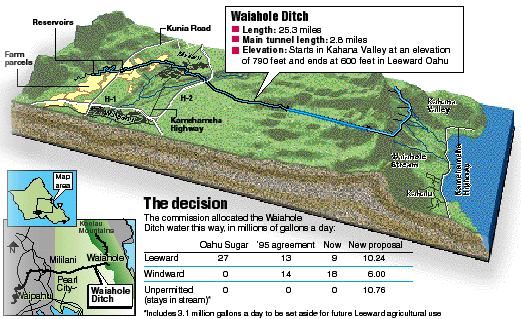
Of the 27 million gallons a day that flow through the ditch, the proposal would give 10.24 million gallons to Leeward users -- 9 million for farmland and the rest for uses such as golf courses, cemeteries and prison facilities.
The long-awaited proposal would allow 6 million gallons to flow in Windward streams and out through Kaneohe Bay.
The plan would allocate an additional 10.76 million "unpermitted" gallons to flow in the same streams -- the Waianu and Waiahole -- for the present.
But of that amount, 3.1 million would be set aside for future agricultural use on the Leeward side. The remaining reserve would also remain in the Windward streams unless environmental studies showed that further use of the water would significantly harm them.
The commission will receive written arguments on the proposal Aug. 11 and oral arguments on Aug. 22 before it makes a decision. The only recourse would be an appeal to the state Supreme Court.
The commission began the trial-like hearings in November 1995 after Oahu Sugar Co. closed and 27 million gallons of ditch water used for sugar was no longer needed. Applicants from both sides of the Koolaus filed water-use permits and reservation petitions for the mountain water. Reasons ranged from diversification of agriculture to protection of native stream fish and the Kaneohe Bay estuary and traditional native-Hawaiian gathering rights. The proposal both encouraged and alarmed environmentalists who want all 27 million gallons eventually flowing in Windward streams.
"We're pleased that the commission has, for the first time, purposely restored water to streams. We're encouraged by the commission's recognition ... that stream restoration is necessary to bring back native stream life," said Charlie Reppun, Waiahole taro farmer and community representative.
"We're alarmed that the commission would even consider issuing permits for all but 6 mgd (million gallons a day) of the ditch flow, which would leave far too little in stream."
The Robinson Estate would be granted about half of its water-use request: 2.5 million gallons of a requested 5.5 million.
Bill Paty, a Robinson Estate trustee, called the proposal "reasonable, but it lacks long-range assurance," even considering the 3.2 million gallons in agricultural reserve.
"It's a little too close for comfort," said Paty, who estimated 75 farmers on the Leeward side employ 500 people. "Farmers look down the road: 'Can I go out and buy a new tractor and make payments if the water doesn't come through?'"
Campbell Estate would lose most of its water-use bid in the plan. It requested 12.1 million gallons for agricultural use on the Leeward side but would be granted only 3.7 million. Donna Goth, director of Hawaii Development for Campbell Estate, said the biggest concerns were the limits that would be put on future agricultural growth as well as bureaucratic and other obstacles that might occur in applying for future use.
Attorney Alan Oshima, representing the Waiahole Irrigation Co., said a cumbersome and lengthy regulatory process may make farmers less competitive and "have a chilling effect on whether farmers can expect to increase production."
Kunia farmer Larry Jefts, a major producer of Hawaii's watermelons and bell peppers, said if demand isn't high enough for water use, ditch owner/operator Waiahole Irrigation Co. could raise water prices or be forced to shut down. The negative impact would be on Hawaii consumers, he said, who "eat fresh food cheaper."
A June 30, 1995, temporary agreement required Waiahole Irrigation Co., which owns and operates the ditch, to send 13 million gallons a day to Leeward fields while restoring 14 million to Windward streams, where interest in taro raising has also increased.
Paul Achitoff, managing attorney of Sierra Club Legal Defense Fund and representing Windward parties, said the "historic decision" would be a good start for "restoring streams diverted by ditch systems all over the state for the enrichment of a few at the expense of the public and environment."
Achitoff said the commission has ignored 35 million gallons a day of ground water on the Leeward side that is "affordable and available." He accused landowners of wanting to save the water for urban development.
Landowners say pumping the water would be expensive and costs would be passed along to the farmers who use the water.
"Everybody wants cheap water," said Loui, who added that use of ground water will be taken up separately.
The proposal encourages water conservation and use of reclaimed rather than potable water. The plan calls for environmental and other studies on water issues to be funded by fees assessed on users.