

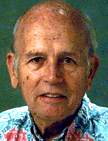
WHEN I last saw Bill Ewing a little over two years ago, he was 91 and looked much as he always had but his memory was beginning to fade. Memories of a former
Star-Bulletin editorAs he sipped a martini at lunch in Jackson, Miss., where he lived, he noted that it was his first in six weeks. Not so, his wife Bettye Ann said sweetly, "Bill, you had one at the neighbors' two days ago and complained about no olive."
Bill, a former Honolulu Star-Bulletin editor, was a major figure in journalism in Hawaii and my immediate boss for quite a few years. He had some aphorisms I loved:
"A gentleman is someone who never insults anyone unintentionally."
He retired from the Star-Bulletin editorship in 1966 but stayed on until 1972 as an editorial page contributor. In 1980 he and Bettye Ann, his second wife, relocated to Jackson, because most of his relatives are nearby.
They have adopted her so fully that she will remain there. Before their marriage she had been a school teacher. Her dainty good looks survive to this day. Bill stayed in great shape, too -- erect, lean and with the same voice and body English he always had.
The voice and elocution were something special. They remind me of Shelby Foote, the Civil War novelist and historian seen sometimes on national public TV.
Bill's manner of speaking was something that separated him from other journalists. He frequently sounded better on radio or TV than he read in print, even though he was using almost the same words.
This was a factor in an important part of his life. I had planned to interview him about it in 1995 -- his association with Adm. Chester Nimitz. He called the admiral "the greatest man I have ever known." I skipped the interview because Bill's memory had become uncertain.
My memory isn't certain either but it is buttressed in part by a Ewing monograph on Nimitz. Bill had been both a Star-Bulletin editorial and evening news radio commentator prior to Pearl Harbor. He had a good following. He was trustworthy, incisive and had that great voice. As a Naval Reserve lieutenant he was mobilized away from the paper on Dec. 7.
On Christmas Day 1941 he was on duty at Pearl when Admiral Nimitz arrived to take command of a chaotic situation. Nimitz, Bill was told later by the admiral, had been told by Navy Secretary Frank Knox to go to the Pacific and stay as long as necessary to bring the war to a successful conclusion.
Bill's first view of Nimitz didn't impress him. Nimitz looked more like a fatherly banker than the hell-for-leather leader needed to pull the country out of the worst hole it had ever been in. But further acquaintance showed a man whose gentle demeanor and twinkling steel-blue eyes belied completely the firmness and resolution within him. Bill was a little like that himself.
NIMITZ, as part of his effort to cut through the chaos around him, quickly recognized the importance of a supportive, reassured populace in Hawaii. After a few months Nimitz asked Ewing to return to civilian life and his trusted, level-headed evening news radio broadcast.
Nimitz asked only that when Ewing heard rumors about the war he would call Nimitz himself or his staff for the facts, then give the public fact rather than rumor. It kept the two men close and gave Ewing close-up insights that built his image of the greatest man he ever knew.
Tomorrow, after a short public service at 10:30 a.m., the ashes of William Hugh Ewing (1903-1997) will be inurned at Punchbowl National Memorial Cemetery of the Pacific with simple military honors.