By Dennis Oda, Star-Bulletin
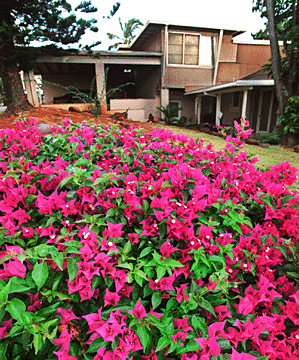
Just one brightly flowering bougainvillea bush will
add an explosion of color to a predominantly green yard.
This home is on Sierra Drive.
THE Fourth of July is a good time to think about fireworks in your garden. Is there an awful lot of green out there that could stand a few rockets of bright color? Flora’s red glare
welcome any time of yearCounty extension agent Ed Mersino says it's a fine idea, within reason. If we had fireworks every night instead of just on New Year's Eve and the Fourth of July, they'd soon cease to hold our attention.
"You can make your garden explode with splashes of color," Mersino said, "but you have to have some kind of a plan for the whole landscape. Generally what people do is to mix colors up, and you have a mishmash."
The first thing to do is to determine what kind of a garden you want. Do you want a tropical garden or a subdued garden? Do you want an Asian garden or a native Hawaiian garden or do you want to use mainland planting? Be careful of a mix of all these styles.
"There's an Asian influence in many of our gardens, a restraint. Traditional Japanese gardens use very little color. But tropical plants like ginger and heliconia are brilliantly colored. You need to define a theme, and then decide about color," he said.
Mersino recommends using bright colors as focal points in the garden, rather than planting an entire garden in crimson or yellow.
"If you want something to jump out at you, plant a clump of red ginger or bougainvillea. A big, splashy red plant will draw your eye, and then attract you to the nearby planting."
He suggested looking at a color wheel, the way the colors are arranged in the rainbow -- violet, blue, green, yellow, orange and red -- and using plants that flower in colors that are agreeable with each other.
"It's hard to talk about color without considering the texture, size and shape of a particular plant. If you want a tropical garden, you want plants with large leaves like banana and monstera. Mainland flowers usually have small leaves. Are the leaves shiny or dull? How big will the plant grow? If you mix up cactus and daisies and ornamental gingers, again you'll have a mishmash."
Mersino recommends using brightly colored foliage plants to introduce focal points in the garden. "The nice part about croton and beefsteak plant is that they hold their color year round. Flowers come and go."
Croton, which is native to the South Pacific, is easy to grow but it requires bright sunlight to keep its foliage in full color. It propagates from cuttings, so if you can find a neighbor who is trimming his crotons, politely ask for a couple of branches.
The best branches are of the diameter of a pencil and about 9 inches long. Remove the leaves and use a rooting hormone like Rootone on the cut ends. Plant in clean potting soil, water thoroughly and keep in semi-shade for about a month until roots have formed and new growth shows on the cutting. It will dry out and die if not watered regularly. The croton can then be transplanted into the garden.
Mersino cautions against planting shower and gold trees in most residential gardens.
"Look at the gold trees -- they are beautiful now, but for the rest of the year when they aren't in flower, the trees are quite drab," he said.
Unless you get great satisfaction from raking, most flowering trees belong in parks or on highways rather than in home gardens because of the mess they make when the blossoms fall.
"The flowers can be raked when they fall on grass, but if they fall on pavement, they stick and the simplest way to remove them is to hose them into a gutter. With a drought projected for later this year, that is not a good use of water," Mersino added.
The National Garden Bureau also has some advice on color in the garden, and much of it is the same as Mersino's. But the bureau also adds these points:
n To brighten shady areas, use light colored plants in white, pink or pale yellow. Dark colors get lost. If you have deep colors under trees, plant lighter colors in back of them to provide a contrast.
n Just as interior decorators use three or four colors as a theme throughout a house, landscape planning should work the same way. Theme colors used in different parts of the garden will unify it.
n For maximum effect, don't plant red ginger or bougainvillea against a brick wall or redwood fence. The planting won't stand out the way that white ginger or bougainvillea will. In the same way, white mock gardenias or tiare won't make much of a statement against a white fence or siding. Use purple or blue or magenta flowers instead.
n If there is something unsightly in your front garden that you can't get rid of, like a utility pole or a fire hydrant, create a colorful focal point as far away from the object as possible. It will draw attention to the bright planting and lessen the effect of the problem area.
n Colors affect our emotions. Hot colors such as red and yellow excite us, cool colors such as blue and green, pink and peach, are considered to be calming. For the entrance of your house you may want to create a feeling of warmth by using the stronger colors in your planting, and in the family areas around the lanai, you might choose the softer colors for a more serene mood.
With two-thirds of the summer vacation still ahead, Mersino suggested a backyard planting project for young children. Because they want immediate results, buy plants from a nursery or garden shop that are already in flower.
"If you have enough space and a place to view it from, you could do a flag," he said. "Petunias come in all those colors, or you could use red salvia, white impatiens and blue daze."
Lacking that much ambition, you could otherwise plant a small bed in school colors or team colors. But if you do go this route, Mersino advises, go slowly. Plant one focal point at a time and then live with it a while. Don't go overboard. What works at Disneyland won't necessarily look great in a backyard.
Explosions of color
What: Ed Mersino hosts a workshop on 'Fireworks in Your Landscape,'
Gardening Calendar
Send queries along with name and phone number to: Evergreen by Lois Taylor, Honolulu Star-Bulletin, P.O. Box 3080, Honolulu 96802. Or send e-mail to features@starbulletin.com. Please be sure to include a phone number.
Evergreen by Lois Taylor is a regular Friday feature of the
Honolulu Star-Bulletin. © 1996 All rights reserved.