RECIPROCAL BENEFITS A peek inside Hawaii’s
‘Pandora’s box’
A law giving rights to same-sex couples
By Linda Hosek
makes history but worries critics
Star-BulletinFor a 34-year-old gay corporate executive with the AIDS virus, a new law extending benefits to adults who can't marry will save thousands of dollars in medical bills for his partner of 13 years. The executive, who declined to be named to avoid discrimination, said he will apply for an $8 certificate to get his partner, who also has the AIDS virus and skin cancer, on his medical policy.
But he also owns a small company with about 40 employees, most of whom have relatives not likely to have medical insurance.
If he has to cover their legal partners the same way his corporation will cover his, he fears he could go out of business.
"I'm happy we're finally being recognized," he said. "But I don't think it's right to extend benefits to couples who aren't committed."
The controversial law makes Hawaii the first state in the nation to legally recognize same-sex couples, extending significant rights in areas of insurance, property, pension and hospital visitation.
Its importance ranges from symbolic to the practical in which some same-sex couples will seek certificates as a step toward legal marriage.
Portland residents and Waikiki condo owners John Weston, 65, and Jim McBroom, 63, plan to fly to Hawaii this month to apply for a certificate to acknowledge their relationship of 27 years.
"Our theory is not so much that reciprocal benefits will help us as much as it is a philosophical statement to assist in achieving civil rights," said Weston, a retired English professor, who has been with McBroom, a semiretired real-estate broker, for 27 years.
But while the bill is historic in extending rights to same-sex couples, the rights remain unequal, said Dan Foley, attorney for the three couples who sued the state in 1991 for the right to marry. ‘A Pandora's box’?
"The irony is that all this was done to deny full equal rights to gays," he said.
The law stems from a bill to offer benefits to same-sex couples to convince the state Supreme Court to overturn its own 1993 ruling to allow same-sex marriage.
State representatives proposed rights that didn't carry costs, but senators insisted that same-sex couples have health benefits.
The House agreed to health insurance, but extended rights beyond gay couples to any two adults. Expanding the category also was a way to kill the bill by making it expensive to implement, Foley said.
But the bill survived because it was politically tied to one calling for a constitutional amendment in 1998 to let the Legislature decide who can marry.
Pressure to pass the amendment led to the passage of both, giving the state a new category of people with rights.
"We feel this may be a Pandora's box," said Fred Fortin, spokesman for the Hawaii Medical Services Association, which provides health insurance to most residents.
Fortin said HMSA didn't think domestic partnerships for same-sex couples would have had much impact on costs.
But the reciprocal-beneficiary law remains an unknown in which it may become a strategy to enrich coverage for any two adults, he said.
It also may force businesses to drop coverage for children to afford coverage for adult beneficiaries, he said, adding, "We may gain on the one hand and lose on another."
Foley described the concerns of the business community as legitimate and predicted the Legislature would clean up the law next year.
He said lawmakers would like to add residency requirements and narrow the category to those with committed relationships.
Rep. Sam Slom, a small-business advocate who opposed the bill because lawmakers didn't know its economic impact, said he anticipated pressure to expand rights for reciprocal beneficiaries.
"The gay and lesbian community is strong," he said. "They will want to add benefits."
Foley said the same-sex community wanted equal rights, but only for committed couples: "You can broaden rights, but limit them to same-sex couples and limit costs."
He said many rights have no costs and that traditional marriage laws would add responsibilities to couples, shifting burdens away from the state.
No one has pinpointed the number of heterosexuals or homosexuals who will add a person to their policies.
"There's still so much homophobia," said Barry Porter, a deputy public defender who will apply with his partner of eight years. "People are still afraid to come out. There's also reticence about putting your name on a list run by the state."
The state Health Department anticipated 20,000 to 40,000 gays will sign up within three months, but may revise its count downward, said Patrick Johnston, department spokesman. Only 25 to 30 people picked up applications Tuesday, the first day forms were available.
He had no estimate of how many heterosexuals will add a beneficiary to their policies, but said numbers would likely increase as people understand the law.
Sen. Matt Matsunaga, who favored domestic partnerships, has estimated that health costs will increase by about 1 percent of health budgets, based on research of other governments who have domestic-partnership laws. Impact may be minimal
The health cost to the state would run about $1.1 million at 1 percent and about $11.3 million at 10 percent, according to the Hawaii Public Employees Health Fund.
Jack Law, a gay man who owns Hula's and the Wave, said the law doesn't affect his costs because he doesn't offer medical insurance to dependents of his 80-some employees.
He likened fears over it to fears raised over the law to prohibit discrimination against employees on the basis of sexual orientation. "People said it would be bad for business, but it created more stability," he said.
Paul Groesbeck, Life Foundation executive director, said foundation staffers have just begun to scrutinize the law, which could enable people with AIDS to become a beneficiary.
But he said most foundation clients have Medicaid, Medicare or private insurance through the state. Groesbeck doubted that they would change their coverage under the new law, explaining that people tend to stick to what they have.
"I hope we can look into this law and make it work," he said.
By Ken Sakamoto, Star-Bulletin
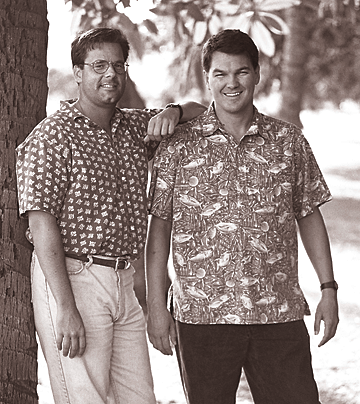
Barry Porter, left, and Dan McInerney will celebrate
once they get reciprocal benefits.
Some feel
By Linda Hosek
vindicated, some insulted by
reciprocal-benefits law
Star-BulletinWhen Barry Porter and Dan McInerney get their certificate to show they are registered with the state as reciprocal beneficiaries, they plan to celebrate. Porter, a deputy public defender, and McInerney, a state hospital nurse, exchanged rings four years ago to mark their commitment.
But the certificate, which will enable them to obtain benefits similar to those offered through marriage, represents social recognition of same-sex relationships.
"To me, it's being treated like everyone else," said Porter, who picked up his application yesterday. "It's an emotional thing. You join the rest of the community."
Others fault the law for blending gays and lesbians into a larger category of "reciprocal beneficiaries" but plan to use it for practical reasons.
The law allows any two adults who can't legally marry to apply for rights, and the state doesn't plan to keep statistics on the applicants' gender or sexual orientation.
For Sue Reardon, Marriage Project Hawaii director, the certificate provides second-class rights, offering only about 45 of some 400 offered through marriage.
But she and her partner, Michelle Zalenski, a counselor, will register for benefits they can use when they start their family.
"This is not a recognition of coupledom," she said. "We're not going to have a party. We're doing this for legal standing and to show the rest of the world this is important."
Liz Winfeld, a mainland consultant specializing in sex-oriented workplace issues, said she resented any law that offered less than marriage and likened Hawaii's new law to a seat in the back of the bus.
"I believe in the inherent goodness of two people joined together to build something," she said. "I will never settle in my life for domestic registration."
Reinette Cooper, a defense attorney, viewed the law in a practical light. She said she may use it to get her partner on the title to her condo.
A marketing professional with the AIDS virus echoed her feeling. He and his partner of 10 years both have excellent medical plans through work, but they want to register for insurance and property benefits.
"We're not running down to sign up to have a piece of paper that validates our relationship," he said. "We did that a long time ago. I'd just like a cheaper auto insurance policy."
McInerney said he agonized over whether he would publicly discuss why he wanted a certificate. Gaining courage from reading Martin Luther King and Gandhi, he decided education was the only way to erode centuries of ignorance and bigotry: "If I said nothing, I wouldn't be able to forgive myself for hiding."
Porter said he hoped the new law would help young gays and lesbians avoid the often devastating pangs of discrimination.
"They are going to be respected and treated a little bit more equally so they will grow up with a little less discrimination," he said. "Hopefully, someday there won't be any discrimination."
By Ken Sakamoto, Star-Bulletin
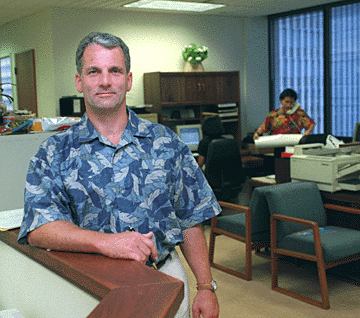
Dr. Robby Jenkins started an insurance company
that serves gays and lesbians.
Insurance firm first
By Linda Hosek
to serve gays, lesbians
Star-BulletinDr. Robby Jenkins, a Kailua High School graduate, had treated AIDS patients for 10 years in Los Angeles when the death of two best friends in October made him realize he needed a break. He moved to Lanikai in April, the same time the state Legislature passed a bill to extend rights to adults who can't legally marry, including same-sex couples.
The bill, which creates a broad category of reciprocal beneficiaries, becomes law Tuesday. (Applications became available at the Health Department this week.)
It was the push he needed to start Pride Insurance and Financial Services, which he believes is the first company of its kind targeted to gays and lesbians.
Jenkins is president and one of five shareholders. Dan Foley, the civil rights attorney who represents the three same-sex couples who sued the state for the right to marry, also is a shareholder.
Launched June 1, Pride Insurance helps clients find gay-friendly insurance companies, make investments and plan for retirement. About two clients daily buy policies, exceeding Jenkins' expectations.
The company also helps couples decide if they want to become "RBs," or reciprocal beneficiaries.
"I expect to talk more couples out of it than into it," he said, referring to liabilities that can outweigh the law's 45 benefits.
Liabilities include a partner's debts, back taxes, lawsuits, bankruptcies and problems that could arise from accidents.
Jenkins said concern over his own liabilities was one reason he decided not to register as a reciprocal beneficiary with his partner.
He said he has identified about 12 life, property and casualty companies willing to insure both same-sex partners equally. He also said one long-term care insurance company canceled after he disclosed that Pride Insurance targeted same-sex couples.
"We decided not to make a big deal out of it and send our business elsewhere," he said.
Jenkins, 40, worked in internal medicine for 10 years and as an anesthesiologist for five years.
He had a difficult time coming out as gay but chose to work with AIDS patients as part of accepting himself.
"It feels good to come home and be out," he said. "And to make no apologies."
Key Dates
Veto deadline: Has passed
Same-sex Archive