Star-Bulletin
Some culture for your garden.
ALONG with the biographies of forgotten football players and cookbooks using only zucchini, the bargain table at most local bookstores features a pile of garden books. A few of them are just good to look at, filled with photos of lilacs and tulips. Others are hands-on texts about how to prepare your garden for winter or plant spring bulbs. None of this makes any sense here, so that's why the books end up on the bargain table. Gardening books
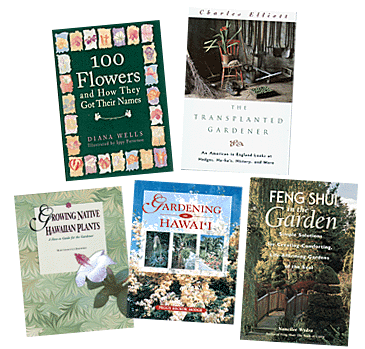
worth cultivatingThe picture books are a temptation, although irrelevant, like Architectural Digest. But every now and then, a garden books shows up that is either based on local gardening conditions or has a new look at a well-worn subject. Five of these recent books bear looking at.
"100 Flowers and How They Got Their Names," by Diana Wells, Algonquin Books of Chapel Hill, 1997, 257 pages, $16.95. From abelia to zinnia, flowers were given names for a variety of reasons and Wells explains, including attractive pen-and-ink drawings of each.
The poinsettia, for example, was named for Dr. Joel Roberts Poinsett, U.S. ambassador to the newly independent Republic of Mexico from 1825 to 1829, which appeared to be about as long as the Mexicans could put up with him. In addition to having the popular Christmas flower named for him, the Mexicans coined the word "poinsettismo" to describe his impossibly officious behavior.
When he went back to South Carolina, he brought several of the plants with him. His antagonizing attitude made him the perfect choice for Secretary of War in 1837 under President Martin Van Buren. He was also a founder of the Smithsonian Institution.
The bougainvillea also has a story. It was named for Louis Antoine de Bougainville, who was commissioned by Louis XV to circumnavigate the world. In the process he was to pick up any odd pieces of territory not already claimed by the British. His mission was also partly scientific, and he was to bring back samples of unknown plants.
A naturalist, Philibert de Commerson, was appointed to accompany the expedition to collect and classify specimens. The bougainvillea, which went by some other name in its native Rio de Janeiro, was one of the early finds.
Commerson brought his valet with him, a not entirely unheard of practice in 1776. The valet, listed on the ship's records as Jean Baret, shared Commerson's cabin and accompanied him on his collecting trips.
In Tahiti, a local chieftain with an eye for ladies seized the young valet, who was revealed to be a Jeanne rather than Jean. She had been employed in France as the governess for Commerson's son when the romance began.
Essentials include curves rather than linear paths and flower beds, healthy vegetation surrounding the house, blocking out unpleasant objects facing the property and ensuring privacy. Wydra gives designs for the Power Garden, the Meditation Garden, the Healing Garden and two particularly well-planned designs for a Retirement Garden and a Children's Garden. She suggests plant materials more appropriate to mainland gardens, but they could easily be replaced by tropicals.
The text is divided into ground covers, shrubs, vines, trees and ferns, and the book is beautifully illustrated with color photographs.
Such practical matters as amounts of sunlight, frequency of watering, resistance to wind and pruning schedules are spelled out.
This, more than any of the others, is the kind of book that will soon have muddy fingerprints and dog-eared pages from frequent reference.
Gardening Calendar
Send queries along with name and phone number to: Evergreen by Lois Taylor, Honolulu Star-Bulletin, P.O. Box 3080, Honolulu 96802. Or send e-mail to features@starbulletin.com. Please be sure to include a phone number.
Evergreen by Lois Taylor is a regular Friday feature of the
Honolulu Star-Bulletin. © 1996 All rights reserved.