By George F. Lee, Star-Bulletin
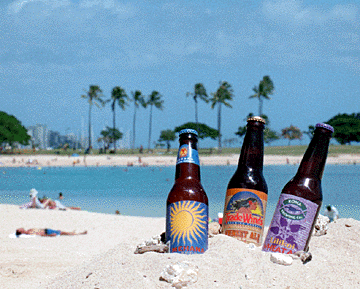
Neighbor island brews, from left, come from Mehana
Brewing Co., Hilo; Tradewinds Brewery, Maui;
and Kona Brewing Co.
Hawaii’s microbrews
are meant to be sipped,
not chug-a-luggedBy Tim Ryan
Star-BulletinHawaii loves beer. Maybe its because of the weather or the way we live -- whatever the reason, Hawaii is the biggest beer-drinking state per capita in the United States at 26.3 gallons per person per year, according to local brewers.
But like other Americans, island residents are learning to sip rather than guzzle the cold brews.
Gordon Biersch brewer Dan Gordon says beer-drinkers in the United States "have been palette-deprived."
"The commodity beers that Americans have been drinking for decades have little taste, little style, watery flavors and sometimes dozens of ingredients. But like wine and coffees and ice creams, people are beginning to realize that for maybe a buck or two more they can have the best, they can experience what other parts of the world have been enjoying for a very long time."
Gordon, head brewer and co-founder of the Gordon Biersch brewery and restaurant chain, is talking about the beers produced in microbreweries or craft breweries.
Hawaii has four microbreweries: Mehana in Hilo, Kona Brewing Co. in Kona, Tradewinds on Maui and Alii Brewing Co. on Oahu.
"Breweries in Hawaii are following a trend that has been well-established on the mainland for the last 10 years in places like Seattle, Oregon, Colorado and Northern California," said Jack Brennan, Alii Brewing's general manager. "People on the mainland are better educated about beers, like they were in the '70s about wine."
Microbreweries, depending on the state, produce 15,000 barrels of beer or less annually. In Hawaii, the designation is 5,000 barrels a year or less.
However, a microbrewery might be best defined not in terms of size but in its approach to making beer, which is based on craft, quality ingredients and flavor.
By George F. Lee, Star-Bulletin
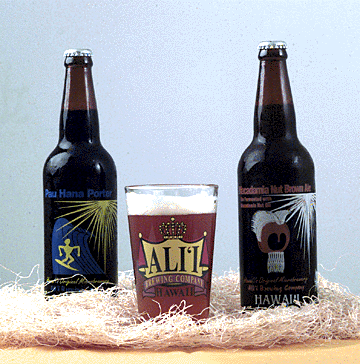
Oahu's Alii Brewing Co. produces a porter, left,
and a macadamia-nut ale, as well as other brews.
Some micros have grown well past the 15,000-barrel mark, but the beer hasn't changed. And many brew restaurants now bottle their formerly on-the-premises draft-only products. Gordon Biersch has just started bottling its beer for retail sales at its new brewery in San Jose. Hawaii will receive about 7,500 barrels of its first-year, 50,000-barrel production, Gordon said.Craft brewers are companies that produce an all-malt beer as their flagship brand. They include brew pubs, microbreweries, regional specialty breweries and contract brewing companies.
Craft beers typically are more robust and flavorful than commodity brands such as Budweiser and Coors. They usually have a darker color and don't contain other ingredients such as corn, rice, foam stabilizers and artificial carbonation.
Craft and microbrews are a minuscule part of overall beer production. In 1996 more than 195 million barrels of beer were sold in the United States -- about 5 billion gallons. The craft beer segment accounted for just 3.8 million barrels.
But micro/craft breweries are growing at a phenomenal rate in the United States, up 26 percent in 1996 from the previous year, according to the Institute for Brewing Studies in Boulder, Colo.
Sunset Grill at Restaurant Row stocks a wide variety of microbrews, such as Red Hook and Sierra Nevada Pale Ale.
"Our customers usually stick with lighter beers with dinner because the stouts and porters are very filling," said manager Ted Toby.
Compadres at Ward Center, like other specialty restaurants, picks its beer on how it complements the food, and includes five Mexican beers, six microbrews and two domestics, with one imported and one domestic beer on tap, said Rick Enos, co-founder and operating partner.
"Microbrewery beer is now on draft and people are willing to pay more for it, making it competitive with the price of margaritas," Enos said.
The newest kid on the restaurant block, Dixie Grill, which features barbecue and crab, has brought in Louisiana-brewed Dixie Lager, which operating officer Bruce Faber said goes well with barbecue. "You don't want a beer that competes, but one that complements and doesn't take over the sauce," he said.
Ruth's Chris Steak House brings in Mehana Ale from Hilo because, general manager Al Hosoi said, it's "wonderful with our steaks and holds up well against prime beef, which not every beer can do."
Restaurateurs like Toby and Enos say customers are more sophisticated about their alcoholic beverages.
"They appreciate the nuances of beer, just as they do wine and tequilas," Enos said. "So they're enthusiastic about microbrews."
But quality doesn't come cheap. These beers, Enos said, are 100 percent more costly. "A keg of Budweiser or Coors costs about $45; a keg of a microbrew is $93 to $100."
Though acceptance of locally produced microbrew beers has been good, making beer, especially beer of high quality, is an expensive and time-consuming operation.
And whether it's Alii, Tradewinds, Kona Brewing or Mehana, each brewer tries to include their own distinct formulas.
Q&A
Why are most beer bottles brown rather than clear?Beer bottles are generally brown because light -- sunlight, fluorescent, etc. -- affects beer. Light reacts with the hop oils and gives the beer a "skunky" smell and flavor.
Know your beers
What are dry beers?
Dry beer was developed in Japan. Using more adjuncts such as corn, rice and genetically altered yeasts, these beers ferment more completely and have less residual sweetness, and hence less aftertaste.
What are ice beers?
Making of ice beers involves lowering the temperature of the beer until the water in it begins to freeze, then filtering out the ice crystals. The result is higher alcohol content. But because the ice forms around yeast cells, protein particles, etc., these are removed as well; leaving less taste and character.
What is cold-filtering?
This is a way of clarifying beer in a shorter time. Beer becomes clearer as proteins and other particles coagulate and settle. The beer can then be drawn off and bottled. One way to reduce the settling time is to chill the beer so the molecules clump and can be easily filtered out. The technique boosts productivity, but removes many components which contribute flavor and body.
What is draft beer?
Draft beer is served from the cask in which it has been conditioned. The term has been applied, loosely, to any beer served from a large container. More recently, it has been used as a promotional term to try to convince us that the beer inside a can or bottle tastes as though it came from a cask.
For instance Kona Brewing's Lilikoi Wheat Ale is made with Big Island passion fruit. The company, the first microbrewery on the Big Island, has eight full-time employees and produced its first batch of beer on Valentine's Day in 1995, said general manager Matson Davis.
Kona Brewing is the biggest- selling microbrewery in Hawaii and this year anticipates producing about 5,000 barrels, he said.
"We saw Kona as an undeveloped gem, though it is very challenging to do business in Hawaii," Matson said.
Challenge means expensive.
A case of empty bottles costs $2 more -- from $6 to $8 -- to ship to Kona from the mainland.
"That's 25 percent higher right off the bat just to get it here," Matson said. "Think of 20,000 pounds of grain and malt and the shipping costs associated with that. We had a pump that went out and it cost $100 to get it here."
But local microbrewers are encouraged that finally Hawaii beer drinkers are coming around to craft beers.
"Hawaii is always a little bit behind what everyone's been doing on the mainland, but the public here is leaning toward quality rather than quantity when it come to beer," he said.
"We know that brands like Coors Light and Steinlager will always have a big share of the market because they're less expensive. We're all fighting for shelf space."
Re-educating beer drinkers through beer fests and beer tastings is the best way to teach the public about draft and micro beers, brewers agreed.
The last two years in Hawaii have seen an increase in beer-related events by breweries to educate the public on what makes a better beer, Alii's Brennan said. This year alone there have been five major beer events in the state.
Alii puts out a quarterly news letter for its distributors to let them know what's happening in the beer world and the company conducts numerous tastings throughout the state, Brennan said.
All Hawaii's breweries and Gordon Biersch will be out in force at the Hawaii Public Radio beer tasting tomorrow.
Hilo's Mehana Brewery, which began bottling its beer last December, is Hawaii's smallest brewery and is hoping this year to produce about 2,000 barrels, said Dustin Shindo, the company's 23-year-old president.
Mehana, the youngest of Hawaii's microbreweries and the only one to self distribute, bottles two and kegs three varieties of its beer and sometime this summer will introduce a fourth beer specially made for Roy's restaurants.
The Shindo family had owned and operated Hilo Soda Works, the Pepsi Cola distributors for the Big Island, but in 1996 when Pepsi began distributing the product itself, the family moved into beer brewing.
"It was just about the time that I had come back from college and I had this idea and rolled with it," Shindo said.
The fledgling company with seven full-time employees only this April opened a warehouse on Oahu and in May started sending beer to Maui and Kauai. Still, 50 percent of Mehana sales are on the Big Island.
Alii Brewing Co. on Oahu is Hawaii's oldest brewery, established in October 1994.
However, after a change of ownership last year, the brewery stayed out of the consumer package market until last November.
Alii, which employs five full-time workers, expects to produce about 2,000 barrels during the next 12 months and is gearing up toward 4,000 barrels annually, general manager Brennan said.
"We went into this because we saw a golden opportunity since there isn't a saturation of craft beers in Hawaii and store shelves here are very vacant of craft beers compared to shelves in Portland," Brennan said.
Alii's sales have increased substantially since November, about 30 to 40 percent a month, Brennan said.
Tradewinds Brewing Co., Maui's only brewery, opened in October 1995 with its five beers: Paniolo Ale, Gingerwheat, Sunset Ale, Hulaberry and Kuaipa. This month the company started selling its beer in Bend, Ore.
7th Annual International
Beer-Tasting FestivalMore than 100 microbrews will be available at a benefit for Hawaii Public Radio:
When: 5:30 p.m.-8 p.m. tomorrow