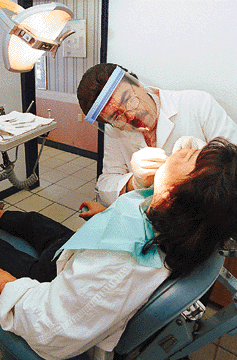
Associated Press
Dr. Laejandro Flores Lara works on a cavity for a
San Diego man in Tijuana. Americans are increasingly
turning to Mexico for cheaper dental and other care.
Fly to Mexico
for dental work?
And save money?
¡Si!
That's what a Kaneohe woman
By Rob Perez
says she did, joining others going south
of the border to save money on health care
Star-BulletinWhen Kaneohe resident Helen Eckert began having serious problems with her teeth, she went to a dentist. In Mexico.
Eckert flew to Los Angeles, met a sister who also needed dental work, rented a car, drove to San Diego, spent a night in a hotel and crossed the border to get treatment from two Tijuana dentists.
She needed root canal surgery and a crown on one tooth, plus crowns on two others. Her treatment tab: $530.
Even after paying travel expenses, Eckert, who doesn't have dental insurance, says she saved a minimum of $1,000 by having the work done in Tijuana — and got a minivacation to boot.
The dentistry, she claims, was excellent.
Eckert is among thousands of Americans who journey south of the border to get their teeth drilled and filled, capped and tapped, cleaned and shined.
The lure usually is financial.
Mexican dentists typically charge about 50 percent less than their U.S. counterparts, and in some cases the savings are much greater.
Whether quality is comparable is not so easily measured.
Some U.S. dentists cringe at the thought of patients going south, saying there's no assurance practitioners in Mexico are properly trained or have access to quality equipment and materials. Low cost, low quality?
Mexican dentists counter that their profession is just like any other, made up of both good and bad practitioners.
"I'm sure the quality of treatment in Tijuana is just the same as the United States or in some cases better," said Dr. Fernando Alonso, who did the root canal surgery on Eckert.
Whatever the quality, one thing's for sure: Mexico has become for many Americans a health-care oasis, where they not only get their teeth fixed but their eyes checked, drug prescriptions filled and ailments treated, all at considerable savings from U.S. prices.
Many of the traveling patients are elderly residents on fixed incomes or people without health insurance. Some have been making the medical treks for years.
At border towns like Tijuana, scores of dentists, physicians and pharmacists have set up offices minutes from the United States, hoping to capitalize on the steady stream of Americans in search of cheap health care.
Some practitioners, like Dr. Alejandro Flores Lara, who did Eckert's crown work, advertise for patients in U.S. newspapers and magazines along the border.
They also rely on word of mouth as satisfied customers tell friends and relatives.
That's how Eckert ended up in Mexico. She learned of the border-crossing dental phenomenon from her sister, Carolyn Lybbert of Poulsbo, Wash. Lybbert learned about it from her hairdresser, and last August went to Tijuana to get a crown put in.
She was so pleased with the results — and the $110 tab, well below the $700 her Washington dentist charged for a previous crown job — that she convinced Eckert to join her on the March trip.
Mexican dentists say they can charge well below U.S. prices because their costs are cheaper and they aren't saddled with costly malpractice insurance.
Dr. Ronald Miller, president of the Hawaii Dental Association, said he used to think dental care in Mexico wasn't good. But when the topic came up recently in a dental study group Miller participates in via the Internet, he was surprised to read messages from mainland colleagues who said quality wasn't bad for basic work.
Miller said he probably wouldn't argue that people can get adequate basic care in Mexico for less than what U.S. dentists charge. But he cautions Hawaii residents who may consider that option.
Part of the fees U.S. dentists charge include follow-up visits — something that would be difficult for a Hawaii resident treated in Mexico, Miller said. If a problem related to the dental work cropped up after the person returned to Hawaii, who would fix it, Miller asked.
He also questioned how someone could check a Mexican dentist's credentials, whether the sterilization standards there are comparable to tough U.S. ones and whether dental equipment was up to date.
In X-ray technology, for instance, many U.S. patients benefit from significant improvements made in the past five or six years, Miller said.
Eckert and her sister said the equipment they saw in the Mexico offices seemed to be from the 1950s and '60s, though Alonso said he purchased his machinery in the mid-1980s.
"Quality (of care) isn't determined by the materials. It's in the skills of the doctor," Lara said.
Few Hawaii residents apparently have followed the same path as Eckert to get their teeth fixed. Rare for Hawaii
Several local dentists said they weren't aware of anyone from here going to Mexico for treatment.
Alonso said Eckert was the first Hawaii resident he's ever treated. Lara said he's treated a few others, including a Latino family from Hawaii who comes to his Tijuana office whenever they visit relatives in San Diego.
Eckert said the option would be good for anyone without insurance or wanting to save money on basic dental work, especially if they're already planning a trip to Southern California.
"People in Hawaii are always looking for cheaper ways of doing things," she said. "This is one."
The practice is popular enough among mainland residents that some insurance companies are taking notice.
Dr. Ramon Baez, an associate professor of dentistry at the University of Texas Health Science Center in San Antonio, said a few U.S. insurers now cover dental work done in Mexico.
He said the quality of dentists there varies just like in the United States. "There are some very, very good dentists who have been trained in the very best schools in Mexico," Baez said.
While most people make the trip for financial reasons, that isn't the only factor. Price not the only factor
For Eckert, quality is important. And she found the better care south of the border.
The dentists seem genuinely interested in the patient's well-being, taking the time to explain everything in detail, Eckert said.
And the offices are very relaxed and informal — some might say too informal.
During her root canal surgery, Eckert met Dr. Alonso's wife and one of their children. When Eckert's tooth was measured for a pin, the doctor gave the measurements to a boy on a bicycle, who delivered it to a nearby lab to be made.
When X-rays were taken, Alonso didn't provide a lead apron for the patient — standard procedure in the United States — and didn't leave the room when the images were taken. The radiation levels are so low that the patient is in no danger of any harmful effects, Alonso said.
Alonso said patients like the extra attention and care he gives, something Eckert attested to.
"I'm an honest dentist," Alonso said. "I'm not just a businessman doing a job."