Top isle executives took home
By Rick Daysog
an average of $692,068 in salaries and
other compensation last year
Star-BulletinWhen Hawaiian Electric Industries Inc. awarded senior vice president Michael May $95,691 for a lifetime membership at the Oahu Country Club last year, it put him in an exclusive company of corporate executives in Hawaii. The membership helped lift May's 1996 compensation package 81.8 percent to $502,104, making him one of only 14 executives at Hawaii's largest public companies who earned more than half a million dollars last year.
May joined a crowd of local executives who received pay raises last year. According to figures compiled by the Star-Bulletin from company filings with the Securities and Exchange Commission, nine out of 14 chief executives of Hawaii's largest public companies took home fatter paychecks in 1996. Four received pay cuts. One executive's pay was unchanged.
Hawaii's top bosses took home an average of $692,068 in salaries, bonuses and other compensation last year.
That's equivalent to $1,890.89 for every day of 1996 and is a 10.4 percent jump from the year-earlier's average of $627,054.36.
The rate of increase far outpaced Hawaii's 1.5 percent inflation rate for 1996.
There are no women in the survey of 30 top isle executives.
Most of the 1996 raises came in the form of higher bonuses or other performance-based compensation, reflecting higher stock prices and improved company earnings.
Base salaries, by contrast, were relatively flat or slightly up compared to last year.
In the survey, five executives earned $1 million or more last year, topping the much-criticized $938,000 that Bishop Estate paid each of its trustees in 1995, the last year for which figures are available.
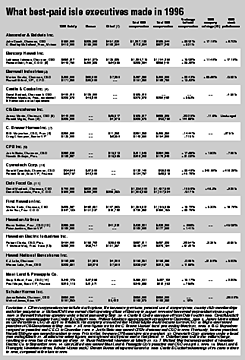
Here's a snapshot of this year's survey: Click on the graphic to see the full-sized chart
David Murdock, chairman and chief executive officer of Dole Food Co. and Castle & Cooke Inc., topped the list at $1,855,010 for his work at both companies.
Murdock's 1996 Dole and Castle & Cooke compensation represents a 24.7 percent increase from the previous year's $1,487,500.
Murdock saw his net pay at Dole drop 10.6 percent to $1,330,000 from 1995's $1,487,500, but that was made up by his $525,010 compensation package at Castle & Cooke.
He did not receive any compensation from Castle & Cooke in 1995.
(Dole is no longer based in Hawaii, but figures for executive compensation were included due to the company's strong presence in the islands, with agricultural and resort holdings.
The company is based in Westlake Village, Calif. Castle & Cooke previously was a unit of Dole but was spun off in 1995.)
Much of Dods' higher pay came in the form of a $462,691 bonus, which was up 37.4 percent from his 1995 bonus of $336,666. The bonus, which is performance-based, came as First Hawaiian's earnings increased 5.3 percent and its stock price jumped 16.7 percent in 1996.
Dods -- who earned an additional $600,000 last year as trustee of the Estate of Samuel Mills Damon -- also engineered the company's expansion into the Pacific Northwest last year with its acquisition of 34 branches in Oregon, Washington and Idaho.
Couch's base salary was unchanged from last year's $590,000, reflecting a companywide cost-reduction program. But his bonus leaped to $225,506 from 1995's $60,021 as A&B earnings rose 17.1 percent and its stock price increased 8.7 percent.
Clarke's 1996 compensation package totaled $687,311, down from his 1995 pay of $887,326. But Clarke's 1995 compensation included $321,173 from HEI's long-term incentive plan which actually was paid in April 1996.
That incentive payout, which was not disclosed in HEI's 1995 proxy, is based on the company's performance for the three years ending Dec. 31, 1995.
The SEC requires companies to list long-term incentive payments in the years that they were earned and not when the actual payments were made, said Peter Lewis, HEI's vice president of administration.
Executive-pay expert Kathy Bayne said that companies are focusing more on performance-based incentives such as stock options to reward their executives. That way executives benefit when shareholders benefit, said Bayne, a compensation analyst at Washington, D.C.-based Investor Responsibility Research Center, which conducts research for corporate clients and institutional investors.
Bayne noted that many corporations are relying less on perquisites like the country club membership that HEI offered May.
"It's pretty unusual for a perk to account for such a big portion of the total compensation package," Bayne said.
An avid golfer, May said through a company spokeswoman that the club membership was part of his overall compensation package, which was offered when he joined the company in 1993. May, who was promoted to president and chief executive officer of HEI's Hawaiian Electric Co. in September 1995, only elected to accept the membership last year.
HEI stressed that company shareholders, not consumers, are paying for May's club membership, which included a $50,000 initiation fee that was grossed up for taxes.
Betty Ann Splinter, HEI's corporate secretary, said the club mem
berships, which are available to other HEI executives, are needed to motivate and retain key executives. She noted that HECO enjoyed a strong year in 1996 thanks in part to cost reductions.
Overall, Hawaii executives enjoyed a better year, and compensation expert Larry Wangler attributes that to the slowly improving state economy.
As tourism bounced back last year, earnings at isle companies were on the rise, and that boosted executives' performance-based pay, said Wangler, an Irvine, Calif.-based principal at Towers Perrin management consulting firm.
Still, local executives' compensation packages are well behind those of bigger mainland companies and aren't climbing as fast. According to BusinessWeek magazine, the average pay for the chief executives of the nation's 365 largest companies in 1996 was $5.78 million.
That's an increase of 54 percent from the previous year and compares with a 3 percent raise for the typical mainland factory worker, the magazine said.
At the top of the list, Lawrence Coss, chairman and chief executive of Green Tree Financial Corp. of St. Paul, Minn., earned $102.4 million last year, followed by Andrew Grove, chief executive of Intel Corp., who earned nearly $97.6 million.
James Gary, a member of Dole's board of directors and chairman of its compensation committee, noted that Hawaii companies tend to be conservative when it comes to executive pay.
Gary, who served on executive-compensation committees as a board member of Airborne Freight Corp. and Washington Energy Co. during the 1980s, said that while chief executives of Hawaii's largest companies may earn about $1 million a year, their counterparts at similar-sized mainland companies earn between $2 million to $3 million a year.
Gary, former chief executive of Pacific Resources Inc. (now known as BHP Hawaii Inc.), noted that Los Angeles Magazine recently ranked Dole's Murdock -- the highest-paid local executive -- as one of the most 10 underpaid corporate bosses in the Los Angeles area.
"The pay doesn't begin to match some of the pay at the mainland companies," Gary said.
"(But) if you're making a million or a million and a half, you're not going to get any sympathy about being underpaid."