
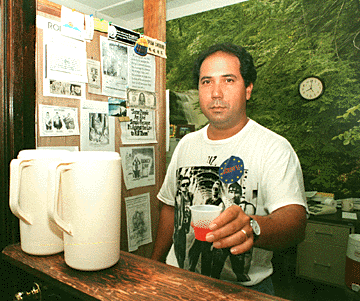

"He pretty much stabilized his lifestyle, but he wasn't motivated to discontinue methadone," said Katada, head of Drug Addiction Services of Hawaii in Hilo.
Finally the man quit, went to college, and now holds a professional position.
That's the kind of success DASH wants to repeat in west Hawaii. The Honolulu-based agency hopes to have a permit by June for a Kona clinic, said DASH's Honolulu administrator Lisa Cook.
 DASH already has 25 patients in west Hawaii who make as much as a five-hour round trip to Hilo six days a week, Katada said. They leave Kona well before dawn, take methadone in Hilo, then drive back for regular daytime jobs. They make the daily drive because methadone stops heroin withdrawal pains, which are said to be about five times worse than a bad case of flu, Katada said.
"All heroin users don't want to be heroin addicts after a while," he said. "It's not a pretty feeling."
Police vice Lt. Chadwick Fukui said heroin use is up because the type of the drug available has changed from injectable "Asian white" to smokable "black tar Mexican."
"They think if they smoke it, they won't become addicted. That's totally a misconception," he said.
Use is also increasing because more is available and the price is down, Fukui said.
Ed Howard of the state Narcotics Enforcement Division said some methadone patients illegally sell their dosage, which can produce a "high" in people not used to it.
Cook said methadone supplies are normally locked in a safe. Patients are given increasing amounts of take-home doses as they demonstrate changes in their lives, and she doubts illegal sales are common.
Patients can backslide into heroin use because of a stress like the loss of welfare or because of craving for the excitement of an illegal lifestyle, Cook said, noting the agency teaches clients how to deal with problems and build a new life.
While DASH operates as a nonprofit agency, the for-profit Comprehensive Health and Attitude Management Program in downtown Honolulu provides the only other methadone treatment in the state.
CHAMP head nurse Bonnie Holland said some clients fly daily from Maui for methadone, although the financial strain is severe. "All the islands would benefit from having a treatment program," she said.
Some clients try a one-month detoxification, but that doesn't work well because they also need time to give up old habits, she said. Back with old friends, they get hooked again when they think, "One time won't hurt."
Drug Addiction Services estimates at least 75 opiate addicts in west Hawaii could use treatment there.
The state Department of Health needle-exchange program for drug users saw a fourfold jump in exchanges in west Hawaii in 1995 and a 10 percent rise in 1996, a program report says.
Heroin use, sometimes with other drugs, was reported by 96 percent of people entering the program.
But while needle use in west Hawaii was climbing, almost two-thirds of the exchanges in east Hawaii stopped in 1996.
The needle program report credits the 1995 opening of DASH in Hilo.
The Kona program is expected to cost about $140,000 in its first year, with about four times that amount of money saved in avoided crime and medical costs.
HILO -- Methadone, a synthetic form of heroin developed in 1964, stops heroin withdrawal symptoms, but its dosage has to be regulated to prevent producing a "high," says Drug Addiction Services Hawaii administrator Lisa Cook.The dose is given daily in liquid or pill form. Methadone remains active in the body for about 24 hours, six times longer than heroin.
Programs avoid giving more than a one-day supply to ensure clients are seen and counseled daily and to prevent addicts from selling their supplies, Cook said.
Federal standards limit eligibility for the program to people addicted to heroin for at least a year. Evidence may be family reports of strange behavior or visits to a doctor for pain killers for withdrawal, Cook said.
Heroin withdrawal can last up to three days, but addicts may have a strong craving for the drug for as long as six months.
There is no limit on how long a person may be on methadone maintenance.
National studies show 90 percent to 95 percent of methadone patients do not return to heroin if they stay on methadone three to five years.
When a person quits methadone, withdrawal takes place, but the process can be gradual, producing only mild symptoms.