

As Japanese investors exit their local properties, this new breed of offshore buyers is snapping up Hawaii commercial real estate at a rapid pace -- and at steep discounts.
"There's no shortage of institutional capital coming into Hawaii," said Jack Rodman, director of Pacific Rim Activities for E&Y Kenneth Leventhal Real Estate Group. "(Many) are eyeing Hawaii because it's one of the markets where values have not recovered."
Rodman, whose company conducts an annual study of Japanese investment in the United States, estimated that the total offshore investment in Hawaii in 1996 ranged between $250 million and $500 million.
Most of those deals were made by mainland institutional investors, although a considerable number of the purchases were made by Korean, Taiwanese and even Malaysian investors, Rodman said.
Opportunity investors, sometimes called vulture investors, typically buy depressed real estate and other assets, aiming to profit when their values rebound. Many of these investors shun the "vulture" label, but their strategies here generally follow this bargain-hunters' philosophy.
And these new investors also are bringing in much-needed capital and management savvy to Hawaii's real estate scene.
The list of players investing in Hawaii, or looking to invest here, reads like a who's who of Wall Street. They include Lehman Brothers Inc., Goldman Sachs & Co., Donaldson, Lufkin & Jenrette Inc. and Apollo Advisors L.P., which is headed by former Drexel Burnham Lambert mergers-and-acquisitions executive Leon Black.
Other well-capitalized deal-makers include:
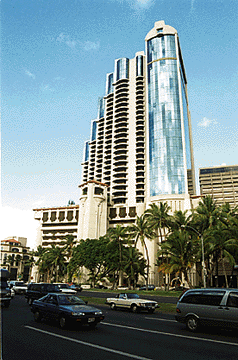
 Oaktree Capital Investments L.L.C., which acquired the discounted mortgage to the 35-story Waikiki Landmark luxury condominium complex in 1995.
Dallas-based Patriot American Hospitality Inc., which unsuccessfully bid on the Alana Waikiki Hotel.
"Those guys all have a lot of money and they're very, very aggressive," said local attorney Jon Miho, who represents Apollo and its Chicago-based partner Trinity Investments Trust L.L.C.
One Los Angeles opportunity investor, Colony Capital Inc., has been one of the most active participants in Hawaii's real estate scene. Last June, the company acquired the Colony Surf building in Waikiki through a foreclosure auction for about $10 million. That came after Colony acquired the 539-room Ritz Carlton Mauna Lani resort in 1995 for $75 million, or $100 million less than its original construction cost.
In 1993, Colony Capital headed an investor group that acquired the 1,200-room Hyatt Regency Waikoloa for about $60 million, a fraction of the $360 million cost to build the hotel. The Ritz Carlton since has been renamed the Orchid at Mauna Lani and the Waikoloa is now known as Hilton Waikoloa Village.
Today's transactions represent only about a tenth of the activity of the late 1980s and early 1990s, when Japanese investors bought about $18 billion worth of Hawaii properties, Rodman said. He added that he still sees a net outflow from Hawaii's real estate markets as Japanese investors step up their sales of troubled properties.
But the new buyers may signal an upward move in Hawaii's long-stagnant office and hotel real estate market.
Much of the renewed interest is a simple matter of supply and demand. With real estate prices rebounding on the mainland, institutional buyers are running out of high-quality, mainland properties at discounted prices. So they're turning to Hawaii.
Rodman noted that mainland investors in 1995 were buying financially troubled Hawaii properties for about half the original cost that the Japanese owners had paid to buy or build the properties. Now, the mainland investors are buying them at prices about 60 percent to 65 percent off the original costs, he said. In areas like Denver and Phoenix, once-distressed properties are selling for 70 percent of their original costs, according to Rodman.
Many analysts also believe that Hawaii's real estate prices will recover over the next three years, following the pattern of many mainland markets.
But there are plenty of pitfalls for the new offshore investors. The state's archaic zoning process can be exhausting and Hawaii's high cost of business can add huge costs to an owner of a hotel, office building or condo complex.
Previous generations of mainland investors, like Chicago-based JMB Realty Corp. which acquired Amfac Inc. in 1988, ran into their share of real estate-related obstacles here.
"Mainland investor groups tend to come into this market with a sense of putting a property that has been underutilized to better use," said local economist David Ramsour.
"But they are generally unaware of the market here and are quite surprised when they can not move them like they do in Dallas, Chicago or Houston."
But Ramsour said the current crop of mainland investors may add value to Hawaii's real estate economy. Many of the buyers are well-funded and can invest additional capital in the properties, creating jobs.
One example is the Yarmouth Group, which bought the Kapalua Bay Hotel & Villas last September for $19 million, or less than a fifth of the $102 million that the previous, Japan-based owner paid for the Maui hotel in 1990. Yarmouth plans to spend about $10 million to renovate the hotel.
The new investors, benefiting from discounted purchase prices, also can lower rents for office buildings or reduce hotel room rates while still making a profit, said Anthony Downs, real estate economist with the Brookings Institution.
An Apollo and Trinity joint venture known as AHI Harbor Limited Partnership offers a case study.
When AHI Harbor purchased the $130 million mortgage to Harbor Court luxury office and condo complex at an undisclosed discounted price last September, the building's office space was virtually vacant until last year due to litigation between Mitsui Trust & Banking Co. and the builder, Harbor Court Developers.
But after AHI Harbor bought the note, it brought in new financing for tenant improvements, paving the way for the signing of big tenants including Kapiolani Health and video-game maker Square U.S.A. The building is now more than 80 percent occupied.
"I think that this is one of the best things that can happen at the bottom of the cycle," Ramsour said.
Here's a look at some of the big deals by institutional investors that have closed in the past year or are pending: