
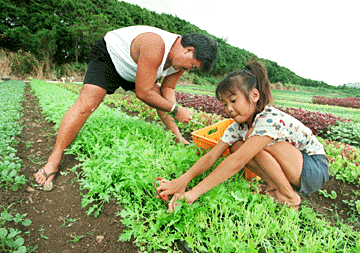
What are the herbs you use in cooking? If you enjoy Southeast Asian cooking, you'll want Thai basil and mint. If you frequently make pasta and pizza, grow basil for pesto and oregano for spaghetti.
Go through your favorite recipes and plant the herbs that you use most often. Most herbs grow like weeds, but unfortunately, most of them also look like weeds, so don't grow more than you need.
All those lovely photographs in the garden magazines might lead you to believe that herbs grow in tidy little mounds and intricate knot patterns, but that is the result of a lot of stoop labor. Because herbs are on the edge of being weeds, most of them behave that way. They can easily get away from you, which is why many growers contain their herbs in pots.
Commercial growers like Dean Okimoto, owner of Nalo Herb Farm in Waimanalo, grow most of their herbs in the ground, but they work on volume. Okimoto's herb farm supplies many of the island's fussiest chefs who can tell French tarragon from Russian tarragon at 10 feet. They sent the Russian variety back faster than you can say "Nyet," and Okimoto never grew it again.
One of the most common mistakes made by home gardeners, Okimoto says, is to treat their herbs with too much kindness. They aren't orchid plants or rose bushes, and they need to be cut back rather ruthlessly.
"Thyme, oregano, tarragon and basil particularly need trimming," he said. "When they get thick, and the weather is humid like it has been lately, the middle stays damp. It never dries out, and you'll get a fungus that eventually kills the plant.
"When any of these herbs get to 7 inches high, cut them back. They'll revive. Pinch the flowers off of basil plants, or the leaves will get smaller and lose some of their flavor."
Cilantro or coriander or Chinese parsley -- different names for the same herb -- is a popular cooking herb, but is one of most difficult to grow here. It was meant to grow in hot, dry summers and wet and chilly winters, which is something difficult to provide here. It will grow only two or three months each year, and if you do plant a cilantro patch, start it from seed. It will do better, but not really great.
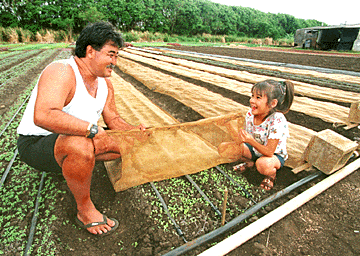
Because most herbs are fast growing, they tend to get root bound in small pots. Rather than repotting them, Okimoto pulls the plant with the surrounding dirt out of the pot, clips off the bottom inch of roots and soil, loosens the remaining roots and returns it to the same pot.
Plants in the parsley family are among the most popular herbs to grow. Okimoto says that any plant in that family, which includes dill and chervil, does best in the winter. Grow these herbs in full shade in the summer. Dill needs a lot of water, and it needs good drainage.
"We amend the soil with sand, and I don't mean beach sand. In the first place, it's illegal to take sand from the beach, and anyway it's full of salt. We use silica sand from Australia. You can get it at garden shops."
If tarragon won't grow in your garden -- and it is a challenge -- Okimoto says that Mexican mint marigolds probably will. They are much prettier, too. They bear tiny orange or yellow flowers, but the orange flowered marigolds are the ones with the tarragon flavor.
Tarragon is prone to a fungus that turns the leaves black. If you find this, cut the plant down almost to the ground, and hope it comes back. If the fungus is not removed, the leaves will grow smaller and smaller until finally the plant will die.
Pennyroyal, while not much of a kitchen herb, makes a good ground cover, particularly in an area where a dog sleeps. "It repels fleas when the dog lies on it," Okimoto said, "and it smells good when you walk on it."
Okimoto has an entire field planted in a small red lettuce called lollorossa, grown from a seed that costs $70 an ounce. Of course, you get a lot of seeds in an ounce, but still, he has them hand-planted in trays until they are strong enough to be transplanted into the ground. It is a staple in his Nalo Greens, a salad mix of 13 items served in many local restaurants and private clubs.
Okimoto waters his herbs by sight. "You can't make up an automatic schedule. We water when they look like they need it." He uses no insecticide or fungicide except for a pyrethrum dust, made from ground-up flowers of the chrysanthemum family. It is not poisonous to humans or pets, but it breaks down rapidly so it doesn't work for very long.
Harvest herbs early in the day when the flavors are strongest, he said, and harvest only what you intend to use. Snip them with scissors for a clean cut so that the plant will grow back. And you don't need to use them only in cooking. A basket, pot or pitcher of mixed herbs makes a fragrant decoration for the kitchen. Think Martha Stewart.