

Comet Hale-Bopp isn't just a pretty thing in the sky to University of Hawaii astronomers Karen Meech and David Jewitt.To them, and other scientists, it's a celestial treasure, yielding information about how the solar system formed 4.6 billion years ago.
Findings suggest, for example, that comets may have impacted the planet, bringing original organic materials that helped start life, Meech said.
She has observed the comet the past year with the Hubble Space Telescope and telescopes on Mauna Kea and in Arizona, Chile and Russia.
"We're pretty much using everything big we can get our hands on."
Jewitt and Henry Matthews, with the Joint Astronomy Center in Hilo, began looking at Hale-Bopp when it was discovered in July 1995.
They observe three days a week with the James Clerk Maxwell Telescope, a submillimeter radio telescope on Mauna Kea.
"It's a really, really good comet," Jewitt said. "We might not see a better one for many decades, maybe a whole lifetime."
It is very bright and molecules can be seen with the radio telescope that aren't visible in other ways, he said.
"It is a special telescope and a special comet.
"More than that," Jewitt said, "this object was discovered outside the orbit of Jupiter, very far from the sun, and we have been able to monitor the development of activity as it fell all the way out of the orbit of Jupiter to where it is now."
For the first time, he said, scientists are able to measure the comet's production of different gases, from the place where temperatures were low and water was frozen solid to just inside the Earth's orbit, where temperatures are relatively high and ices are fizzing into gas.
The comet was active even when discovered, Jewitt said.
"A big fuzzy coma was around it, producing a lot of gas."
It was releasing two tons of carbon monoxide per second, he said.
"To us, it was mind-boggling. The further from the sun, the colder it gets, and comet activities should shut down. This guy was active even far from the sun. We knew water was not responsible. It would be frozen like an ice cube."
So there was enough carbon monoxide to drive its activity from the beginning, he said.
"A whole bunch of different molecules are visible in the comet and the best thing, it's such a bright comet, all the lines we see are incredibly strong," he added.
They're getting high quality measurements as a result, he said.
Meech said new infrared technology, combined with the comet's brilliance, has made it possible to see molecules in Hale-Bopp never seen before in comets.
Many of the compounds are basic building blocks of life, she said.
"That's why people are so excited. It's giving new ideas on what sort of molecules we see in deep interstellar space are actually preserved in comets in the formation process."
She said some scientists were surprised and puzzled to detect compounds believed to form at different temperatures.
"So maybe we either need to revise our comet formation scenarios or we need to revise our understandings of interstellar chemistry. It's giving us very interesting clues as to how these things form."
Scientists also have found the comet is rotating like a spinning top that wobbles a little, in contrast to the simple rotation of many comets, Meech said.
Its rotation varies between 11.2 and 11.6 hours and it occurs on a 22-day time scale, she said.
"It's not so surprising because of the activity coming off the comet," she said, describing very strong jets of dust and gases that cause it to tumble irregularly.
Just looking at the comet, people can see light bouncing off, reflected from dust, Jewitt noted. But with the submillimeter telescope, he and Matthews actually can see sunlight absorbed by the comet and radiated as heat, he said.
Measurements since the beginning of February show Hale-Bopp has between 40 and 100 times more dust in it than Halley's Comet had at the same distance from the sun, he said.
Meech said the comet's huge dust cloud when it was discovered in July 1995 revealed "right away that it was a very unusual comet. Water was not controlling its activity. It was almost certainly carbon monoxide."
Dust is only seen from comets when it's warm enough to heat the ices, which go into gases that push dust grains away, she said. Looking at old photos, she said, images were discovered that were accidentally taken of the comet in April 1993 when it was farther from the sun and still had dust.
"That this one has so much carbon monoxide may suggest most comets are like that," she said.
Perhaps Halley's Comet, which has passed close to the sun many times in several thousand years, has run out of the more active gas, she said.
Maybe Halley's Comet started out more like Hale-Bopp, which hasn't been through the solar system much, she suggested.
"It (Hale-Bopp) is giving us samples of the early solar system."
With its "Hale-Bopp Comet Cruises" sold out, the Bishop Museum is offering families another chance to see the brightest comet to travel inside Earth's orbit since 1577. Bishop offers
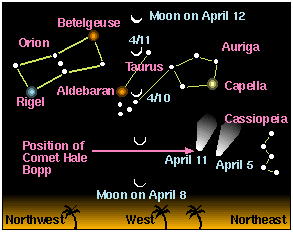
Hale-Bopp expeditionA "Great Comet Expedition" is planned from 5 to 9 p.m. April 11 to observe the comet from a private location on Oahu's leeward coast, away from city lights.
The museum planetarium staff and Hawaii Astronomical Society volunteers will present comet demonstrations and "guided tours" of the night sky.
Telescopes will be available to see the comet, constellations and galaxies.
Participants are asked to take picnic dinners, beach mats, lawn chairs and binoculars.
The cost is $22 for Bishop Museum members; $25 for nonmembers, and $15 for children 6 to 12 years old. Transportation will be provided for an extra fee.
Expedition-goers will receive exclusive Bishop Museum Comet Hale-Bopp T-shirts. Reservations must be made by April 9 by calling 848-4106.
For more information, call the Bishop Museum's Comet Hotline, 848-4162, or visit the museum's Hale-Bopp Web site at http://www.bishop.hawaii.org/bishop/planet/HBHP.html.
Text Site Directory:
[News] [Business] [Features] [Sports] [Editorial] [Community]
[Info] [Letter to Editor] [Stylebook] [Feedback]
© 1997 Honolulu Star-Bulletin
http://starbulletin.com