
1. Taro root and poi are healthy, nourishing foods.
2. Taro root and poi are easily available and at bargain prices at your neighborhood market.
The answer is "true" to the first and "false" to the second. A shortage of taro root has made poi less of a commodity and more of an under-the-counter transaction. But Haruso Joe Sawamoto says that anybody with a back yard and a certain amount of energy can avoid the poi scarcity by growing the family's own taro.
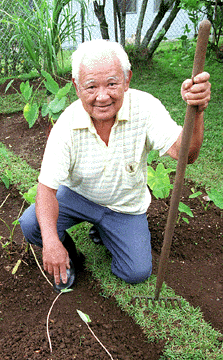
Sawamoto farms a 430-square-foot taro patch in his Kaneohe garden, and accomplishes two things. He produces enough taro to provide poi for his entire family and he avoids mowing the lawn because he doesn't have any. Furthermore, he hasn't flooded his back yard.
"There are two ways to grow taro," Sawamoto explained. "There's the lo'i, or wetland taro, and the mala 'ai, or dryland taro. All taro that can be grown in a lo'i will grow in the dryland method, but not the other way around."
Sawamoto, who is 70 and who retired several years ago from the Pearl Harbor Naval Shipyards, began growing taro by the dryland method three years ago. "Gotta keep busy, gotta keep out of my wife's hair," he explained.
The project was so successful that he grew more than he and his wife, their two married daughters, grandchildren and great-grandchildren could use. He has since replaced the less successful varieties with sweet potatoes, green onions, daikon, lettuce and carrots.
He says that if his retirement checks stopped coming, he and his wife could live off what his back yard produces. If the meat industry uses every part of the pig but the squeal, Sawamoto does better. No part of the taro plant goes to waste.
He makes his own poi, he has published recipes for taro chips, taro pudding, scalloped taro, taro mochi and taro hash browns. He says the stems taste like asparagus and the leaves like spinach. And that takes care of the taro plant.
Sawamoto also makes his own compost to nourish his taro. He works with three piles -- young, middle-aged and senior, with the material, as you and I, moving from one stage to the next.
"The first pile is a week's supply of fresh cuttings from the garden along with some dried material and sod," he said. The pile is about the size of large picnic cooler.
He wets it down then covers it with plastic to retain the heat. Compost decays best at about 118 degrees . Higher temperatures, he said, destroy the enzymes that promote decomposition. After a couple of weeks, he promotes each pile one stage, then starts a new one and uses the oldest. From green waste to finished compost takes about six weeks.
He uses no kitchen waste or manure, so the compost piles do not attract pests and they have a clean, earthy smell. With close neighbors, this is a real consideration. At the end of six weeks, there will still be some branches and leaves that have not decomposed, so Sawamoto chops these up with a wicked looking butcher's cleaver. "Good exercise -- you need that along with the poi to be healthy," he said.
"Then I spread the compost over the place I'm going to plant. I let it dry out for a week and then I mix it into the soil -- one part compost to three parts soil. Mound the soil maybe 6 to 9 inches high and 36 inches in diameter."
He explained that the mound provides good drainage for the amount of water that taro requires. "The water is what develops the gluten in the taro. Gotta have that or the poi's no good," Sawamoto explained. "But the water has to flow through the soil or it stagnates. Then the taro's no good."
He uses about a gallon of water on each mound every day. He tests his taro corms for their gluten content by putting them in a bowl of water. "If they float, too bad. Must sink," he advises.
He plants one or more huli (young taro plant) in each mound, depending upon how large he wants the underground taro corm to be. A second or third huli will provide smaller corms, but the overall harvest will be about the same -- three pounds per mound. "I purposely grow them small because it's easier to make the poi."
From planting to harvest takes about nine months. "We harvest two mounds each week, which is a lot more than we can use. My wife takes extras when she visits with friends. My idea is that all those fallow sugar and pineapple fields could be planted with taro.
"It's bad that they should just sit there. Adam Smith said that land and labor are the only things of value. We can't waste either one."

The newest is Anthurium "Tropic Fire" developed by Drs. Haruyuki Kamemoto and Adelheid Kuehnle of the University of Hawaii's Department of Horticulture. "Fire" has bright red blossoms and glossy dark green leaves. It's fast-growing and produces seven flowers per shoot each year.
"Tropic Fire" will be on exhibit at the 17th annual Anthurium Plant Show and Sale at Ward Warehouse. The free show, sponsored by the Hawaiian Anthurium Society, is open from 10 a.m. to 8 p.m. today and 10 a.m. to 4 p.m. tomorrow. The new anthurium has not yet been released for general sale, but is expected to be available in garden shops this summer.