

Hard times have fallen on Oahu's private playgrounds, with shrinking memberships, empty waiting lists, and rumblings within the exclusive private clubs.
Boards of directors are rethinking sky-high initiation fees. Some have set up affordable "social" memberships. Many are looking for ways to adjust to a tight economy and changing interests.
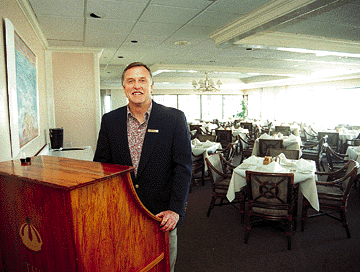
"Our membership has been dropping a little each year for the past three years," said David Shell, general manger of the Plaza Club in downtown Honolulu. "At this point, we're holding on."
The Plaza Club, like many of the 5,500 private clubs across the country, has felt the poor economy, changes in the tax code, and demographic shifts that put younger members at odds with the clubhouse gentry.
The Pacific Club, like the Plaza, emphasizes dining and social activities. Both are feeling the pinch of 1994 changes in the federal tax code that reduced deductions for business lunches from 80 percent to 50 percent and eliminated deductions for membership fees.
"We've seen a decline in business," said general manager David Chism. "People have stated they've reduced usage, not only of restaurants but of clubs as a whole."
Business-lunch traffic, long a mainstay at "city" clubs, has dwindled. The change has been a major concern of restaurateurs across the country.
"If you can't advertise on TV or the newspaper, the best way to get customers is to take someone to lunch," said Kathy Masunaga, executive director of the Hawaii Restaurant Association. Masunaga noted that restoration of the deduction was a top priority at a White House conference on small business last year.
A 1994 survey of its 1,000 member clubs by the National Club Association found more than half suffered a drop in food and beverage sales, staffing, and membership because of the tax changes.
Two bills sponsored by Hawaii delegates seek to restore the benefit. A measure introduced by Sen. Daniel Inouye, now in the committee on finance, would restore the lunch deduction to 80 percent. Congressman Neil Abercrombie, taking it a step further, has a bill in the Ways and Means Committee increasing the deduction to 100 percent.
But other changes are affecting club dining rooms.
"Fifteen years ago, the three martini lunch was prevalent," said Shell. "They'd take the afternoon off. People in business just don't do that anymore. Drinking at lunch has dropped off."
Younger members are more health conscious, Shell said, and more apt to have a working lunch at their desk.
Meanwhile, some yacht clubs and country clubs are struggling as well.
At the Waikiki Yacht Club, membership has dropped in the past five years from about 1,500 to the current 1,000.
"Businesses are down, cash flow is down. People don't have enough to pay the price of admission," said P. Gregory Frey, commodore of the Waikiki Yacht Club.
The downturn comes in the midst of protracted lease negotiations between the yacht club and its landlord, the state of Hawaii. The Ala Wai Yacht Club across the harbor is facing similar lease renewal, as is Mid Pacific Country Club in Kailua.
The 53-year-old yacht club is trying to attract new members with lower-priced "associate" memberships. Paying about a third of regular initiation fees and half the monthly dues, associate members have access to most of the club's amenities, except moorings, parking, and credit accounts.
Meanwhile, the Waikiki Yacht Club is adjusting to declining usage of its galley restaurant, once open six days a week. "We're taking cost-cutting measures, like being 'dark' more often during the week," Frey said.
At the prestigious Oahu Country Club, membership is said to be dwindling and waiting lists have vanished.
While the club's management declined comment, some longtime members say the club is losing members because incomes can't keep up with an initiation fee that went from about $20,000 to about $50,000 during the booming 1980s.
One member who asked not to be identified said regular memberships have dropped below the club's limit of 500 and its $50,000 initiation fee has been temporarily reduced to $31,000.
Others say the proliferation of private golf courses on Oahu has drawn away some members who can't justify the monthly fees and other costs of belonging to the club.
Meanwhile, clubs are trying to adjust to a changing world.
The Plaza Club has come up with a program called "Island Society" to broaden the club's appeal. For a few dollars more, members have access to tee times and other amenities at golf and athletic clubs here and around the world.
"What a lot of city clubs are doing is changing their focus to become more family oriented," said Kathy Driggs, of the Club Managers Association of America. "Country clubs kind of got that picture a while ago."
Unlike older members whose interests center on golf, younger members want child care, summer camps, and other family activities.
"With most couples both parents are working and they have far less time to spend with the family," said Driggs. "When they do, they want to spend quality time with them."