

Not any more.
With the right knowledge and resolve, the Waipahu renter says becoming a homeowner is an achievable goal. It may take a few years of saving and budgeting, but Furtado at least knows how to pull it off.
"I'm a lot more informed about what to do," she says.
Furtado is better educated about the home-buying process thanks to a new program started by the local U.S. Department of Housing and Urban Development.
In conjunction with nonprofit organizations, the federal agency this month started free workshops designed to demystify what can be an intimidating, complicated, jargon-heavy process, especially for first-time buyers.
The series of workshops -- about 10 hours of instruction in all -- are especially geared for people like Furtado who want to become homeowners but aren't quite ready to take the plunge.
Among other things, participants learn budgeting, saving for a down payment, searching for a home, making an offer, applying for financing and closing a loan.
HUD started the workshops as part of a national effort to boost the U.S. home ownership rate, which stood at 65 percent in mid-1996. Hawaii had the lowest rate -- 52 percent of households -- among the 50 states.
Judging from the initial popularity of the workshops, lots of isle renters are interested in becoming homeowners.
Jill Hurt, Hawaii director of HUD's single-family housing division, said workshops scheduled through August are booked. The agency is trying to do at least one set each month. Classes can accommodate up to about 25 people.
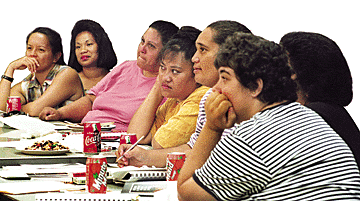
At a recent workshop in Makalapa, Furtado and about 20 others listened as HUD officials reviewed details of a typical loan closing.
Several participants said in interviews before the workshop that they didn't consider home ownership a real possibility until they took the classes.
But to become owners, renters must develop a plan that spells out precisely how they'll reach their goal, they said.
First, that means doing a detailed household budget -- something many people have never done before. You need to know how you're spending your money before you can determine how much can be saved each month for a down payment or used to retire debt.
Second, you have to know how much of a mortgage you can qualify for. That helps buyers narrow the home search by determining what price and monthly payments are considered within their reach. Part of the classes deal with how to pre-qualify for a loan.
Holly Kuehe, one of the workshop participants, said coming up with a realistic plan for achieving home ownership is important.
"It's just like a business plan. If you don't have a good one, there's nothing to aim for," Kuehu said.
Equally important is knowing what to expect when you start shopping for a home.
What kind of loan should I get? What should I look for in a home and in a neighborhood? What costs will I be required to pay at closing?
With all the jargon that's used in loan papers and other documents, the process isn't easy to understand for many people. But the seminar participants said the instructors did a good job of explaining the process in lay terms.
What's more, the instructors underscored the importance of carefully reading all documents, jargon and all, said Harrilyn Robello, one of the participants.
"You have to read all the fine print, otherwise you're signing your life away" without knowing what you're signing, she said.
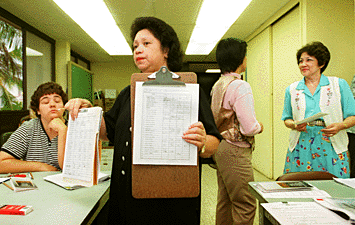
La Vern Roman checks to see if fellow classmates have
signed up for the U.S. Department of Housing and Urban
Development workshop on home ownership. The classes,
which started this month, aim to help would-be
home buyers achieve their goal.
Another point stressed in the classes: anyone interested in buying a home should first get his or her financial house in order.
If bills are past due, get them current. If debts are unusually high, start paying them off. If a credit report is inaccurate, correct it.
A person's credit history is a major factor a lender considers when deciding whether to approve a loan.
Even people with clean credit histories, however, often have trouble coming up with the hefty down payment -- sometimes tens of thousands of dollars -- usually needed to buy a home. That's generally considered the biggest obstacle to home ownership in Hawaii.
But there's a way to get into a home for no more than about $500, the seminar participants were told.
HUD sells homes that it gets back from lenders following a foreclosure. The mortgages are federally insured, so when an owner defaults, HUD pays the insurance claim to the lender and assumes ownership of the property.
Hurt said the agency gets about 10 foreclosure properties a month, all in varying conditions. It markets them at low prices to get sales within 90 days. A down payment of only $500 is required if the buyer intends to live in the home.
The agency pays up to 3 percent of the sales price toward the buyer's closing costs, which in most cases covers the entire tab, Hurt said. The one catch: the buyer must qualify for a mortgage, just like with any other home purchase.
Several of the seminar participants said buying a HUD home was an attractive option -- and perhaps the only way they could get into a home.
Hurt said nonprofit groups interested in co-sponsoring the seminars can call HUD at 522-8190, extension 251.
The agency also is planning a June 7 homeowners' fair at the Blaisdell Center, featuring exhibits, booths and other services aimed at helping renters become homeowners.
Mini versions of the home-buying seminars will be offered, and lenders, builders, real estate agents and others will be on hand to answer questions, Hurt said.