

You're not from a Saxon or Teutonic tribe, so why are you encouraging your kids to participate in ancient fertility rites?
Is chocolate candy a self-indulgent warp our modern commercial culture has put on a spiritual observance?
To answer the last first, you could say there's a direct link from the goodies in your basket to at least as far back as the fourth-century celebration of Easter, according to two Honolulu religion scholars.
"Historically, Easter has been very much tied into fasting. A lot of Christians forget that," said David Panisnick, a religion professor at Honolulu Community College. "The element of fasting, of asceticism, of giving up things has always been a part of the Easter recognition."
He said the first Christians began celebrating Jesus Christ's resurrection from the dead on the first day of each week in the first century. That's about 200 years before they began commemorating Christmas.
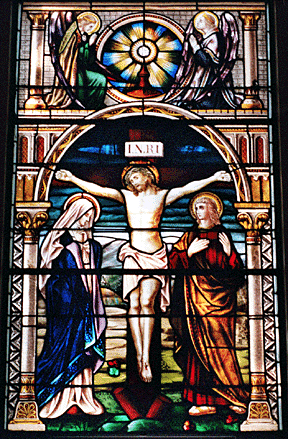
It is now observed in a chain of days, but "early Christians celebrated the crucifixion and resurrection at the same time," Panisnick said. Even though the day now marks the killing of Christ, Good Friday got its name because of the end result. The chain of events "for a Christian represents deliverance from sin and therefore from death."
"By the end of the second century, they were celebrating Easter as a special day of the year, and it was a day of fast. By the third century, Easter Week was in place. By the fourth century ... Lent was in place, and it was 40 days of fasting," Panisnick said.
The concept of special Easter food is an example of how symbols from pre-Christian European cultures got intertwined with church observances, Becker said. Decorating eggs is a craft tied to the holiday, and it was carried to an art form by Ukrainians, Slavs and Russians.
Panisnick said: "The egg is a fertility symbol, life contained in this microcosmic earth, the chick coming out of the egg. The other symbol coming out of European fertility sects was the bunny, for the obvious reason" of their prolific birth rate.
"People see the symbol of the egg breaking forth with new life as the symbol of the tomb," said Becker. "The shells are left behind, as we live with the fact that the witness to the resurrection is an empty tomb."
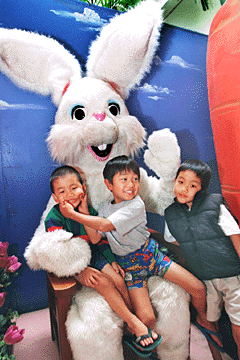
"You don't have the presider dressed up like a bunny. Some people can't make the distinction between something that carries on the celebration outside the church and something that enhances the celebration," he said.
"A lot of customs associated with different cultures were a way of taking what was done in church into the homes, to carry on the festivity," Becker said. "You bring everything you are to your worship of God; you celebrate as a whole person."
Panisnick said, "The pagan influence on Christianity was there from the beginning," and it grew as Christians became missionaries to the European tribes who celebrated new crops and new births as the springtime renewal of the earth.
Even those seasonal hot-cross buns started out with curved lines depicting the horns of an ox, "a powerful Saxon fertility symbol." He said the pagan influence wasn't a problem then. It helped because people didn't have to cut themselves off from their past to join the new religion.
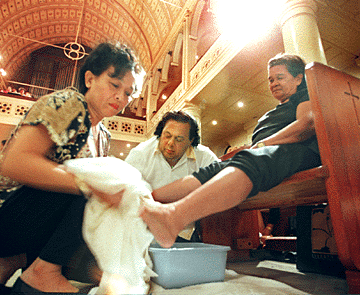
Becker sees the answer to the challenge in the participatory drama that marks churches' Easter observance, from re-enactments of the Last Supper, where Christ washed the feet of his apostles, to Good Friday walks behind a carried cross, to pre-dawn gatherings Sunday to relive the story of women finding Christ's tomb empty.
"Worship is something you do; you can't just watch. There's a real need for people to engage in giving praise to God, involved as a whole person - not like watching television.
"There's a saying that for Christians, God doesn't have any grandchildren, only children," Becker said.
"The whole purpose of the Easter liturgy is to ensure that every generation knows God as the parent, has the experience, not the secondhand stuff that grandchildren hear from parents who experienced it.
"We celebrate as the Jews celebrate Passover: not as 'A long time ago, God set our ancestors free from slavery,' but 'As God sets us free, we pass over, today.'"
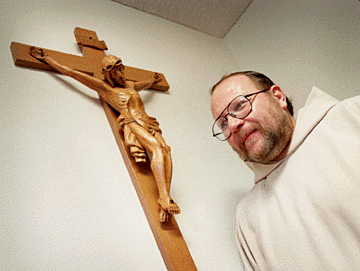
Easter is early this year, but it will be late for Eastern Orthodox Christians in Hawaii and around the world.They have a month of daily fasting from meat, fish and dairy products ahead of them before they celebrate Easter. They celebrate the same religious event, but the disagreement over when to do so dates back to the first century.
"April 27 is Easter for us," said the Rev. Dean Kouldukis, pastor of Sts. Constantine and Helen Greek Orthodox Church. "It must be celebrated after the Jewish Passover, according to tradition." Passover begins on April 22 this year.
Churches in Russia, Greece and the Middle East still use the Julian calendar, created by Julius Caesar in the first century, to calculate the arrival of Easter. Western churches use the Gregorian calendar, which was created by Pope Gregory in 1582.
The formula they use was debated in the 325, at the Council of Nicaea, which agreed to establish Easter as the first Sunday after the first full moon after the vernal equinox.
March 21 is observed as the vernal equinox, the first day of spring, in the West. And this year the full moon occurred last weekend, setting up the early Easter.
Depending on when the moon reaches full phase, Easter could come as early as March 22 and as late as April 25.
But on the Julian Calendar, the equinox is April 3 this year, Kouldukis said.
"It's not really a problem for us. The challenge is explaining to our Western Christian friends," said the pastor of the only Orthodox Christian congregation in Hawaii. He said it includes about 100 families from a variety of branches of the church, a rare ecumenism among ethnic groups that might be at war elsewhere in the world.
Meanwhile, they are in the midst of the rigors of Lenten practices no longer observed by Western churches. "We still maintain the tradition of fasting - no meat, fish or dairy products - beginning with the first day of Lent, which was March 10, and ending Easter Sunday. The whole time is strict fasting. I don't believe that Christians in the West do that." They may not eat meat with blood in it, which rules out fish but not shellfish.
When it comes to Easter, it is their tradition to celebrate with a midnight service that ends about 2 a.m. Sunday. Kouldukis said the timing reflects what used to be a service ending at sunrise.