
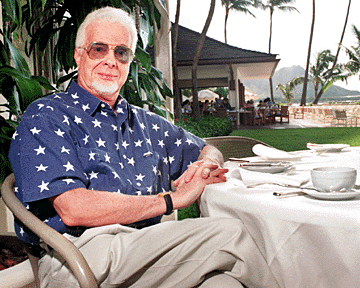

"You can never tell when, or where, or with whom. It's usually when I'm performing with the trio, sometimes solo, maybe even with an orchestra," pianist Nero says from his Pennsylvania home.
Suddenly he laughs, saying on these nights "when everything is happening, jelling" he sort of drifts into a "Shirley MacLaine" state.
"Yeah, the music feels so good and keeps getting better and better," Nero goes on. "Then it happens. I look down and get the feeling that somebody else is playing and I'm just watching. It's like an out of body thing. It's very nice."
Maybe, tomorrow and Saturday night at the Blaisdell Concert Hall, Nero will be able to pull his MacLaine routine from his magical music repertoire.
Nero, whose real first name is Bernard, is best known for being a virtuoso pianist, but he is also a composer, symphony conductor and arranger. He performs more than 100 recital and symphony concerts each year, is the musical director and conductor of the Philadelphia Pops Orchestra, the Tulsa Philharmonic and the Florida Philharmonic. This season marks his 17th as music director-conductor of "Peter Nero and the Philly Pops."
He's also performed in a number of movies including "Sunday in New York", where he composed the score and the title song. His composition, the "Diary," based on the writings of Anne Frank, is awaiting plans for a Broadway production based on the 15 tunes.
As a soloist, he performs around the country and internationally with dozens of orchestras and with his trio. Working with several different orchestras a year is "very stimulating," Nero said.
"Performing for the first time with an orchestra is exciting because everything is fresh and new. But since I've been working with the Florida Philharmonic and Philly Pops, for so long -- though they're very different ball games -- that's simple because we're so familiar with one another."
The most difficult part of his career, Nero says, is preparing a season-long program.
"Playing a concert like the one in Honolulu is fun. But putting together a program as a Pops music director in a city where I have continuity one year after another starts feeling like one long composition."
The Brooklyn-born Nero started formal piano training at age 7. He would have started earlier if the family could have afforded a piano. In its place he
knocked out tunes on a toy xylophone. When he visited relatives who owned a piano he started playing that.
"My grandmother convinced them to give it to us because they weren't using it," Nero said.
At 14 he attended the High School of Music and Art in New York. After high school, while on a scholarship at the Juilliard School of Music, Nero performed Gershwin's Rhapsody in Blue on Paul Whiteman's television Special.
So fame and fortune came early? No, because Nero never believed the kind of music he played was commercial.
"I played what I wanted the way I wanted with no illusions of a major career in music," he said. Staying with his own kind of style eventually made the difference.
One night while playing jazz in a "saloon" where the 25-year-old was paid $95 a week, he was approached by a record promoter who asked him if he could play pops.
"He said there was a record company looking for a pops pianist, but I told him I wasn't a pops musician. 'I don't do what the others do, playing melodies with lots of frills.'"
The man convinced Nero to do a demo record of some of the work the pianist played at home but never in public. Three days after the demo record was completed, Nero had a contract with RCA where he recorded extensively with 23 albums in eight years, garnering eight Grammy nominations and two Grammy Awards. When he later moved to Columbia Records, Nero earned a gold record for his million-selling album and single, "The Summer of '42." And he's recently released two albums on Concord, one an Ellington tribute, the other, a piano and orchestral recording and has signed with Pro Arte Records which has released three albums of orchestral music for that label.
"In my wildest dreams I didn't think that by having a good time with Mozartian arrangements, some jazz fusions, and taking a ballad and just playing the melody would ever sell," he said. "You have to find your own way because there are no formulas."
While record sales are always important to an artist, filling concert halls is also a priority to Nero.
"I always felt that with all the put-downs of Liberace over the years he still exposed a lot of people to music they might never have heard before. He was a very good pianist which was overlooked because of his costumes and the singing and the unorthodox style of his concerts."
That leads to a discussion of the film "Shine," the extraordinary true story of piano prodigy David Helfgott's harrowing mental breakdown and triumphant recovery. In Helfgott's recent United States tour, audiences have loved him while critics have bashed his playing.
"You have to take in account (Helfgott's) background and approach it that way," said Nero who has seen the film but not a Helfgott concert. "It's amazing that someone who went through all that mental anguish and the condition he's in now can still play at all.
"That's the basis I have to judge, but I do agree with the critics about his performance based on the movie soundtrack which Helfgott performed.
"But he's bringing people into the concert hall who are hearing music they've never heard before. These people are enamored of the whole idea...and have discovered this special music because of 'Shine.' His life and his music moved them."
And that's always been Nero's goal.
"I always want the audience...to feel something. I have got to go for that otherwise I might as well stay home. There's no use in just playing notes."
What: Peter Nero performs "The Magic of Gershwin"