
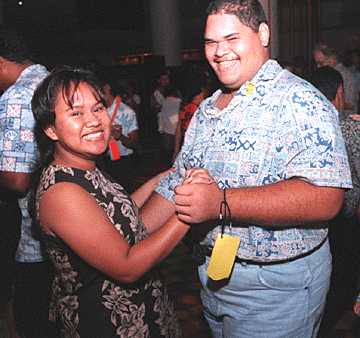

In this grimy refuge -- etched by time and vandals' knives, with a stained parquet floor -- there is laughter and love and caring. Eighty-nine Leeward 7th- to 12th-grade students who suffer various degrees of mental or physical disabilities are dancing. And smiling.
Kids who once were castaways, or kept separate from non-afflicted children, now share in many of the same school activities as their more fortunate peers, including a Social Dance.
The event is just one part of the Department of Education's Adaptive and Inclusion Physical Education Program led by Tracy Taylor, a teacher who doesn't believe in the word "can't."The program serves all special-needs students from pre-school to age 21.
"Rather than look at these kids as having an impairment and thinking that they don't belong, I ... look at how to modify our curriculum, how we can make it beneficial to the students needs," said Taylor. "Our key motivation is how to make the curriculum work for them."
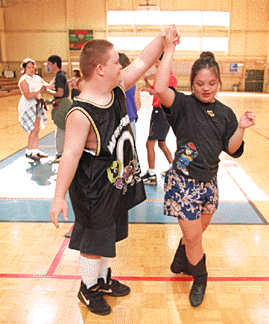
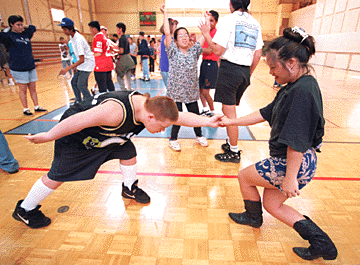
The disabilities range from visual to multiple impairment. Some students must have "shadows," aides who remain with them throughout class.
Pearl City High School student Theresa Gaballo, 19, has a smile that lights up a room. She wears thick glasses but one can't help but notice her eyes twinkling when she talks about how much fun it is to dance. "And you meet different people from different schools too," she said.
Her teacher Rhoda Yoshida says the social skills learned by the students carries over into the regular classroom. "They come away respecting each other more and being more polite," said Yoshida, who has 13 students in her multiple handicapped class.
Social Dance is just one of several Adaptive P.E. programs, which have included swimming, horsemanship, ice skating, archery and bowling.
"I have blind students who are better in archery than sighted kids," Taylor said. "I have a student who has no arms and his feet are on his knees. And he's dead-eye accurate with a Frisbee from 30 feet by throwing it from between his cheek and shoulder."
The Social Dance students position themselves in the gym like typical teen-agers. They're spread over several rows of bleachers while Taylor explains the day's program. Some kids lounge and slouch; some sit ramrod straight; others' eyes wander skyward; some stare at the floor. A few are in wheelchairs.
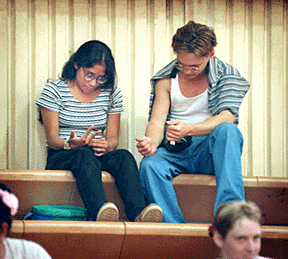
"This time you're on your own," Taylor says. "I won't be leading you. If you get lost that's OK Just look at the person in front."
"Shadows" stand behind some of the more disabled kids, moving the students' arms in the style of the dance.
Teddy Auwae, 19, a Nanakuli High School student, says he prefers "ladies' choice" dances, "Cuz I like them to choose me."
Lynn Himalaya, the education assistant with Auwae, said Adaptive P.E. programs teach students that it's OK to be themselves, that "they're more capable than they might believe."
The class is year-long and held one hour a week. On Friday the group got to test their newfound social and dance skills at their second annual "Banquet." Fifty regular education students volunteered to attend the 9 a.m. to noon party as participants, not chaperones.
All the special ed kids started the banquet with an "A" grade, then had to work to keep it during the "prom" test, including writing down names of dance partners, performing a specified number of dances and displaying dining skills.
Special ed students danced with regular students; teachers danced with students; students danced alone. And colored lights danced on the ceiling as the music blared in Rumours nightclub.
Tommy Sobrado, 19, of Pearl City High, though blind and needing a walker, danced the "Macarena" supported by his "shadow" Virginia Cuban. Waipahu High School's Victoria Ra, 15, also blind but confined to a wheelchair, was led in a dance by her aide who simply held her hands and swayed them to the music.
Tori Itamoto, a junior at Pearl City High School, volunteered to attend because "I knew they didn't have anyone to dance with and I wanted to help them have fun. They don't have anyone else."
"We all have our own cliques at school so we don't mix with them very much," added Charlotte Pajinag, also a junior at the school. "They're just people like us really. They're always friendly and happy to be included in stuff. I think they just want to have fun. I wanted to be part of that."
Mingling the two levels of students is a win-win situation for each side, Taylor said. "If special education students are not given the opportunity to experience different situations or have choices, they'll never learn how to deal with choices when they inevitably come.
"If we limit their options, then that's as far as they're going to go. But if we say there is no limit then we are only limited by our own imagination to create different options for them."