
Don't lose hope.
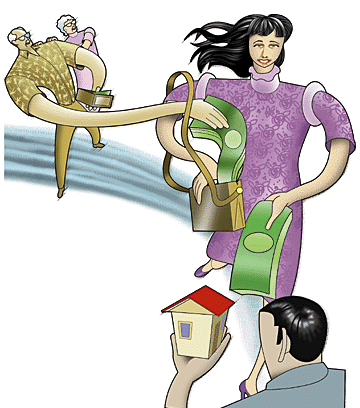
Many who find a way into Hawaii's high-priced housing market do so with the help of parents, relatives, or friends.
"It's pretty typical here for first-time home buyers to have someone else participate in the down payment, or participate as a co-mortgager," said Carl Cunningham, regional director of Honolulu Mortgage Co. "That's a function of the high cost of housing, and a cultural aspect of our society. People help people."
A nationwide survey by the National Association of Realtors last year suggests a similar trend is developing across the country. The survey found 23 percent of first-time buyers got help with a down payment from friends or relatives. Six percent got loans from friends or relatives.
"The use of gifts from parents, grandparents and relatives to come up with a down payment is on the rise," said Trisha Morris, senior public affairs associate at the national association. "Lenders are much more willing to accept situations like these. It's becoming more and more of an accepted practice."
The phenomenon, Morris said, is fed by rising costs, low savings, and changing demographics.
"More of our markets are being influenced by multicultural buyers," she said. "The use of multi-sources for the down payment is certainly becoming more common."
Immigrants from Asia and other countries, once concentrated in coastal states, are affecting inland housing markets, bringing a higher savings accounts and closer-knit families, Morris said.
"The savings rate in the United States is very low compared to that of some other countries. First-time buyers (in America) don't often have much saved."
Home buying in Hawaii has long been a family affair, with estimates ranging from 40 percent to 60 percent of transactions involving gifts, loans, or other help.
"Prices here are higher than on the mainland, where maybe you're buying a $50,000 condo and have to put down very little," said Dave Vierra, a mortgage loan officer at Prudential Locations Inc.
"Here, it's $150,000 or $200,000. That kind of money you just don't have, so you have to look to other sources."
The problem, lenders say, is the down payment. While many first-time buyers have the means to meet monthly mortgage payments, they don't often have a nest egg saved for the up-front commitment.
Benefactors have several options: personal loans, co-signed mortgages, or outright gifts. Another common arrangement is for parents to make the down payment, then move in with their kids who make the monthly payments.
Co-signing requires no money down but puts the signer's assets on the line if the mortgage is foreclosed.
Greg Furuya, partner at the tax consulting firm Deloitte & Touche, sees a lot of gift-giving, co-signing, and other parental involvement in Hawaii.
"Most parents co-sign on the mortgage," he said. "They'll put up their residence as collateral. It's what they do for their children."
Furuya notes that gifts are less common because equity is often tied up in parents' homes.
For those with liquid assets, the law allows gifts of up to $10,000 a year per person without consequences. But there are ways to up the ante: If both parents are alive, each can give $10,000 -- a total of $20,000 -- a year in nontaxable gifts, Furuya said. The figure doubles to $40,000 if each parent gives $10,000 to each spouse.
With good timing, the $40,000 can double to $80,000.
Furuya suggests closing the deal early in the year, allowing gifts late one year and early the next to be combined.
Another option is tapping a parent's estate. During their lifetime, each parent can give up to $600,000 to a child or other beneficiary without tax liability. But check first with an accountant or tax specialist about potential tax consequences down the road, Furuya suggests.
Still an obstacle for some first-timers despite help is the requirement in most conventional mortgages that the down payment include at least 5 percent of the buyer's money. Since lenders often seek a 20 percent down payment, that would limit a gift to 15 percent.
"What lenders generally feel is the more money a person has to put personally into a property the less chance they're going to walk away from it," said Leilani Mayekawa, an assistant vice president at City Bank.
Meanwhile, lenders are coming up with programs that target first-timers and their benefactors.
At Bank of Hawaii, which handled 2,500 home mortgages last year totaling $565 million, the "Next Generation Mortgage" allows parents to put gifts into interest-earning certificates of deposit. Unlike gifts that get swallowed up in mortgage financing, the CDs can be reclaimed in full.
"We think it makes good business sense to create products specific to marketplace needs," said Marie Imanaka, senior vice president for the mortgage banking division of Bank of Hawaii.
At City Bank, the First Rate program charges no "points" in closing a deal, a savings worth $6,000 on a $300,000 mortgage.
Meanwhile, Honolulu Mortgage's Cunningham says, when it comes to signing a mortgage, the more names the merrier.
"It's a little more paperwork but our default level is much better than the national level," he said. "We're at about half the rate of default."
That's because people in Hawaii are very concerned about their credit ratings, he said.
"It's the credit culture of Hawaii," Cunningham said. "You don't do something to bring shame to your family."
It's the down-payment, not the monthly mortgage payments, that bars many from home ownership, lenders say. The problem is a mix of high housing costs and poor saving habits: Some with adequate incomes can't muster the minimum 5 percent of the down payment required in most conventional loans. Here's how parents and other benefactors are trying to help:
Gift: A mortgage "gift letter" stipulating the gift is for home purchase, no repayment expected. A benefactor can give $10,000 a year per recipient without tax consequences.