
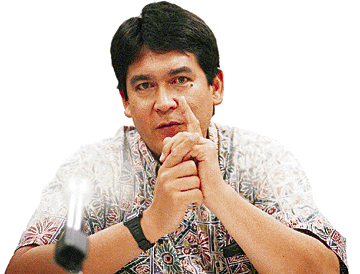

"The farther out we're trying to forecast, the more difficult it is," said Carl Bonham, professor of economics at the University of Hawaii and a member of the Council on Revenues.
The council, a panel of economic experts appointed by the governor and Legislature, has the task of predicting how much money the state will have to spend in upcoming biennial budgets.
Its quarterly tax-revenue reports, the backbone of the state's budgetary plan, drew little notice during the booming 1980s. A healthy economy and a flush budget easily absorbed any wayward predictions.
But the '90s have brought layoffs, cutbacks and other fiscal woes. As operating budgets get tighter, the fluctuating nature of revenue forecasts is greatly magnified.
"The problem that will never go away is you make a forecast and three months later, the world has changed," said Paul Brewbaker, chief economist at Bank of Hawaii and chairman of the council.
"Either there's been a gulf war or the Legislature has changed the tax code, or the inflation rate has dropped -- there's always something."
Two events -- the devaluation of the Japanese yen and a drop in Hawaii's rate of inflation -- last week caused the council to cut its December revenue growth prediction by $270 million over the next two fiscal years. The latest projection, dropped in the middle of legislative deliberations over a proposed $11.8 billion operating budget, brought calls for a new round of cuts, layoffs, and a possible tax hike.
The bombshell also prompted Gov. Ben Cayetano, under intense political pressure after earlier cuts, to question the forecast.
"We have no recourse but to question it because the impact is so great," said Cayetano, who instructed his Department of Business, Economic Development & Tourism to come up with a projection of its own.
Brewbaker stands by the council's work.
"We arrived where we did and have no reason at this point to change our assessment," he said.
The tax revenue forecasts, in June, September, January, and March, are meant to guide state officials in preparing operating budgets.
State law allows the governor to override the council but it must be publicly explained, and the action is not taken lightly.
The council was meant to stop the political interference that marked earlier budgets.
Cayetano, mindful that he is questioning seven of the best economic minds in the state, hopes state lawmakers will keep an open mind.
"Whatever we do, it has to have a great deal of credibility, otherwise the Legislature won't buy it," he said.
Some lawmakers are skeptical.
"I would rather rely on the council than the administration or an elected body like the Legislature," said Rep. Calvin Say, chairman of the House Finance Committee. "Previous to 1978, we could manipulate figures however we wanted to make ourselves look good and balance the budget."
Say is prepared to cut programs or raise taxes to meet the council's unhappy forecast.
"They're doing a favor for the public at large," he said. "If the drop is large, so be it. That's what we have to live with."
Each council member makes separate economic assumptions to be cranked into the model, and the ultimate forecast -- not always agreed upon -- is arrived at by consensus.
But the council's strength -- its autonomy -- is also its weakness. Without ties to the state, it lacks resources that could improve the accuracy its forecasts.
"I think there's a lot to be said for our autonomous system, but I wish there was some way to give us more tools," said Bonham. One shortcoming, he said, is the council's reliance on the state Department of Taxation's "econometric model," an outdated set of equations recently described by Cayetano as "archaic."
Brewbaker agrees.
"For years, we've been trying to get directors of taxation and chairs of money committees to provide some resources to enhance the capability of people in the tax research office," he said. "If you want to build a good model you have to invest the resources to do it."
But even with the best model, Brewbaker said, economic forecasting will remain "a moving target."
The obvious solution, he said, is for elected officials to build a cushion of 1 percent to 2 percent into the state budget to allow for swings.
"If you're going to build yourself a cushion, you have to do it systematically, regardless of forecasts," Brewbaker said. "Fiscal prudence suggests that."
Lowell Kalapa, Executive Director of the Tax Foundation of Hawaii and a former member of the council, sees a shortcoming in the group's makeup.
"The council today is comprised largely of economists who do not have a lot of expertise in public finance," he said. "That has tended in recent years to work against the council because you're dealing with a tax and finance system that is governmental. It's government as opposed to private industry."
Even so, he said, the Council is a big improvement over the way things were earlier done.
"Prior to 1978, every two weeks we'd have a new budget projection because the governor would come down with one, and the House Finance Committee would come up with another. Then they'd send their budgets over to the Senate and they'd say, 'no, you're wrong.' So we'd have three different budgets and three different forecasts. It was just real wild."
Two changes, prompted by the recent uproar, may be in the offing: elimination of the March forecast; and increased use of resources at the state Department of Business, Economic Development & Tourism.
The March forecast, coming in the middle of budget deliberations, last week showed how disruptive it can be. Cayetano is considering a move toward bi-annual reports, similar to the federal government's system.
And DBEDT, rich in expertise, could be a great help to the resource-hungry council.
"I think the current membership and skills of the council notwithstanding, the process could only profit by bringing more technical expertise to bear," said Brewbaker.
The seven members of the Council on Revenues, established under the state Constitution in 1978, are appointed by the governor and state Legislature. They are: The members:
Paul Brewbaker: Chief economist of Bank of Hawaii; the council's chairman.