
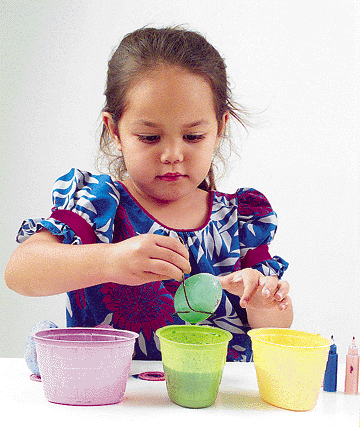

A simple, humble concept. Yet corporate America offers dozens of ways to do it better, faster, brighter, with more pizazz.
As far as indulgences go, this is a cheap one. A simple egg-decorating kit with dye tablets, some stickers, cardboard egg-holders and basic decorating hints goes for about a buck. Spend a dollar or two more and you can have glittery eggs, marbled eggs, speckled or even tie-dyed eggs.
Because you'll probably buy just one kit (how many hard-boiled eggs can one family eat, anyway?), and because the variety is flat-out overwhelming, we've tried out about 20 of them for you. Our decorating panel of children ages 5 to 12 tested the kits for ease of use, the fun factor and final results.
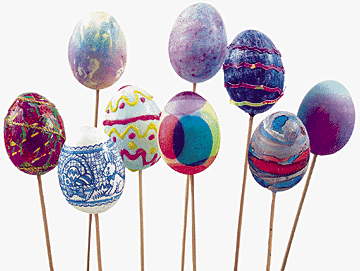
Their works of art are shown on this page, so this is closer to what you'll really get -- not the perfect eggs pictured on the boxes.
The eggs were then refrigerated and taken out a day later to see how well the colors and designs held up once the eggs started to "sweat."
Here are our evaluations of the newest, neatest or most unique kits.
(Some kits are available at stores besides those listed. Prices vary by store, and many kits will go on sale as Easter approaches.)
2 Nice Idea, But ...: Tie Dye ($2.67, Wal-Mart) is a sophisticated kit that involves wrapping the egg in cloth and placing it in a plastic case. Dye is then squeezed through holes in the case. Results are sporadic; colors are pale. If you did a dozen eggs this way you might master the technique near the end.
3 Quickest, Cheapest, Neatest: Shrink-wrap kits (many varieties) give you a dozen clear bands of thin plastic. You slip an egg into the band and lower it on a spoon into hot water. The band molds onto the egg. Good for high volume. Involves no creativity, however, and because of the hot water, kids can't do it alone.
4 Best Textured Effect: Strings of Color ($2.39, Daiei) is like squeezing Silly String onto your colored egg. It's a different look that holds up well in the 'fridge. But you can only do half of the egg at a time and it has to dry completely before you can continue. This may take 30 minutes (the box doesn't explain this), which is beyond the attention span of many kids.
5 Looks Most Like a Real Robin's Egg: Speckle Egg ($1.79, Daiei) uses sponges to dab paint onto the egg. Provides a lot of variation -- subtle speckles or bright bands of color. It's messy and when the colors run the speckles blur. Still pretty, though.
6 Best Variation on a Traditional Theme: Color Patch ($2.47, Wal-Mart), an improvement on the basic dip-and-dye method of producing two-toned eggs. You set the egg into a holder that allows only a small section of the egg to touch the dye. Then you rotate the egg and change colors. The result is a sort of oval version of plaid. Striking and simple. It also survives refrigerator condensation well if you blot it gently.
7 Nifty But Sticky: Color Curls ($1.97, Wal-Mart) involves sticky strips of a soft foam material that are wrapped in a spiral around the egg. Can be clumsy to work with, so some kids didn't like it. This is a better choice, though, than the similar Bands of Color kit which uses paper strips that are impossible to wrap evenly around an egg.
8 Most Striking One-On-One Project: Swirl-an-Egg ($2.39, Daiei) uses an oil-based dye to create marbleized patterns. Colors are squeezed onto the surface of a bowl of water and the egg is swirled through. Results are stunning, but it's tricky: You have to do it one egg at a time, so you can't have several kids working at once. Can get sticky in the 'fridge, but the colors stay bright and the stickiness lessens as the egg warms up.
9 Easiest for Little Hands: Doodlers ($1.99, K-mart) lets you paint directly on the egg using cosmetic-type applicators. Colors are bright and there's a pretty good holder so kids don't have to handle the egg much. Colors run a lot in the refrigerator, though.
 No matter what it says on the box, every coloring process is messy. With some kits you drop an egg into a plastic bag, squeeze in some dye and squish it around until the egg is covered in a swirly pattern. Sounds very neat, but watch a kid try to get the egg out of the bag -- it's just as messy as the old dip-and-dye method. Cover the workspace and make sure everyone's wearing old clothes or aprons.
Check the box when you buy it to see if you have to add vinegar to the dyes. At 3 tablespoons per color this adds up to more than a cup per kit; be sure you have it on hand. Even if the kit doesn't require vinegar, you can often get brighter colors if you add some in place of some of the water.
The finished product will never look as good as the beautiful eggs on the box. Children tend to expect that, and this can lead to frustration (read that, whining). Just be prepared.
Kits that include glitter look nice, and kids do love the sparkles. But the glitter doesn't show up that well and tends to come off on the hands.
When decorated hard-boiled eggs are taken out of the refrigerator, condensation causes the colors to run. Some coloring methods have better staying power, but because these are food-coloring processes, all of them do run. The worst dyes drop straight off the egg and pool in the bottom of the carton. Try letting the eggs sweat a little, then carefully blot them dry with a napkin.
The more concentrated dyes also tend to get tacky out of the refrigerator. These are the dyes that are squeezed onto the eggs, painted on or applied with a sponge. Again, let them warm up a little and blot them dry. You might lose some vibrancy, but the eggs will be easier to handle. And don't store these in cardboard egg cartons. They might get stuck.
Stencil or stamp design kits are best for blown-out eggs. When refrigerated, they run so badly that the designs can be unrecognizable. Also, they can be hard for young children to use.
No matter how simple a kit may sound, adult supervision will be necessary. If your kids are still young enough to want to decorate eggs, they're probably not old enough to go solo. They'll need help, at least to get started. Sometimes it takes two pairs of hands to carefully set down an egg so it can dry without smearing.
HOW TO HARD BOIL
SAFETY TIPSWhen refrigerated eggs are taken out, colors will run. Beware of stains. Blotting with a napkin makes them easier to handle.
Don't use hard-boiled eggs in egg hunts, unless you don't intend to eat them, because of the danger of salmonella.
EGG LOREIn Greece, eggs are colored crimson, to represent the blood of Christ. In parts of Germany and Austria, eggs are colored green for Holy Thursday. Slavic people decorate eggs in patterns of gold and silver.