By George F. Lee Star-Bulletin
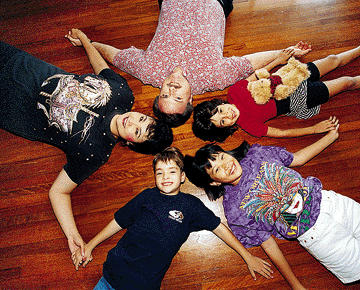
Elizabeth and Kent Keith join their children in a circle of love.
Angela, 6, holding the bear, and Spencer, 7, are from Romania.
Kristina, 11, is from Japan.


"Protect each other."
These are the first two precepts of a family mission statement posted in the kitchen in the home of Elizabeth and Kent Keith and their adopted youngsters Kristina, Spencer and Angela.
The Keiths are representative of growing numbers of people in Hawaii and on the mainland who are crossing national and ethnic lines to adopt children.
"Ours is an intentional family," Kent Keith said. "We came together on purpose and we think that we were meant to be together. We do love each other and we're trying to help each other and protect each other; so that to us is what a family is.
"It's not based on biology, it's based on that love and that commitment."
The Keiths along with two other island families -- the Gifts of Maunawili and the Hahns of Wheeler Army Air Base -- talked recently about the special problems involved when people adopt children of different races and cultures.
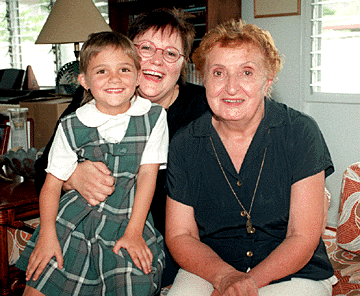
The Gift package includes mother Sheila Gift, 51, a U.S. citizen of Czech/German descent; daughter Valeria, 6, from Bucharest, Romania; and grandmother Gertrude Gift, 79.
Flash points in Sheila Gift's adoption experience include when she drew the right lot among four anxious couples vying for a newborn in Romania; when she later bonded with the infant as if she were the child's birth mother; and when her husband died two years ago leaving her the single parent of a 4-year-old.
"I don't know what I would have done if I didn't have her," Sheila Gift whispered.
Now, Gift feels another pressure.
The Kaneohe public health nurse said she's written and sent a little money to Valeria's birth mother. Gift wants to keep communication lines open in case Valeria ever wants to contact her birth mother. However, the birth mother married and her husband has written requesting more money. Gift hesitates to send more because "it's just very difficult to do that. I want to keep contact and I want to send them whatever I can, but I don't really have an answer. I have to see which way to turn."
"She deserves to be queen," Donna Hahn said.
Hahn, 33, lost six babies through miscarriage over a period of 10 years. After the last miscarriage, she felt too spent physically and emotionally to undertake another pregnancy
The couple had come to appreciate Korean culture and made many friends during an Army tour in Korea. They adopted Christi Jo in 1995.
"She's our dream come true," said Hahn, wrapping the child in a hug.
The only problems the Hahns anticipate are trying to preserve their daughter's culture and anticipating some prejudice down the line.
"It's important to know where you came from, to experience toys from their own country. She has an Asian doll baby, a white doll baby and a black doll baby," Hahn said.
Doug Hahn, a rangy Army chief warrant officer and helicopter pilot, added quietly that people should not be judgmental of adopted children -- neither because they're adopted nor because their race is different from their parents'.
"Every child needs love," he said, noting that he and his wife are the next couple in line to adopt a Korean boy.
They waited unsuccessfully for a number of years to adopt a local child and finally broadened their sights internationally. Reflective of their expansiveness, they went to Romania to adopt a girl and came away with a boy, too.
"We knew in a nano-second after seeing him that he was our son," Kent Keith recalled.
For example, Elizabeth Keith finds herself telling people, "They are our real children."
Still, they are prepared to tell their children about their birth parents.
"We have pictures of birth parents and if they ask and when they're ready for it, then they can see," she said.
Her husband explained, "We wrote a little page or two about what we'd learned about the birth parents and we have the photos and they're in the safe. It's like a letter from us to each child and someday if they want to know, it's waiting for them."
The last two precepts of the Keith family mission statement are:
"Help each other become all that we can be."
"Have fun with your family."
The three children also drafted family rules. The typed mission statement and rules preside on a wall between the kitchen door and table. With youngsters come noise and rambunctiousness. So, a child penciled in one rule at the bottom -- "No screming."